
The farmhouse on Kolar Road was the kind of property that did not announce itself from the road. A discreet gate, gravel inside, fairy lights strung between trees that had been old for thirty years. A banner: Mehta Cement Co. Annual Social Evening. A bar with good bottles. White-coated staff moving between guests with practiced efficiency.
Two of the staff were not professional caterers.
Priya noticed Baldev’s wrist before she noticed his face. The bandage was fresh, clean, visible below his cuff. He was carrying a tray of champagne flutes with his good hand, the other held carefully at his side. When he looked up and saw her, the tray did not shake. He was a man who had decided, sometime in the past week, on a particular form of composure.
She took a glass of juice from the tray without looking at him. Aryan took one too, unaware of anything except that the garden was larger than he’d expected.

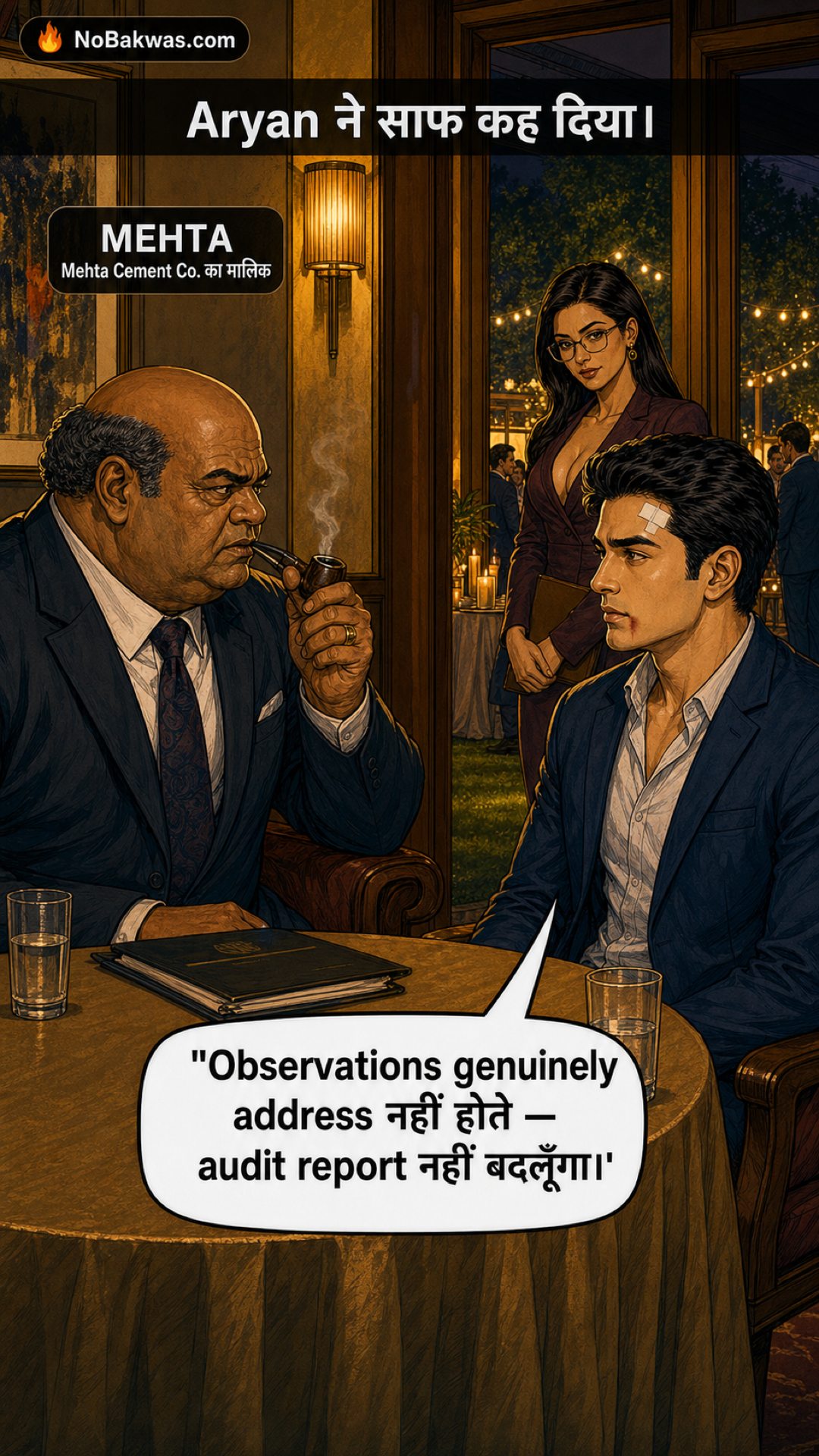
Mehta was at a corner table by nine, moving between conversations with the comfort of a man on his own land. He had the particular ease of someone who had been rich for long enough that he’d stopped noticing the room. When a junior engineer introduced Aryan, Mehta looked at him the way you’d look at a small structural problem you intend to resolve tonight.
They sat. Drinks appeared. Someone brought a folder of papers.
Mehta talked about the cement business for four minutes — production cycles, infrastructure contracts, the difficulty of maintaining quality standards when material costs were what they were. He talked in the way that accomplished men sometimes talk, which is to say carefully and at length, with the expectation that the listener will understand what is not being said.
Aryan listened. When Mehta finished, Aryan said: “The observations in my report reflect what I found. If they are genuinely addressed, I’ll note that. The report itself doesn’t change.”
Mehta looked at him for a moment. Then he picked up his glass and looked at the garden, and the conversation moved on to other things.
Shalini found Aryan twenty minutes later, near the bar.
She introduced herself pleasantly — “Mehta sir’s secretary, I manage everything for these events” — and asked if he was having a good evening, if the drink was to his taste, if his wife was comfortable. She had the particular warmth of someone who is professionally good at making people feel seen.
Aryan, who was not suspicious of warmth at parties, talked to her about Bhopal, about the new posting, about the flat on Nehru Nagar Road.
Priya was at the juice counter twenty feet away, and she watched.

She almost missed it. Shalini was moving toward the juice counter from the left, approaching Aryan’s drink from the side, her hand at waist height. The motion was small and practised — the gesture of someone who had done this before and found that the smaller the gesture, the less there is to see.
But Priya was watching. And Priya had spent four years learning, among other things, to read a room.
She set her glass down and walked toward the counter.

Shalini registered her half a second too late.
What happened next, Priya would describe to no one. It required two fingers applied to a point below the jaw where certain nerves run close to the surface, and a particular angle of pressure, and about four seconds. Shalini’s eyes widened, then went soft, then closed. She slid sideways with the slow deliberateness of someone falling asleep in an inconvenient location.
Priya caught the elbow, guided the slide, and left her where she was.

She walked back to Aryan with two fresh glasses of juice from the other end of the counter. He was still talking to a man from the municipality about road-laying contracts. He took the glass without looking away from the conversation. He didn’t notice the heels visible under the far end of the juice table.
Priya stood beside him and smiled at the municipality man’s story about a contractor from Jabalpur.

She found Mehta alone near the garden wall at ten past ten. He was watching the party from the edge of it, hands in his pockets, the way a man watches something he has built and is calculating the cost of maintaining.
She stopped in front of him.
He looked at her. At the gold dress, which had cost a fraction of anything in this garden. At her expression, which was the same expression she’d had when she called him from Baldev’s phone a week ago — not hostile, not nervous, simply very clear.
“Mehta sahib,” she said.
He waited.
“मैं सब सह लेती हूँ,” she said. “बस मेरे पति को हाथ मत लगाना।”
She held his gaze for the length of time it takes a man to understand that a door has closed, then walked back toward the fairy lights and the sound of the party.

Aryan submitted the audit on Monday morning.
The report ran to forty-one pages. The irregularities were listed plainly — three categories, specific figures, dates cross-referenced against site inspection records. His supervisor read it, asked two questions, and sent it to the directorate.
R.K. Mehta received a formal notice twelve days later. He called his accountant that afternoon. He did not call Baldev.
The corrected books took six weeks to prepare. The revised figures were filed quietly, through a chartered firm in Bhopal that handled this kind of revision for clients who had miscalculated the risk.
It was Aryan who found out, later — not all of it, but enough. Baldev’s wrist. Shalini’s sudden departure from the party. The two glasses of juice. He put it together the way you put together a thing you have been keeping at the edge of your attention without admitting you were keeping it there.
He didn’t ask her directly. He thought about it for a few days, then let it settle into the understanding he already had of her, which was incomplete and probably always would be and which was, he had decided, one of the more interesting things about being married to her.
The ceiling fan in their bedroom clicked on every fourth rotation. He had meant to fix it for three weeks. He fell asleep before he remembered to.


Reader Comments
Loading comments…
Leave a Comment