
Baldev had been in many rooms with frightened women.
This was what his experience had taught him to expect. He came in. He made clear that the situation was serious. He let the silence do most of the work. The rest — the calculation, the concession, the understanding that cooperation was the sensible option — followed without much effort from him.
He had not expected her to be calm.

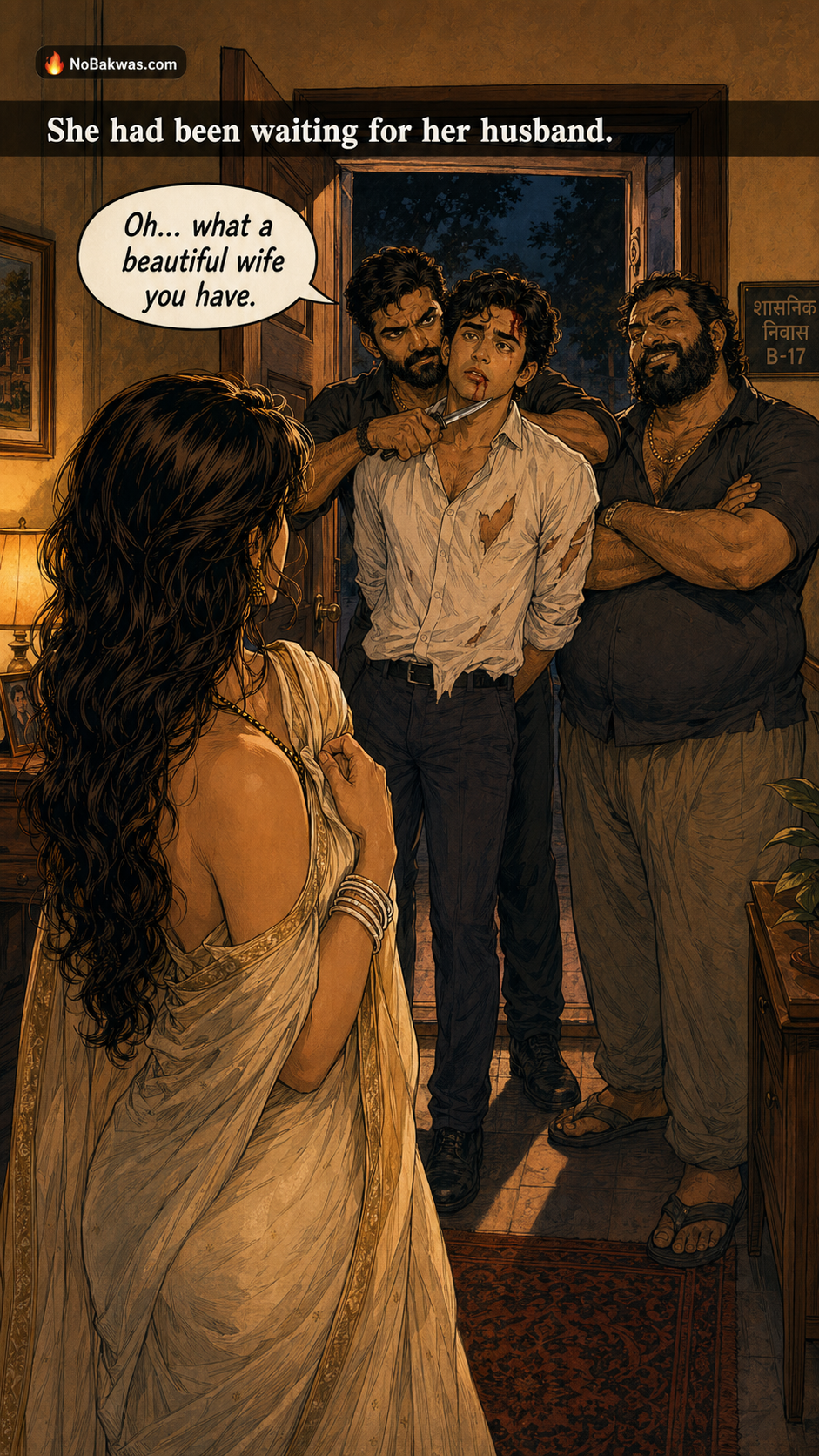
She had sat there in the ivory saree, watching him the way a person watches something they have already finished thinking about, and he had thought: she is afraid and holding it very still. He had thought that many times before and been right every time. He had thought that she was very beautiful and that this was unfortunate, in the way that most facts about a situation are not personal.
What she knew about karate, she had learned on the second floor of a building near her college — a dojo above a stationery shop, run by a retired army man who had very clean fingernails and no patience for people who trained the way they trained for a certificate. She had gone twice a week for three years. She had gotten her belt. She had not thought about it, particularly, since.
It turned out the body does not forget what it has been taught.


The sequence, reconstructed: Baldev moved. She was faster. His wrist first — the angle that the human wrist does not prefer — and then his weight redirected, and the corner of the bookshelf, and then Baldev and the floor having a close conversation. The younger one — Raju — had let go of Aryan’s collar because the brain does what the eyes tell it, and by the time his brain told him to do something useful, it was too late.
She had the kind of economy of movement that only exists in people who have trained until it stopped being a decision.

Baldev got up. He tried the door. She was already there.


When it was finished, she sat on the sofa with her knee on Baldev’s neck and her weight settled and her hands entirely still. Raju was against the wall. Aryan was standing in the doorway of the bedroom, watching her with an expression she chose not to look at directly because she had things left to do.

“His number,” she said.
Baldev gave it.
She scrolled Raju’s call list, found the name, confirmed it, and went to the front door and let both men out.

What she said when she called the number — Aryan heard it from the doorway, later that night, while she was speaking in the voice she used when she had decided on something — Mehta would think about for the next two days without arriving at a response that satisfied him.
R.K. Mehta was in the back of his Innova when the call came. He looked at his phone for a moment after it ended, then put it in his jacket pocket and looked out the window. A truck went past in the other lane, tarpaulin flapping loose.
He sat with it for two days.
Then he called Shalini.
Shalini had worked for him for four years. She ran his calendar, managed his correspondence, and appeared at industry functions with the ease of someone who had decided, practically, that her role was partly ornamental and had stopped being bothered by it. She was intelligent in the ways that mattered, and she knew better than to ask about the parts of Mehta’s business that weren’t in her calendar.
“The Annual Social Evening,” Mehta said. “Move it up. Next Saturday.”
“That’s three weeks early.”
“I know. And the new auditor — send him an invitation. Bring his wife.”
“And when he’s there?”
“Make sure he has a good evening,” Mehta said. “The kind that makes a man think about his options.”
The invitation arrived at Nehru Nagar Road on Thursday morning while Aryan was at the office. A cream envelope, gold lettering, Mehta Cement Co. printed on the flap. Priya read it standing in the doorway.
When Aryan came home she put it on the table in front of him. He read it twice.
“Standard practice,” he said. “They invite the auditor.”
“We’ll go,” Priya said.
He looked at her.
“We’ll go,” she said again, and filed the envelope with the household papers.
Continue reading: Wrong Key — Part 4

Reader Comments
Loading comments…
Leave a Comment