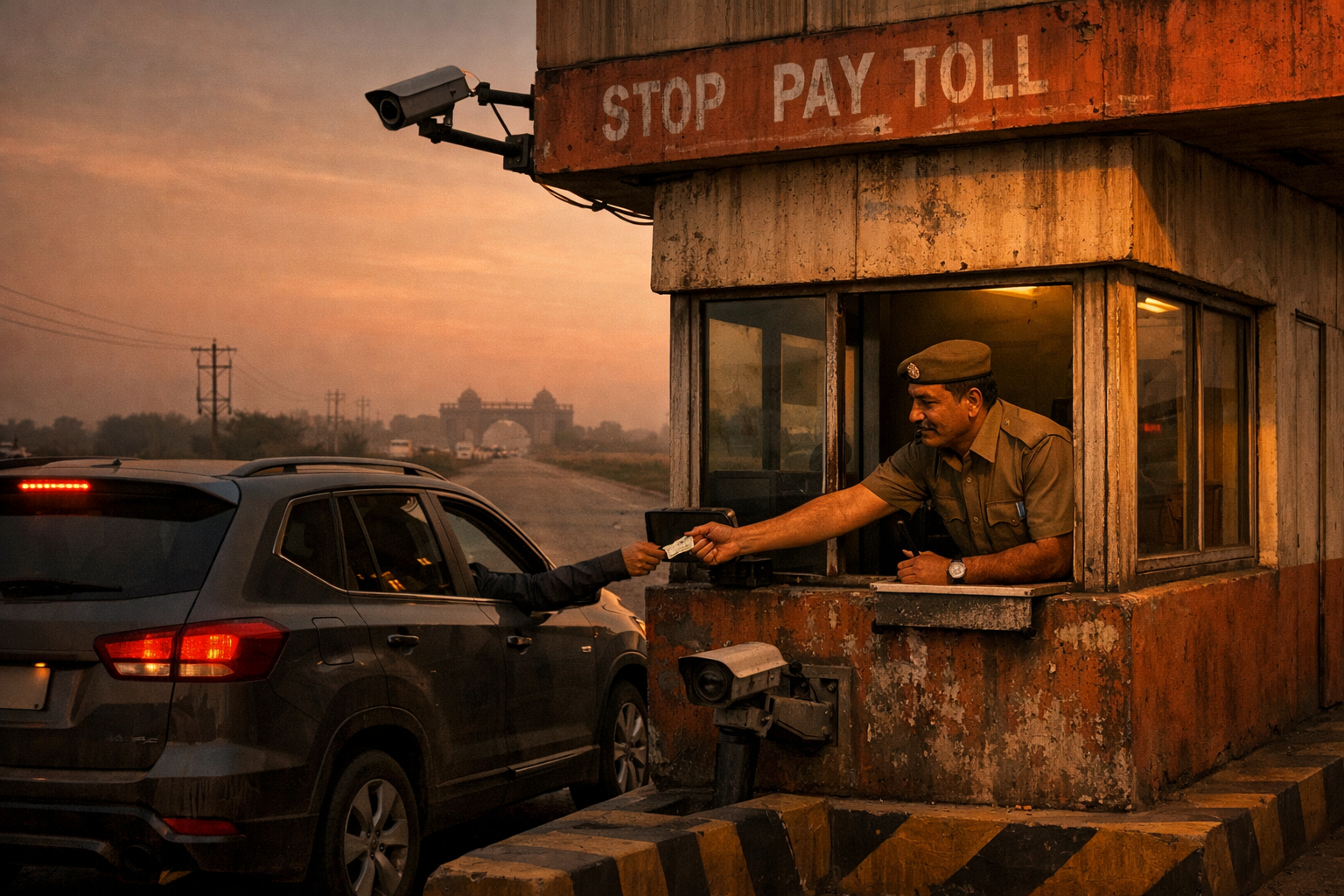
The first time Arjun noticed the camera, his daughter was asking him about penguins.
She was seven, and she had recently become convinced that penguins were unfairly distributed across the world, that it was wrong for them to be only in cold places, and that someone should do something about this. Arjun had been half-listening, the way fathers do on familiar roads — his hands on the wheel, his eyes on the Morinda toll plaza coming up ahead, his mind three days behind on a logistics filing that his CO had already asked about twice.
He handed two hundred rupees through the window. The man at the booth — everyone called him Sharma Ji, a compact, cheerful man with a grey moustache and a habit of saying “God bless, sahib” — gave back the change with both hands.
“Sharma Ji,” his daughter said, from the backseat. She had been coming on these Tuesday drives since she was four. She knew the man’s name before Arjun had bothered to learn it.
“Gudiya, God bless,” Sharma Ji said, and waved them through.
It was as they pulled away that Priya said, “Papa, why are there two cameras?”
Arjun looked in the rearview mirror.
She was right. There were two. One mounted high on the booth frame, angled at oncoming traffic — standard, the kind you saw at every toll. The other was lower, half-tucked behind the payment ledge, and it was not pointing at traffic at all.
It was pointing left. Down the service road that curved toward the cantonment’s eastern gate.
Arjun drove on. Priya had already moved back to penguins. The thought lasted about forty seconds before the radio swallowed it.
He forgot about it for five days.
It came back on a Sunday morning, the way small things do — quietly, without warning, while he was shaving. He stood at the mirror and thought: that camera was solar-powered. He didn’t know how he knew this. He must have registered it without meaning to — the small black panel on top, the wiring that didn’t go into the booth structure.
State PWD cameras were wired to the grid.
He set down his razor.
 Two cameras. One facing traffic. The other — pointing somewhere else entirely.
The next Friday he took a different car — his wife’s Wagon R instead of his own Innova — and drove through the Morinda booth alone. He went through on the left lane, paid cash, and as he pulled forward he held his phone in his lap and pressed the camera button without looking.
He got four frames. One was blurry. One caught the edge of the booth. Two were usable.
At home that evening, he zoomed in.
The camera had a brand marking. Small, partially scratched off, but legible if you knew what you were looking at. A make he didn’t recognise. Not a standard traffic surveillance unit. The housing was weathered but the seam was clean — recently opened and resealed. And the angle: if he traced the line of the lens from where it sat, it pointed not just at the eastern gate, but — he pulled up Google Maps, measured it with his thumb — directly at the junction where the Pathankot highway on-ramp met the cantonment access road.
Any vehicle of significant size, leaving the base for a forward posting, would pass through that frame for approximately nine seconds.
Nine seconds. A timestamp. A direction. Repeated, over weeks, over months. Enough to map patterns. Enough to know when something was moving and roughly where it was going.
He sat in his study for a long time.
Then he wrote it up. Two pages. Submitted it Monday morning through proper channels.
On Thursday his CO called him in and told him, not unkindly, that he was overthinking. “These cameras are everywhere, Mehta. PWD, NHAI, private contractors. Every road in Punjab has seventeen cameras. What you’re describing is coincidence of angle.”
Arjun said, “Sir, this one is solar-powered and the brand isn’t on the approved vendor list.”
His CO looked at him for a moment. “File a supplementary note if you want. I’ll pass it up.”
Arjun filed the note.
He heard nothing.
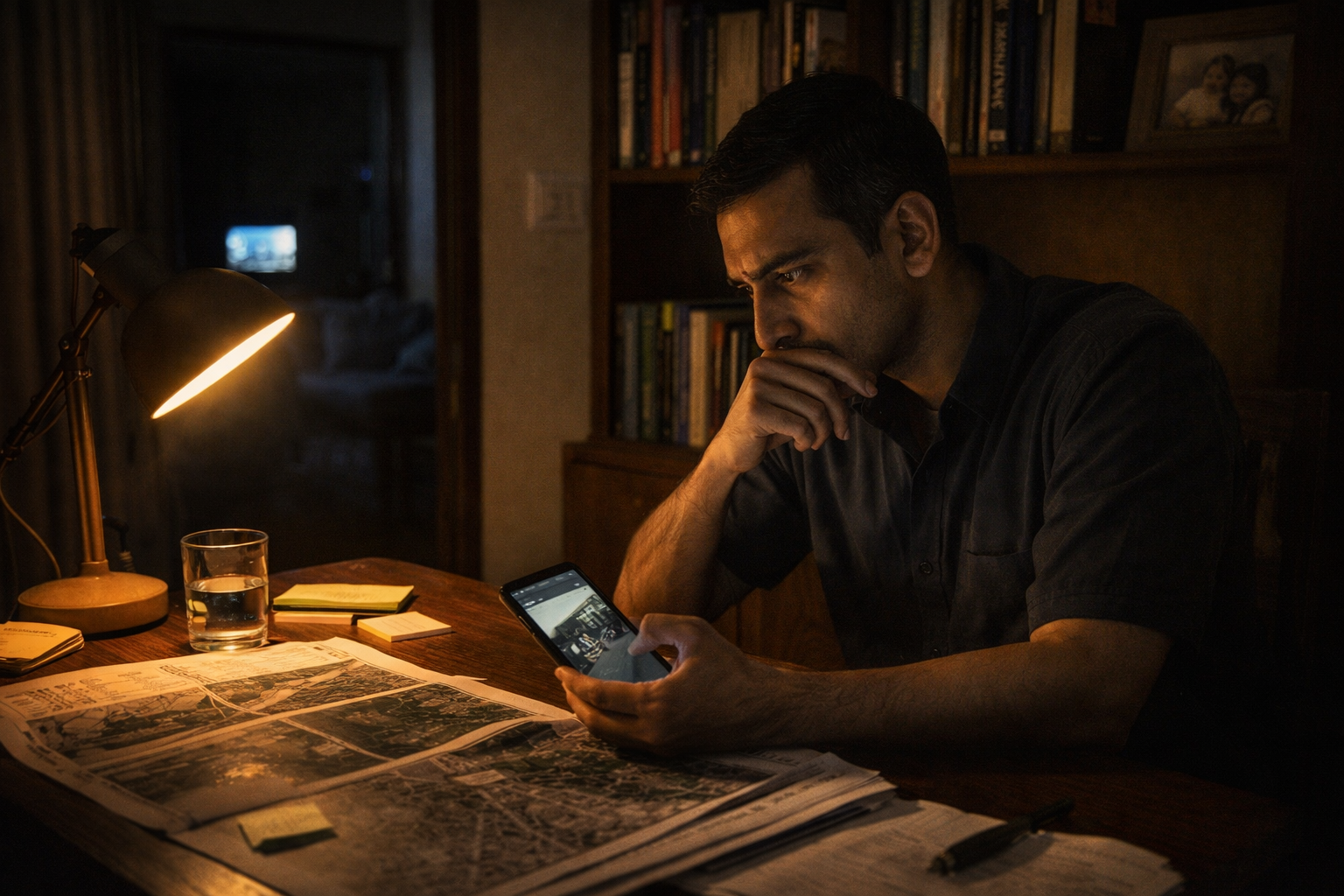 The maps didn’t lie. Someone had planned this very carefully.
He called Nusrat three weeks later.
They had worked together briefly in 2014 — a joint civil-military task force in Pathankot, tedious administrative work, nothing dramatic. She had been sharp, literal, the kind of person who noticed when two numbers in a column didn’t add up and wouldn’t let it go until they did. She was IB now, posted in Chandigarh. He had her number in his phone under “IB Nusrat” because he’d never got around to adding her surname.
She picked up on the second ring.
“Mehta. It’s been eight years.”
“Nine,” he said. “I need a favour. Unofficial.”
A pause. “How unofficial?”
“I need you to check a company registration. Gurugram. Called Suryaprakash Solar Security Solutions.”
Another pause. Longer.
“Give me forty-eight hours,” she said.
She called back in thirty.
“Registered fourteen months ago,” she said. Her voice had changed — flatter, more careful. “One director. No operational website. No GST filings beyond minimum threshold. But here’s the thing — they have active camera installation permits at six locations in Punjab. All approved through state PWD. All signed off by the same junior officer in the Chandigarh infrastructure desk.”
“Six locations?”
“All within a kilometre of either a railway station or a defence logistics access road.” She stopped. “Mehta, who did you submit your note to?”
“My CO. Told me it was coincidence.”
“Your CO told you that on Thursday. I’m looking at an internal IB memo dated Wednesday. Someone already flagged Suryaprakash. Someone already wrote it up. The memo was marked ‘under observation — do not disturb.’”
Arjun said, “Meaning?”
“Meaning either someone above me is running a counter-operation — letting the cameras feed disinformation — or the person who wrote that memo is the reason the cameras are still running.”
In those twelve days, Arjun drove through Morinda six more times. Different lanes. Different times of day. He began to understand Sharma Ji the way you understand a stage set once you know it’s a set — the friendliness looked the same, but he could see the edges of it now. The man was not a spy in any traditional sense. He was too comfortable. Too local. He had worked this booth for nine years, his son’s kiryana shop was two kilometres away, his wife grew marigolds in front of their house on the service lane. He was not ideologically motivated.
He was being used without fully knowing it. Someone had given him a camera and told him to keep it pointed a particular way and paid him to say nothing. He probably thought it was for a road safety survey. Or a journalist. People accepted small arrangements without asking questions when the money was consistent and the ask was minor.
The real operator was somewhere else.
Nusrat found Tariq by following the permit trail.
The Suryaprakash director had one recurring expense — a cash payment, quarterly, to a catering contractor in Amritsar. The catering contractor had a registered premises at a market near the railway station. When Nusrat’s contact pulled his travel history, he had crossed into Pakistan seven times in three years on a textile trade visa.
She put a physical tail on him for one week.
On the sixth day, he met Sharma Ji at a halwai shop two streets from Wagah.
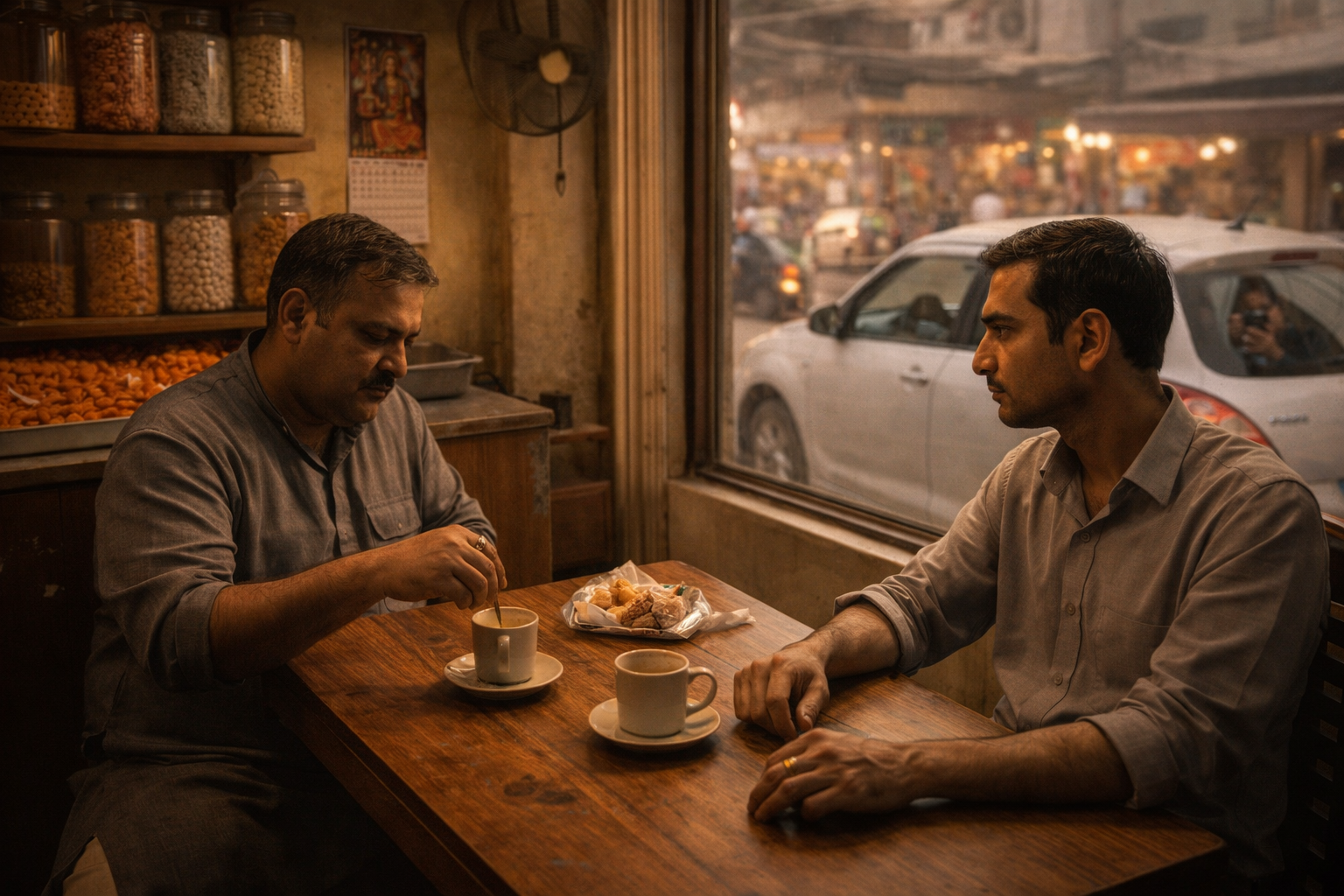 They ate mithai. They talked about nothing. They never once looked at each other directly.
They sat for ninety minutes. They ate mithai. They talked about nothing, in the manner of men conducting business while appearing to do the opposite. Sharma Ji left first. Tariq sat for another twenty minutes, alone, then left.
Nusrat photographed all of it from the car.
She took everything to her supervisor the next morning.
Her supervisor — a heavyset man named Randhawa, fifteen years in the bureau, decorated twice, known for his memory and his silences — looked at the folder for a long time.
Then he said: “Good work. Leave this with me. I’ll take it up.”
“Sir, there’s a major convoy movement in eleven days. If the cameras are still—”
“I know,” he said. “Leave it with me.”
She left.
By Thursday she had checked twice. The cameras at Morinda were still running. Sharma Ji was still at his booth. No alert had gone to the state police. No flag had been raised with Army HQ.
She called Arjun.
“I think Randhawa is the problem,” she said. She was standing in a parking structure because she didn’t trust her office walls. “I can’t prove it yet. But he shut it down too fast and too clean. He didn’t ask me a single question.”
Arjun said, “He didn’t ask you any questions.”
“Not one. When someone hands you a live espionage file, you ask questions. You push back. You send it up the chain while making noise. He just took it and said he’d handle it.”
There was a long silence.
“The convoy moves in eleven days,” Arjun said.
“I know.”
“Can you change the route?”
“I can’t change an Army logistics schedule. That’s not my authority. Can you?”
“Not officially. Not without explaining why. And if Randhawa is already watching—”
“If you put it in writing, it reaches him first.”
Another silence.
“I know someone,” Arjun said. “I’ll call you back.”
Col. Vikram Sood, retired, answered on the fifth ring. He was at a golf course in Panchkula. Arjun could hear the flat thwack of a drive.
He explained everything in four minutes.
Sood listened without interrupting, which was unusual for him.
When Arjun finished, Sood said: “Don’t touch the camera. Don’t touch Sharma Ji. Don’t file anything. Just reroute the convoy. Quietly. Call it a road quality assessment. Log it as administrative. No record of why.”
“And Randhawa?”
A pause. “I’ll make a call.”
“To who?”
“Someone who will ask the questions Randhawa should have asked.”
The convoy took NH 44 instead of the Morinda route. Sixteen vehicles, pre-dawn, logged as a training exercise review. Arjun rode in the third truck.
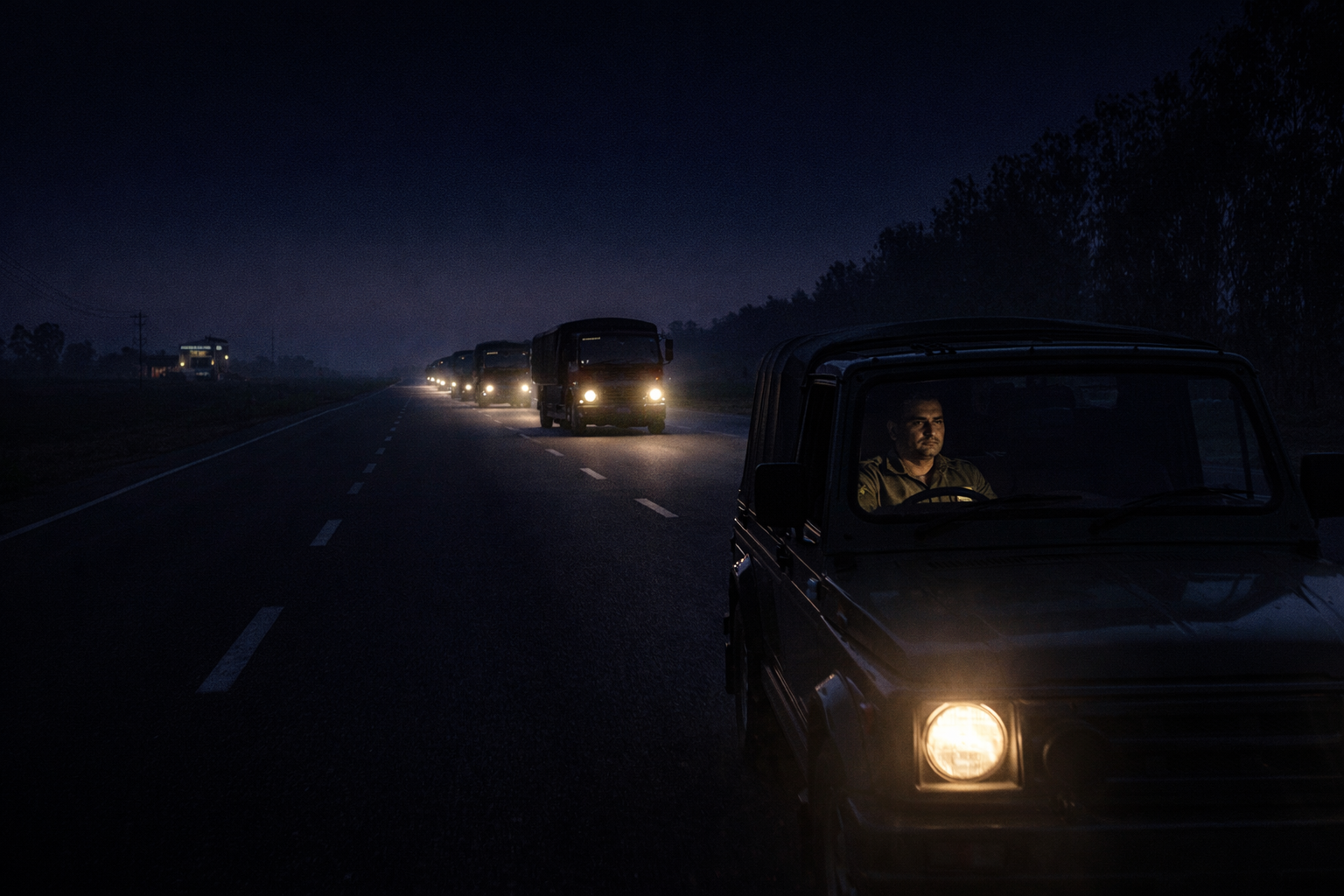 Sixteen vehicles. A different road. No record of why. Some decisions are made in silence.
He watched the turnoff for the old road pass on his left, dark and ordinary, and felt something loosen in his chest — not relief, just the absence of immediate dread.
Nusrat found out about Randhawa’s brother ten days later, through a contact she should not have had and will never acknowledge.
His name was Sajid. He had been in Lahore for a business meeting in 2019, detained on a visa irregularity that was not an irregularity — it was a pretext. The detention was unofficial. No record, no charges. He had been held, quietly, in a house outside Lahore, for six years. His family was told he was missing. Randhawa knew he was not missing.
The ask, when it came, was never dramatic. Just: you will see certain files and you will decide they need more time. You will write a memo that closes the door. No intelligence delivered directly. No codes passed. Just — the absence of action. The closed door. The memo that says under observation, do not disturb.
Six years of doing nothing, at the right moments, for the right files.
The cameras had been his idea. A small escalation. A favour that felt minor because it involved no violence, no document theft. Just a solar panel and a view of a road.
Nusrat sat with this for three days.
On the fourth day she typed a seven-page note, encrypted it, and sent it to an address she had been given once, years ago, for exactly this kind of situation. She did not know who received it. She did not know what would happen to Randhawa, or to Sajid, or to the house outside Lahore.
She knew what she had done.
She went home and made rice and watched television and tried not to think about a man in a room somewhere who was either about to be freed or about to be moved somewhere no one would look.
Three months later, Randhawa was transferred to a documentation review desk in Hyderabad. No announcement. No proceedings. The kind of transfer that means everything and is explained as nothing.
The cameras at Morinda came down during a routine PWD audit. No press release.
Sharma Ji kept his job. He knew nothing, officially. He would go on saying “God bless, sahib” to the cars passing through, and one day he would mention to someone that the camera behind the payment box had been removed, and the someone would shrug and say yes, they upgraded the system.
Arjun drove through the booth on a Tuesday in December. Priya was in the backseat. She was working on a school project about migratory birds now — penguins had been replaced.
He pulled up, paid Sharma Ji, took the change.
Looked in the rearview mirror as he pulled away.
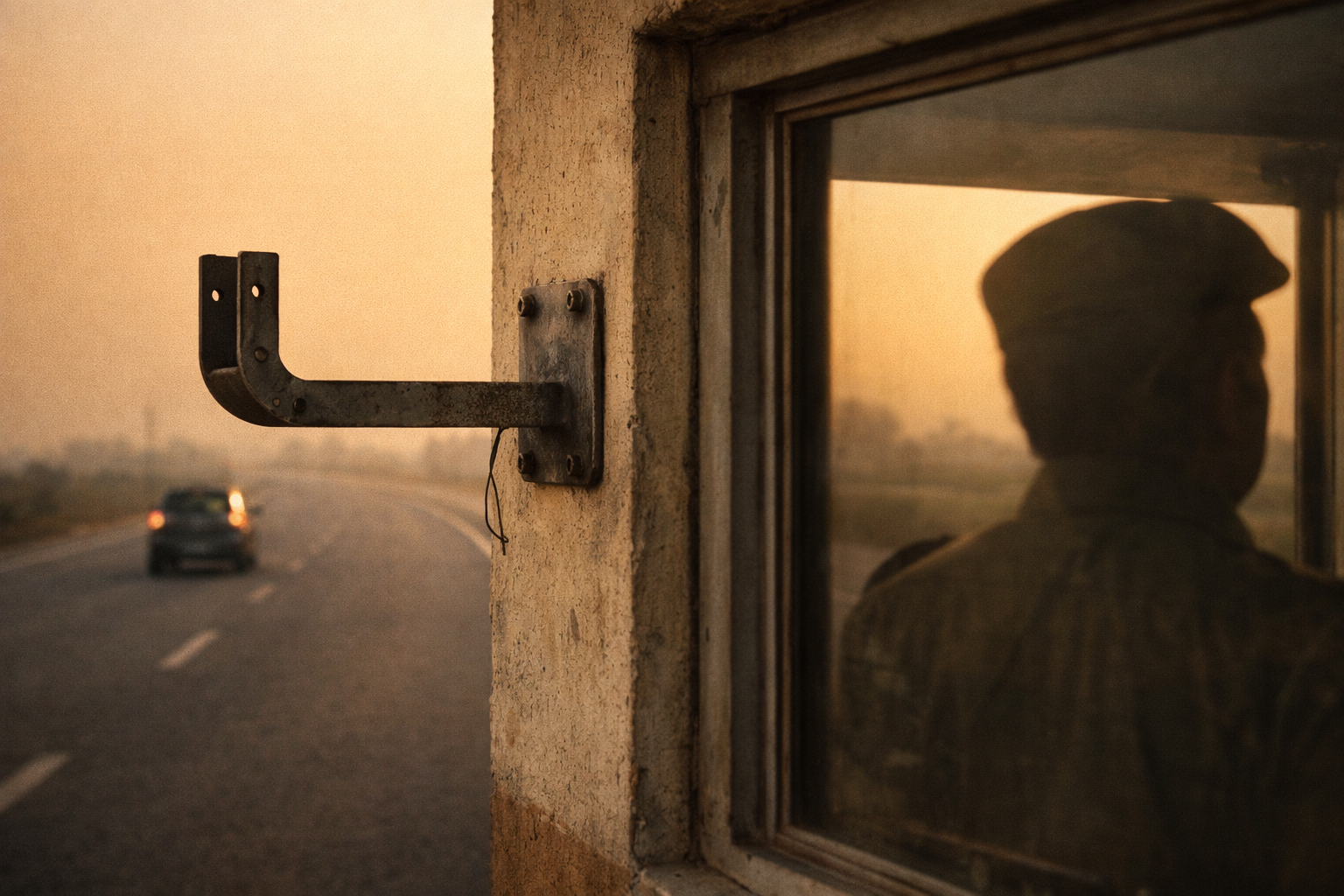 The bracket was still there. Just the bracket. No camera. No explanation. The world had no idea.
The bracket was still there, on the booth frame. Just the bracket. No camera.
He didn’t say anything. Priya didn’t notice.
He turned onto the highway and drove.
Somewhere outside Lahore, a man waited.
No one came.

Reader Comments
Loading comments…
Leave a Comment