Anushka Bose had been thinking about Ramnath Verma for six days before she bought the flight to Kangra.
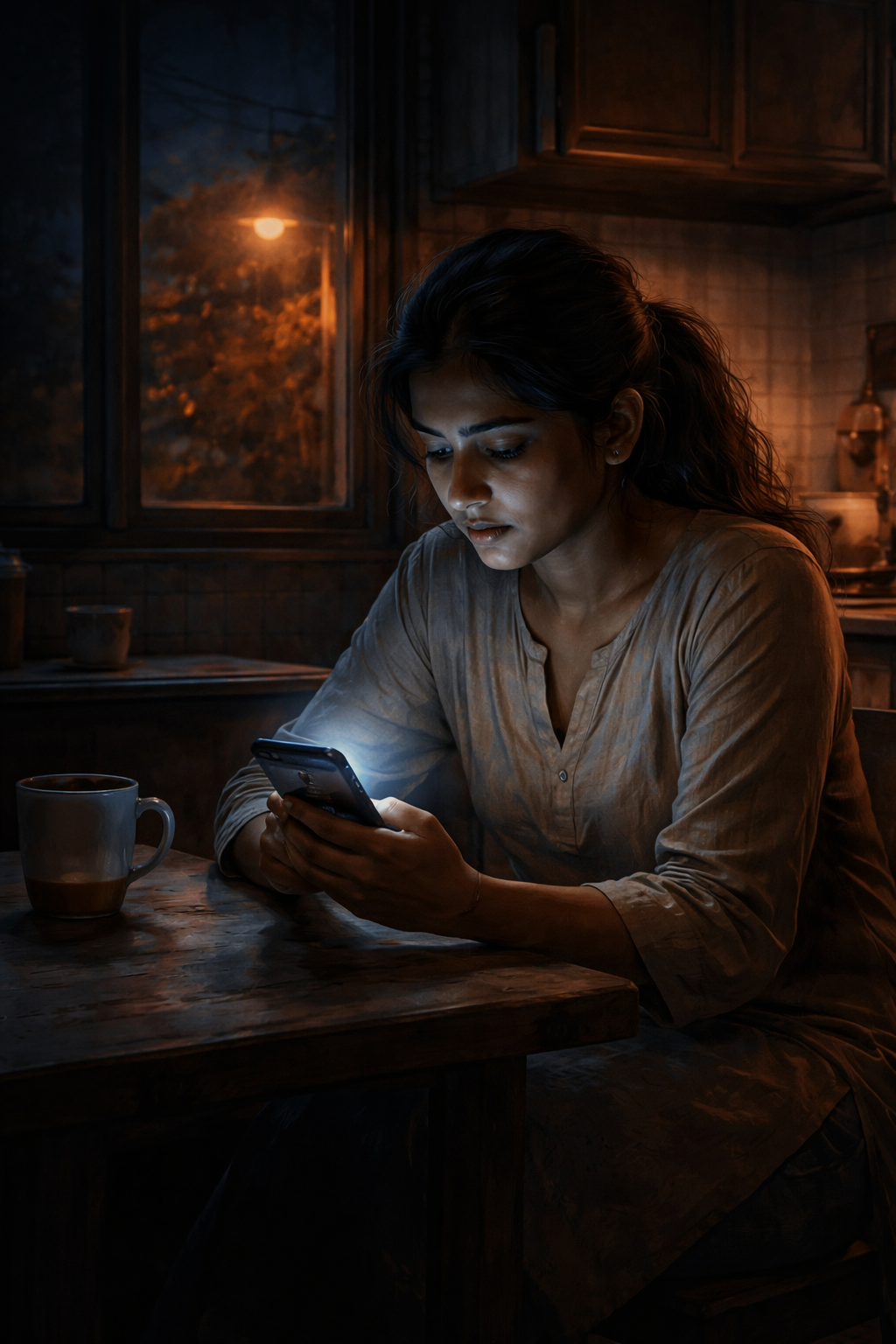
She was in her kitchen in Gurgaon on a Monday morning, the cold-case spreadsheet open on her laptop. Forty-seven Indian cases she had flagged over three years — each with a one-line summary, a place, a year, and a private score from one to ten. Ramnath Verma was entry 23. Mandi. October 2014. Schoolteacher killed in his own house. Case closed without an arrest. Score: two.
Two, because there was no angle. Every witness described Ramnath with the same sentence: he was a quiet, boring man. No enemies, no debts, no affair, no politics, no money. He read Premchand in the evenings and marked Hindi papers in red ink. A police inspector who had been on the case for three days in 2014 told a local reporter: “Someone entered the house. Someone killed him. Someone left. We do not know why.” That was all.
Anushka had skimmed the case twice over the years and moved on.
But the phrase quiet, boring man had not let her go. Her entire podcast — The Cold Case Desk — was about people the world had decided were not worth investigating. Eighty thousand listeners. Twenty-three million episode downloads since she had started alone in 2022 with a laptop mic and a library card. The cases that resonated most were always the ones the system had shrugged at.
She opened the flight site. Delhi to Kangra. Booked the 6:15.
The mountain road from Kangra to Mandi took the last three hours of her first day in Himachal. Pine trees on both sides, the light doing what mountain light does at four in the afternoon — thinning, going amber, the kind of light that makes a moving car feel historical. The road climbed and dropped and climbed again. Small wooden houses with slate roofs. A tea-selling stall where she stopped and the owner told her which road to take without being asked.
“Reporter?” the man said.
“Podcaster.”
“Same thing,” he said.
The town was small enough that the school, the municipal office, the market, and the two lanes of houses fit inside one valley. She checked into a guesthouse run by a retired army man who kept a register the size of a geography atlas. He asked which case she was here for. She said Ramnath Verma. He looked at her for a long moment.
“He was a quiet man,” he said.
“So everyone tells me.”
“Too quiet, maybe.”
She wrote the sentence down after he left.
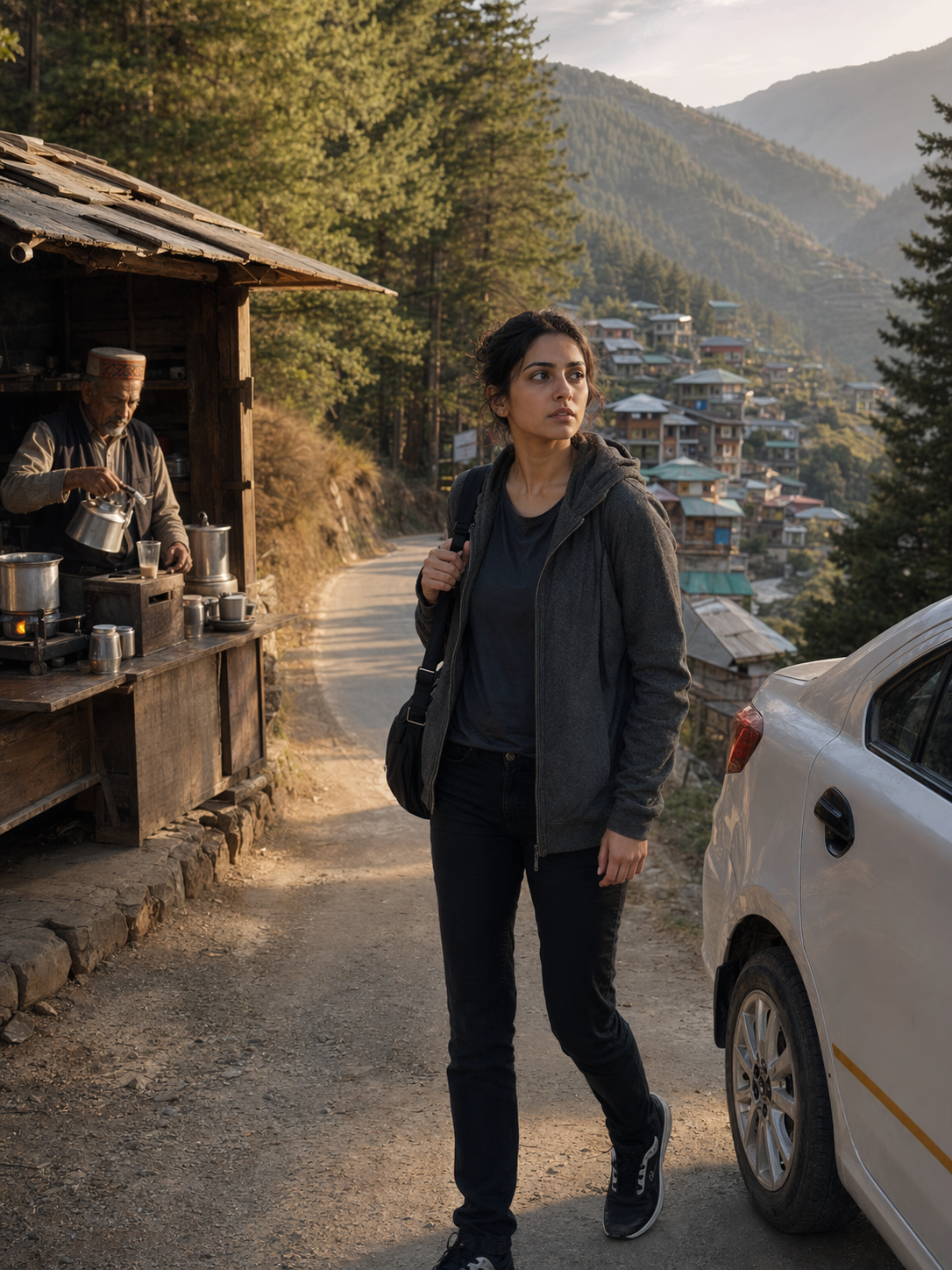 First day in the valley — a town small enough that the whole of it fit inside one bend in the road.
By the end of day two she had interviewed seven people who had known Ramnath Verma. Each of them said versions of the same thing.
Principal Rana, now retired, in his garden with marigolds: A diligent teacher. Came on time, left on time. Marked papers in the staff room until six. Never asked for anything.
Mrs Thakur, Hindi department colleague: A gentle man. Very fond of Premchand and Harivansh Rai Bachchan. We used to have tea together. He talked about his wife, about his students. Nothing else.
Om Prakash, the school peon who was 62 when Ramnath died and was still, at 74, the school peon: Good man, madam. Left his chalk always neatly arranged.
A former student, now a banker in Chandigarh, on a video call: He was my favourite Hindi teacher. Never yelled. I remember he would lean over your desk to check your work and the top of his head smelled faintly like coconut oil.
All of it added up to a man who had existed, had taught, had been liked, and had died without leaving a single edge to grip.
Anushka wrote in her notebook that night: Boring is a word people use when they have not looked carefully. Ramnath Verma has been described as boring by eleven people in two days. Either he really was, or everyone in this town is being very careful.
She underlined the second sentence twice.
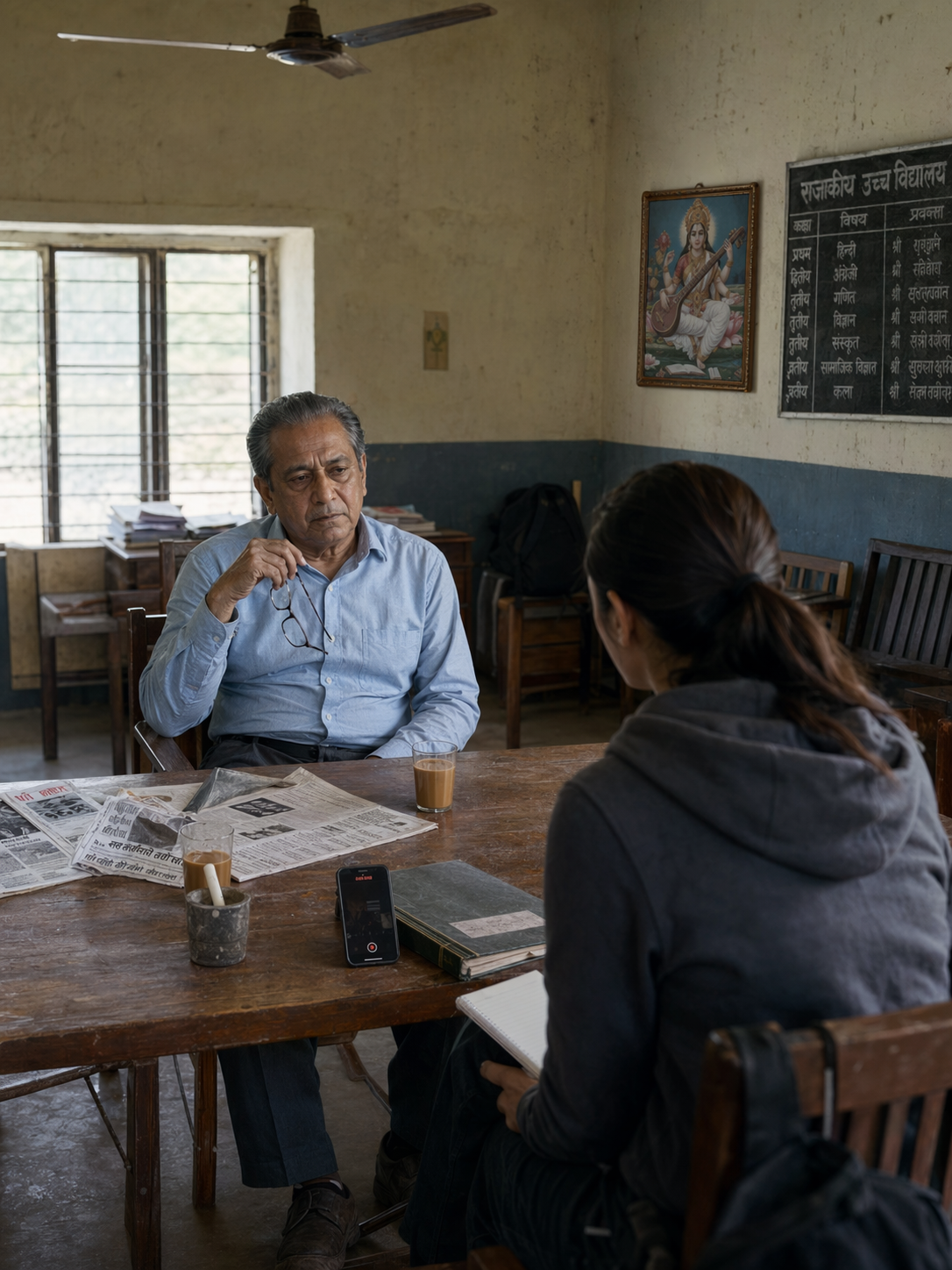 Day two — “A gentle man. Nothing else.”
Ramnath’s widow Kamala Verma lived in the same house. She was seventy-two and answered her own door on the third knock.
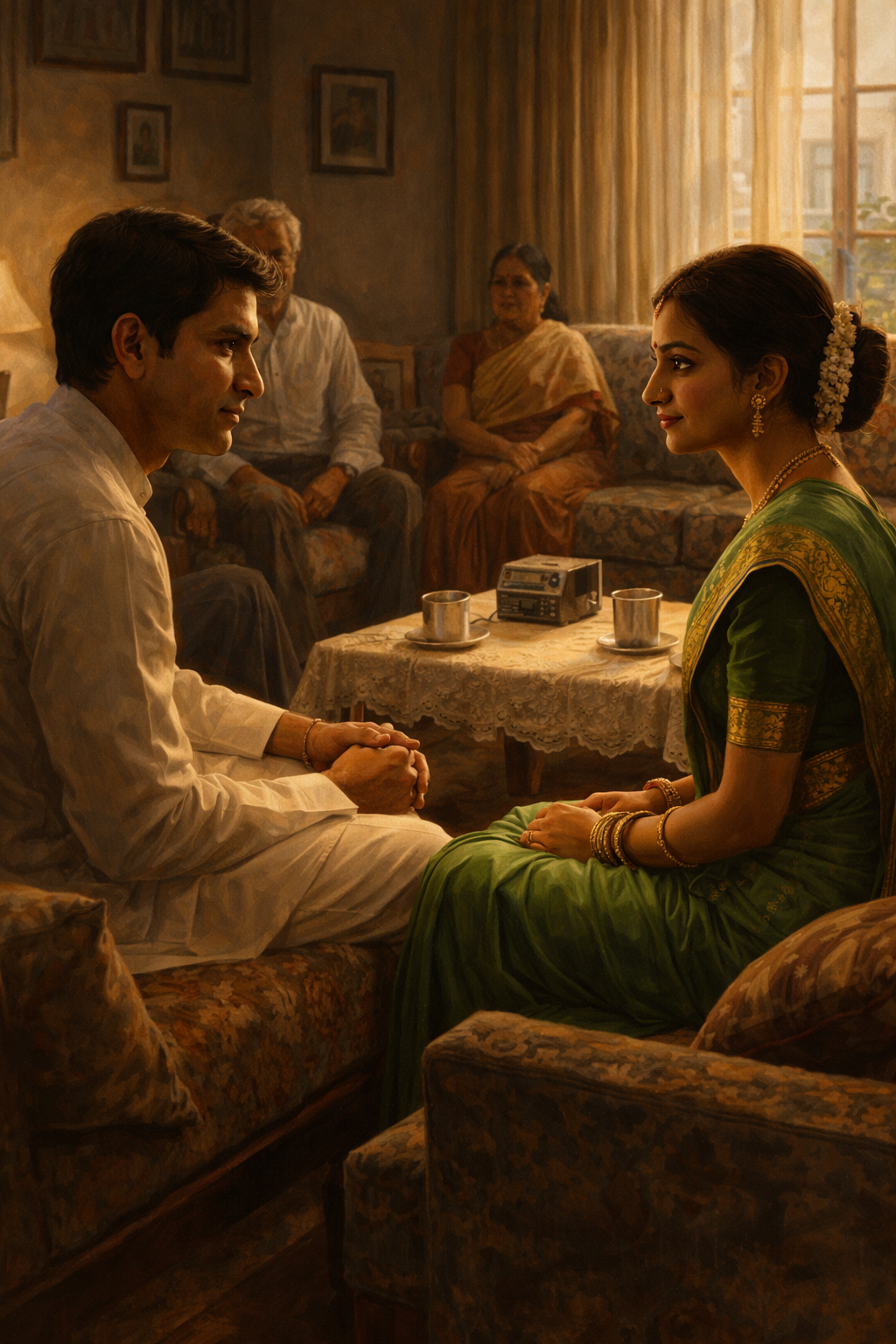
“Come in,” she said. She was small, neat, her grey hair in a knot at her nape. Her house was clean in the way that very clean houses are — cleaned every day because there is nothing else to do. A framed black-and-white photograph of Ramnath in his teaching dhoti and short-sleeved shirt hung on the central wall of the sitting room.
“You are the podcast girl,” Kamala said.
“Yes.”
“Why my husband?”
Anushka had answered this question many times. She said: “Because I think the men who are called boring are usually not.”
Kamala nodded. She had known, Anushka felt suddenly, that someone like Anushka was coming. Not this year — eventually. In the way that certain people keep certain doors open for certain arrivals.
They sat in the front room. Kamala brought tea. Anushka asked her questions. Kamala answered them simply.
They had been married forty-three years. They had no children — a medical fact they had both made peace with. Ramnath had left the house at seven every morning. Returned at four. Marked papers until seven. Read until nine. Slept at ten. On Sundays, he took the bus to Mandi and sat in the lending library there for four hours.
“Why the library?” Anushka asked.
“He said he liked the silence.”
“What did he read?”
“Whatever came to his hand.”
Anushka watched Kamala’s hands as she said this. They were steady. Her eyes were elsewhere.
“Kamala-ji,” Anushka said. “Did your husband ever — in his last year or so — seem to you to be working on something?”
Kamala stirred her tea. “He was always working on something. He was a man who needed to be working.”
“Something he did not share with you?”
A long pause.
“My husband told me everything he wanted to tell me,” Kamala said finally. “What he did not tell me, he did not tell me.”
That, Anushka understood, was the end of that answer.
It was Om Prakash the peon, on the morning of day four, who brought her to the storage room.
“Madam,” he said. “There are some old things of sir’s. In the back storage. The new principal said I should throw them away but I kept them.”
The back storage was a small concrete room behind the senior wing, full of broken desks and bundles of old examination papers. Om Prakash opened a steel almirah with a small key he had kept in his pocket for eleven years. Inside, on the lower shelf, were seven spiral-bound Hindi-ruled notebooks, each with Ramnath Verma’s name in careful handwriting on the cover.
“He used to ask me to keep them in the almirah when he was going on leave,” Om Prakash said. “So they would not be disturbed. After he died — I did not know what to do with them. So I left them here.”
“Have you read them?”
“I do not read much, madam. My eyes are not good.”
Anushka sat on a broken desk and opened the most recent-looking notebook. She expected lesson plans, student marks, administrative notes.
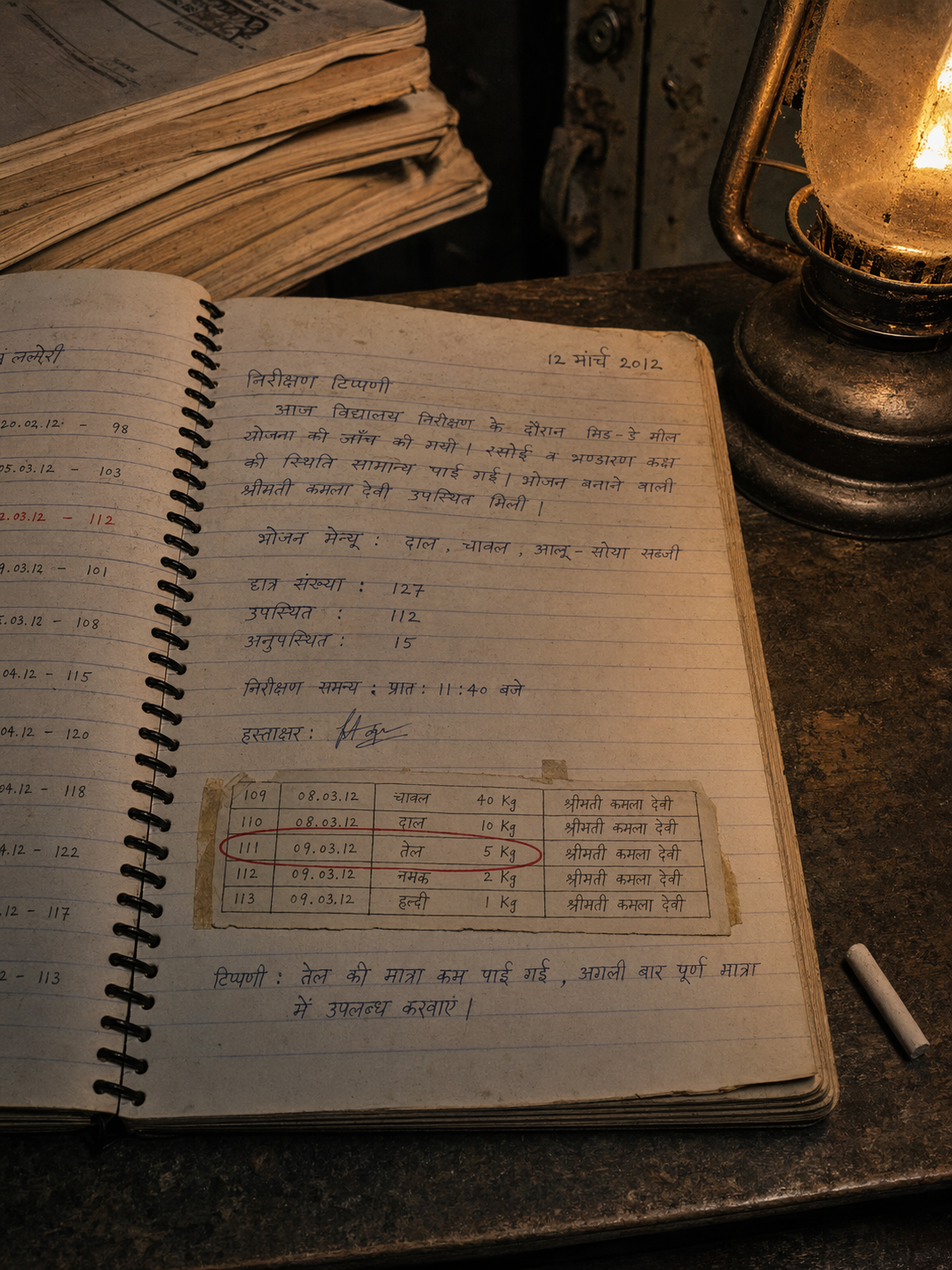
The first page was dated 12 March 2012.
Today, I noticed again that M. Thakur’s cousin collected scholarship money for 14 tribal students. Only 6 of those students exist in the school register. I have checked. I will check again.
Anushka closed the notebook.
She opened it again.
She read for two hours on the broken desk without moving.
 Seven spiral notebooks, 2007 to 2014 — not a diary. An investigation.
Over the next three days Anushka moved the notebooks to her guesthouse room and read all seven of them end to end, in order. They spanned 2007 to 2014. Seven years. They were not a diary. They were an investigation.
Scholarship disbursement register shows 47 tribal students received funds this year. School enrolment register shows only 19 tribal students. Difference: 28 students. At Rs 12,000 each, that is Rs 3,36,000 for this quarter alone.
I will not raise this at the staff meeting. I will not say anything to Principal Rana. I have watched him for two years and I believe he is only signing what is placed in front of him.
The name that appears on every disbursement sheet as the municipal office clerk is Shailesh Negi. He is the son-in-law of the panchayat sarpanch. He is M. Thakur’s cousin’s husband. These are small facts but they repeat in a pattern.
I am not a reporter. I am not a policeman. I am a Hindi teacher and I have time on Sunday mornings when nothing else is happening in this town. I have decided to make a full record. One day somebody will look.
The notebooks were written in the kind of careful Hindi a man learns when he has spent his life making students’ handwriting better than his own. Every entry was dated. Every claim was cross-referenced. Photocopied pages pasted in — receipts, register extracts, a photograph of a ledger with a red circle around one line.
The last entry was 19 October 2014.
Final cross-check complete. Every tribal student named in the 2013–14 disbursement list does not exist. Total embezzled in that year alone: Rs 14,80,000. I will file RTI on Monday the 20th and send a parallel complaint to the CVC. After that the matter leaves my hands.
Ramnath Verma was killed on the night of 19 October 2014.
Anushka spent the next four days verifying the notebooks’ claims. She filed fresh RTIs of her own — the first responses came back in eight days. The dates lined up exactly. The students named did not exist. The clerk named was real. Shailesh Negi. Now 51. Now standing as a party candidate in the coming bye-election.
She rang a classmate from journalism school who was now in investigative work in Delhi. He pulled electoral records, property filings, tax returns as far as was legal.
“He’s a small fish,” the classmate said. “But the lake he’s in — the lake is not small.”
Anushka went back to her laptop and began to write.
She released Episode 7 in three parts over nine days.
Part 1: the portrait of the boring teacher. Part 2: the discovery of the notebooks. Part 3: the cross-check, the embezzled fund, the still-alive clerk now running for office.
Part 3 went up on a Thursday.
By Saturday evening it had been downloaded two million times. #RamnathVerma was trending in India. Morning news anchors were running the story. The CBI’s Himachal desk released a one-line statement: We are aware. A state-level Hindi daily ran a two-page feature with photographs of the notebook pages Anushka had uploaded.
Her phone began to do unusual things.
She recognised most of the threats on X for what they were — the ordinary sludge. But one direct message came from a number that had no public profile. It said only: You are not very big, Anushka. We know where your mother lives in Kolkata.
She took a screenshot. She published the screenshot in Part 4.
Shailesh Negi invited her to his house in Mandi for a conversation. The invitation came through his campaign office, very formal, very correct.
She went. She carried two phones, one recording openly, one recording hidden.
His house was a pleasant two-storey with a veranda that faced the river. He met her at the gate in a pale kurta, open-necked, sleeves rolled. He was the kind of man whose face can be described later only as pleasant. He shook her hand. He offered her chai and a plate of biscuits.
“Your podcast is very popular,” he said. “My daughter listens to it.”
“Does she,” Anushka said.
“Yes. She is in eleventh class.” A small smile. “She told me I should meet you. She said you would be interesting.”
“I am less interesting than the story.”
“The story.” He stirred his tea. “The story is a very interesting story. But I will tell you something. Ramnath was my friend.”
Anushka said nothing.
“He was a very careful man. Very methodical. He was interested in accounts — in numbers. Perhaps too interested. We used to joke about it. Boys will be boys, you understand.”
“He was fifty-eight when he died.”
“Yes. But men stay boys, in a certain way.” He smiled again. The smile did not reach anywhere.
“Shailesh-ji,” Anushka said. “Do you know why Ramnath was killed?”
The smile paused.
“Nobody knows why Ramnath was killed, Ms Bose. That is the tragedy.”
“Do you know who killed him?”
“If I knew that I would have told the police many years ago.”
She looked at him for a long moment. He looked back steadily.
“Thank you for the chai,” she said.
She walked out. She published the full conversation — recorded audio, uncut, both phones — as Part 5. One of the news channels ran it that evening between two of its prime-time debates. The silence between her question and his answer ran on air for four full seconds.
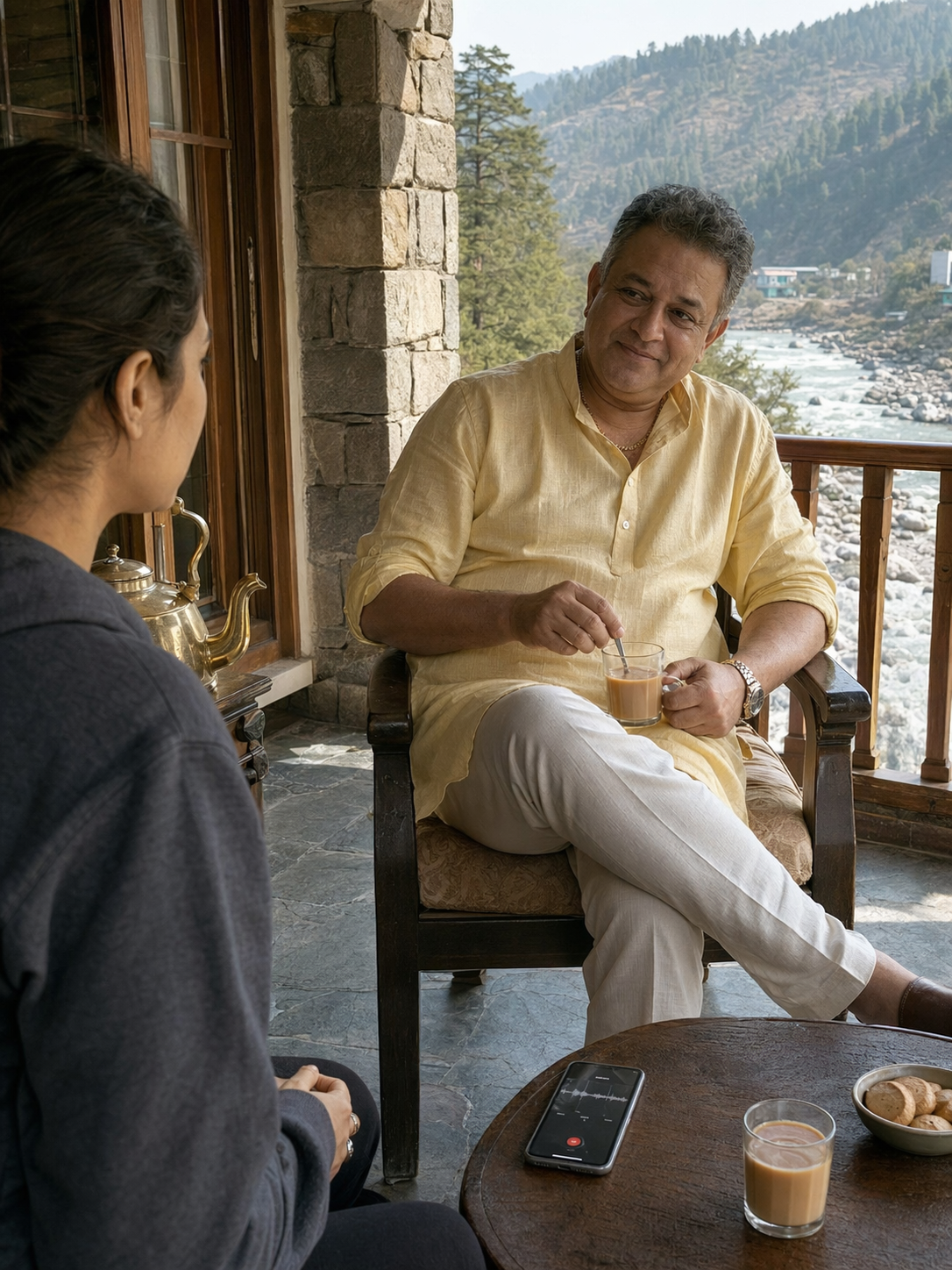 “Boys will be boys, you understand.” — The chai meeting.
Spotify India dropped her podcast the following Tuesday. The reason given was “content under review for regional sensitivity.” She had been a Spotify partner for three years.
She moved the remaining episodes to her own Substack and to Pocket Casts. She set up a small support fund for her production costs. Forty thousand subscribers signed up in nine days.
A defamation case was filed in the Mandi district court. She retained a lawyer. The first hearing was scheduled for four months from now.
An uncle she had not spoken to in six years called her mother from Kolkata. Tell the girl to stop. This is not a story. This is a problem.
Anushka kept releasing episodes.
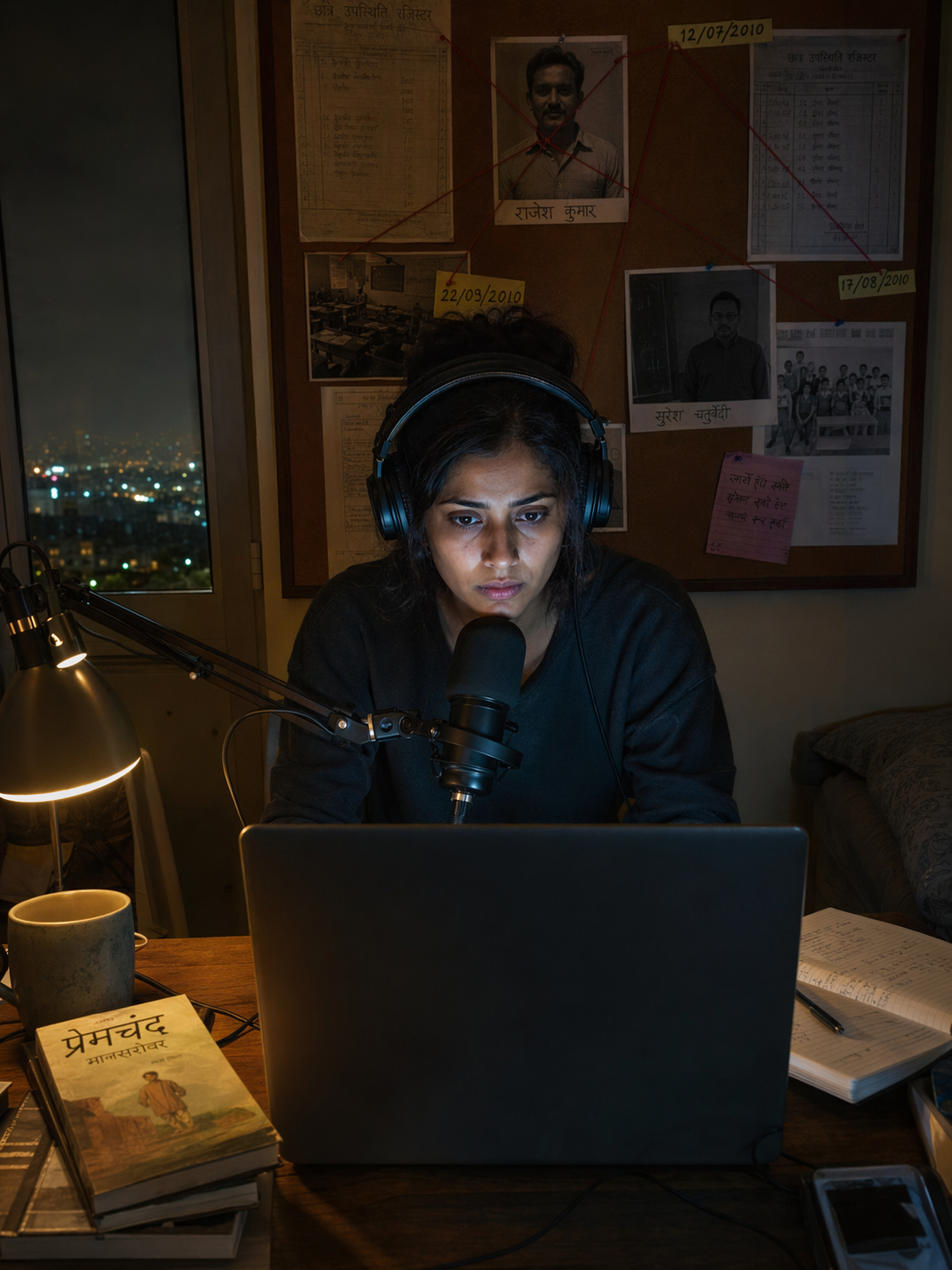 She kept releasing episodes.
On a Friday morning in May, the Himachal CBI raided three houses in Mandi — including Shailesh Negi’s. Account books were seized. Twelve people were arrested. Negi was held first for questioning, then formally charged: corruption, misappropriation of public funds, conspiracy.
Two weeks later the CBI added a further charge. Conspiracy to commit the murder of Ramnath Verma in October 2014.
The party quietly removed Negi from its candidate list. They did not name the reason publicly.
Anushka went back to Himachal once more. She did not film. She did not record.
She sat in Kamala Verma’s front room and drank tea for an hour and a half without producing a microphone. Kamala’s hands were, this time, not steady.
“He told me nothing,” Kamala said. “Until the Sunday before he died. He said that night — he said, Kamala, on Monday I am going to do a thing that may make our life unusual for some time. He did not say what.”
“Did you ask?”
“No.” A small silence. “He was not a man who would be asked. He was a man who spoke when he had spoken to himself first.”
“Kamala-ji,” Anushka said, “your husband was not a small man.”
Kamala was looking at the photograph on the wall. She did not turn.
“He was a small man,” she said. “That is what he was. He was a small man who loved small things. Hindi poems. His students. Me.” She turned finally. “What you are telling me is that a small man, if he pays attention for long enough, can change something bigger than himself.”
“Yes.”
“That is a terrible thing for a wife to be told after eleven years,” she said.
And she cried — not loudly, not for long — for the first time since Ramnath had died.
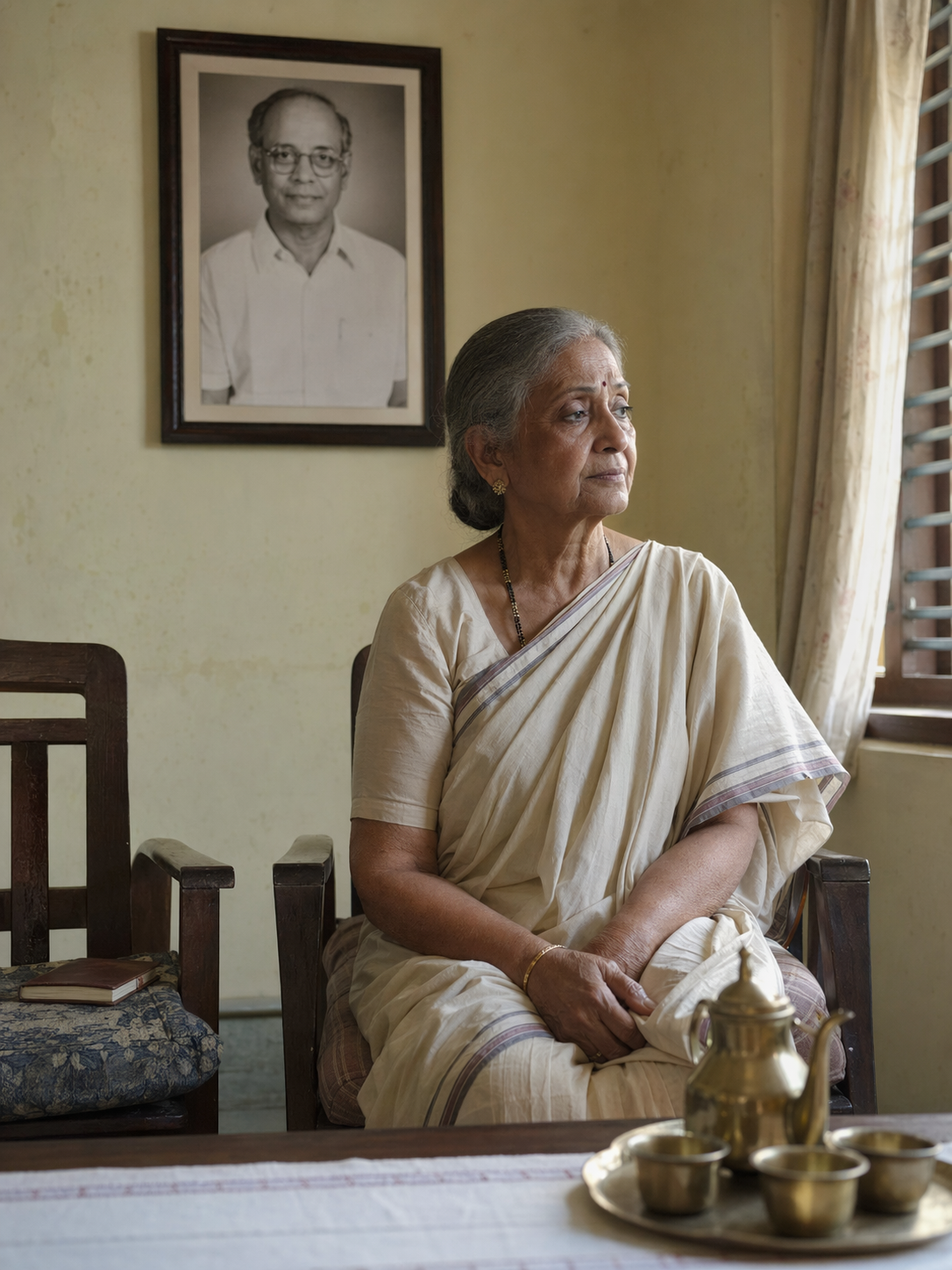 “He was a small man who loved small things.”
Anushka returned to Gurgaon. She sat in her kitchen and did not record for three days.
Then she recorded one sentence.
He taught Hindi. He graded papers. He read Premchand in the evenings. He was doing something the whole time.
She published it as Part 7, the final episode of the case. It ran for seventeen seconds.
It was downloaded three million times in the first week.
On her desk, from that week onward, Anushka kept one of Ramnath Verma’s notebooks — the one from 2014, the one that ended on 19 October. She did not re-read it. She kept it there because a notebook like that deserves to be somewhere a person is paying attention.
That was what he had been doing.
Paying attention.
This is a work of fiction. The characters of Anushka Bose, Ramnath Verma, Kamala Verma, Shailesh Negi, Principal Rana, Mrs Thakur, and Om Prakash are the author’s invention. Any resemblance to real persons, living or dead, is coincidental. The podcast “The Cold Case Desk,” the alleged scholarship embezzlement scheme, the cold-case murder, and all institutional actions depicted — including CBI actions, party decisions, and legal proceedings — are fictional. The setting draws on general features of small towns in Himachal Pradesh; no specific town, school, or municipal office is depicted.
Reader Comments
Loading comments…
Leave a Comment