The wedding date had not been fixed yet, but Simi could feel it settling into the house the way monsoon humidity does — silently, everywhere, impossible to escape.
Her father had mentioned the name twice now. Arvind. Son of some business family in Cuttack, educated abroad, good family, good money — all the words her father used that meant the conversation was already over before it began. Her mother had started talking about silk sarees. Her aunt from Puri had already called twice.
Simi sat on the edge of her bed in their large Bhubaneswar bungalow — the kind with a garden in front and a generator out back and a separate room just for her father’s guests — and stared at the ceiling fan turning slowly in the afternoon heat.
And thought about Paradip.
She always came back to Paradip.
 The analytical lab at PPL — where her hands first stopped listening to her
The first day she arrived at Paradeep Phosphates Limited, she thought she would hate it.
The plant was forty minutes from the town by road, and in May, the coastal air outside hit you like a wall — hot and dense and salt-stung. The facility was enormous, industrial and serious, with the low hum and sharp smell of sulphuric acid plants in the background and row after row of DAP production units stretching across the compound. The PPE felt heavy and stiff in the heat — hard hat, safety goggles, closed shoes that were not the white sneakers she usually wore.
She was one of four trainees assigned to the analytical lab. The other three were boys from government engineering colleges who wore their nervousness loudly, talking too much and laughing at nothing. Simi had done her research. She had read PPL’s process manuals on the train from Bhubaneswar. She was ready.
The engineer who came to brief the trainees that morning was not who she expected.
He walked in at exactly nine, in a pressed white shirt, clipboard in hand, and looked at the group with the kind of calm that comes from not needing to prove anything. He introduced himself in plain, precise Hindi. Rajesh Mehta. Analytical section supervisor. You’ll be rotating through three sub-sections over eight weeks.
He did not smile. He checked their names against a list. He explained the safety protocols in the same even tone he probably used to explain everything. When he looked at Simi to confirm her name, his eyes passed over her the way they passed over everyone else — like a fact being registered.
She told herself it was the PPE. Or the heat. Or the fact that she hadn’t slept well on the train.
She told herself it was not him.
The first mistake happened on day four.
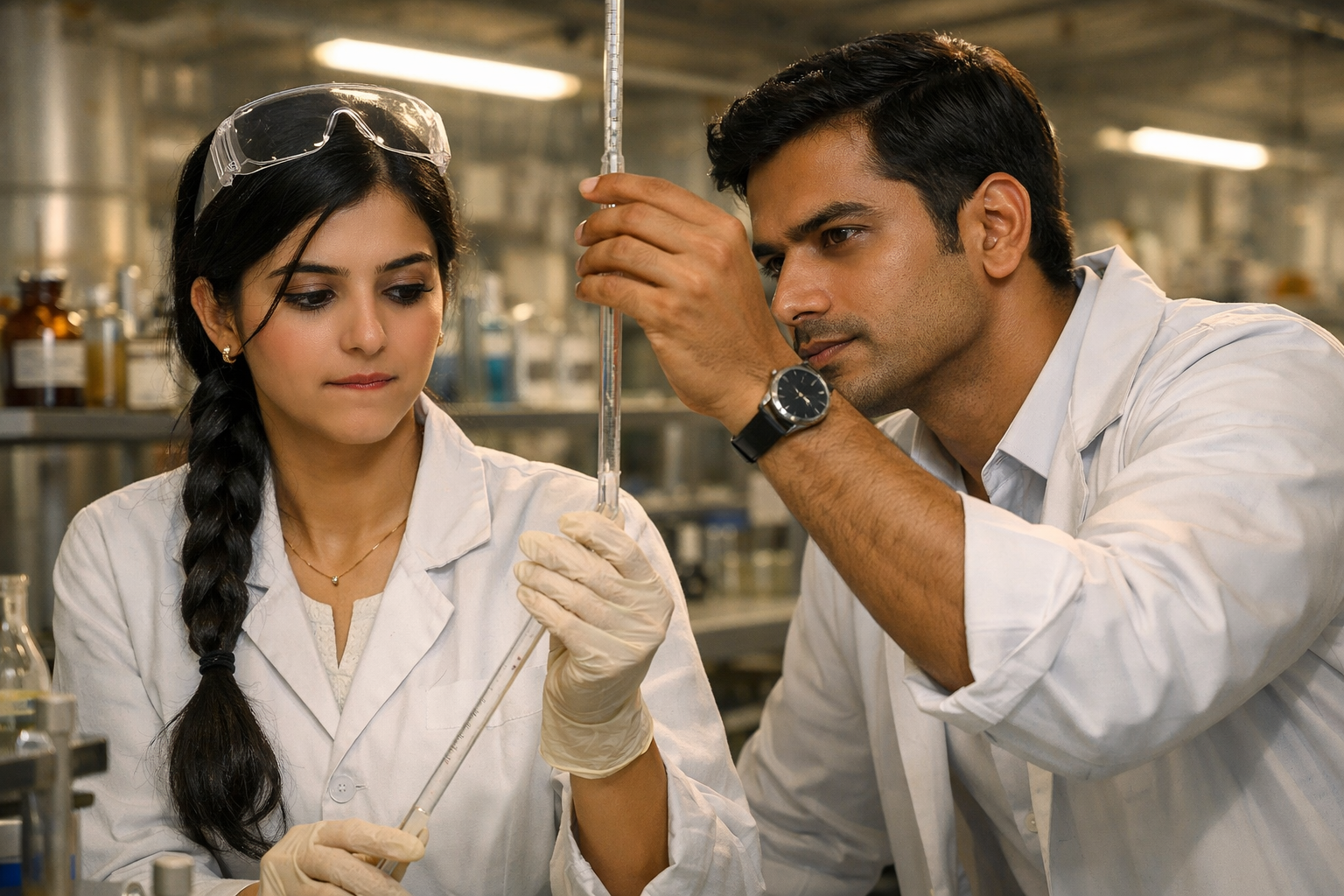
She was running a titration — the kind she had done in her college lab thirty times without error. Simple procedure, standard reagents, the result should have been 18.4 ml. She read 21.7.
She stared at the burette.
Read it again, Rajesh said, from somewhere just behind her left shoulder, closer than she expected.
She read it again. 21.7.
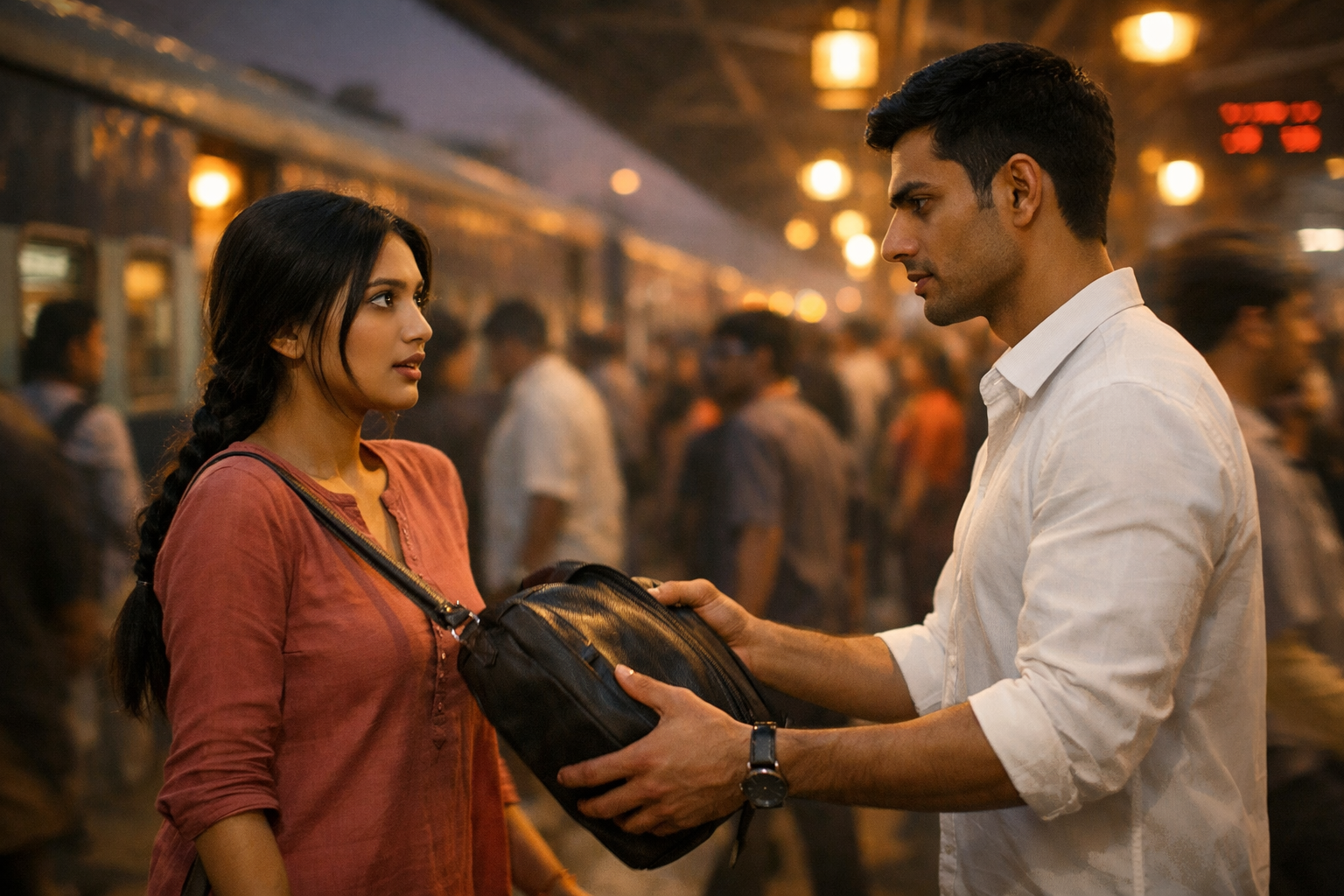
He took the burette from the stand without touching her hand — there was one careful inch between his fingers and hers — and checked the meniscus himself. His forearm was three inches from her face when he held it up to the light. She could see the faint lines of his watch strap against his skin.
Parallax error, he said, very calmly. The light in this corner is wrong. Move to station three for readings.
He set the burette down and walked away to the next trainee.
Simi looked at station three. She looked at her result sheet. She had never made a parallax error in her life. Not once.
She moved to station three and told herself she just needed to concentrate.
It happened again on day six. And day nine. Never when the other engineers supervised her — never when his colleague Suresh was walking the floor, or when the senior trainee Priya was checking results. Only with Rajesh. Only when he was within ten feet of her did her hands do things they had no reason to do — a wrong pipette volume, an endpoint overshot, a reading transposed.
By the end of the second week, she knew what it was. She had known, probably, from the third day, but knowing it and saying it were different things. Her hands were unreliable around him because the rest of her was unreliable around him.
She found this both mortifying and — quietly, in a way she kept very small — wonderful.
She didn’t know that his friends had noticed before he did.
There were three of them — Vikram, Anand, and Suresh — who had worked with Rajesh for two years and understood him the way you understand a person when you have eaten lunch with them three hundred times. They noticed the way Simi’s results were always slightly off on his supervision days. They noticed the way she took notes more carefully when he was explaining something.
On a Thursday evening in the third week, when the trainees had joined the lab team for tea outside the plant gate on the dusty road that ran toward the port terminal — Paradip’s industrial horizon behind them, cargo ships visible in the distance like grey mountains — Vikram said to Rajesh, very casually: Your trainee makes mistakes only with you, you know.
Rajesh looked at him.
I have noticed, he said. The station lighting is inconsistent.
Anand looked at Suresh. Suresh looked at his chai.
Yes, Vikram said. The lighting. And he smiled into his cup.
 Paradeep Sea Beach, Marine Drive — twenty-five minutes on a bike that felt longer
The picnic to Paradeep Beach was Anand’s idea, but the seating arrangement on the way back was Vikram’s.
It was a Sunday, the trainees’ only full day off, and the lab team took two bikes and a borrowed jeep to Paradeep Sea Beach — the long quiet stretch where the Bay of Bengal meets the shore and the sand is deep gold and the water is the kind of blue you don’t believe is real until you are standing in it.
Simi had been to better beaches. Her family had taken her to Puri’s five-star beachfront resort, holidays planned in advance and charged to her father’s corporate card. But there was something different about this one — the way it was empty in the early morning, the way the water came in low and slow, the way the lighthouse stood in the distance like an old certainty.
She took her dupatta off and held it in her hand and let the wind take her hair loose from the braid.
She did not know that Rajesh was standing twenty feet behind her, watching the same water, until she turned.
He looked away first.
They ate roasted peanuts from a small vendor near the wooden walkway and walked along the Marine Drive, the coastal road that curved beside the sea. Simi walked with Priya. Rajesh walked with Vikram. Four feet of salt air between them.
On the way back — the sun low and amber, the bikes packed — Vikram declared loudly that the jeep’s back seat was full and looked directly at Simi with the expression of a man who has planned this very carefully.
Simi di, you’ll have to take the bike with Rajesh bhai. If you don’t mind.
She minded so much she said fine immediately.
The ride back was twenty-five minutes on the narrow road from Paradeep Beach toward the staff quarters. The wind was warm and sharp with salt. She held the back handle of the bike and then, when the road got uneven near the Smruti Udayan turn, she did not hold the back handle anymore. She held his jacket instead — carefully, with two fingers, like she was pretending she wasn’t doing it.
He didn’t say anything. She didn’t say anything. Twenty-five minutes.
The girl in the corridor was named Silu, and she was Simi’s own friend.
Simi had met Silu in the first week — she was from Cuttack, placed in the PPL HR department, easy to talk to. They had eaten lunch together twice, walked around Smruti Udayan Park on Saturday morning, bought bangles together at the small market near the port gate. Simi liked her without reservation.
Until the Wednesday afternoon she turned the corner near the plant’s administrative block and saw Silu standing with Rajesh in the corridor — both of them leaning against the wall, laughing. Not professionally laughing. Laughing. Like people who find each other genuinely amusing.
She kept walking. She went into the break room, poured tea she didn’t want, and stood looking at the industrial skyline through the window — the fertilizer plant’s pipes and columns against the flat blue sky — and felt something she did not have a clean word for.
That evening, when Rajesh called the ladies’ hostel to clarify a data point from the day’s lab session, she did not answer.
She told herself she was busy.
He called the next day. She did not answer again.
In the lab on Thursday she was professional and precise and made no errors and did not look at him directly. He tried twice to speak to her outside the technical context. She gathered her notes and left. On Friday he tried once more, in the corridor outside the lab. Simi. Just her name, in that steady way he had of saying things. She kept walking.
She was not proud of herself. But she also knew that she was twenty-one years old and had never felt anything like what she felt in that corridor, and it sat badly in her chest and she did not know how to set it down.
 Paradeep Government Hospital — the only place she stopped pretending
She was in the canteen on Friday evening when Priya came in with the news.
Rajesh bhai had an accident. On the Kujang road. He’s at the hospital.
Simi stood up before the sentence was finished.
She does not remember the autorickshaw ride to Paradeep’s hospital — the narrow roads, the evening heat, Silu sitting beside her saying things she didn’t hear. She remembers the fluorescent light of the corridor. The smell of antiseptic. Vikram at the door, his face saying: relieved it wasn’t worse.
Road, uneven patch, he went down. Left arm fractured. Ribs bruised. He’s okay. He’s awake.
She went in.
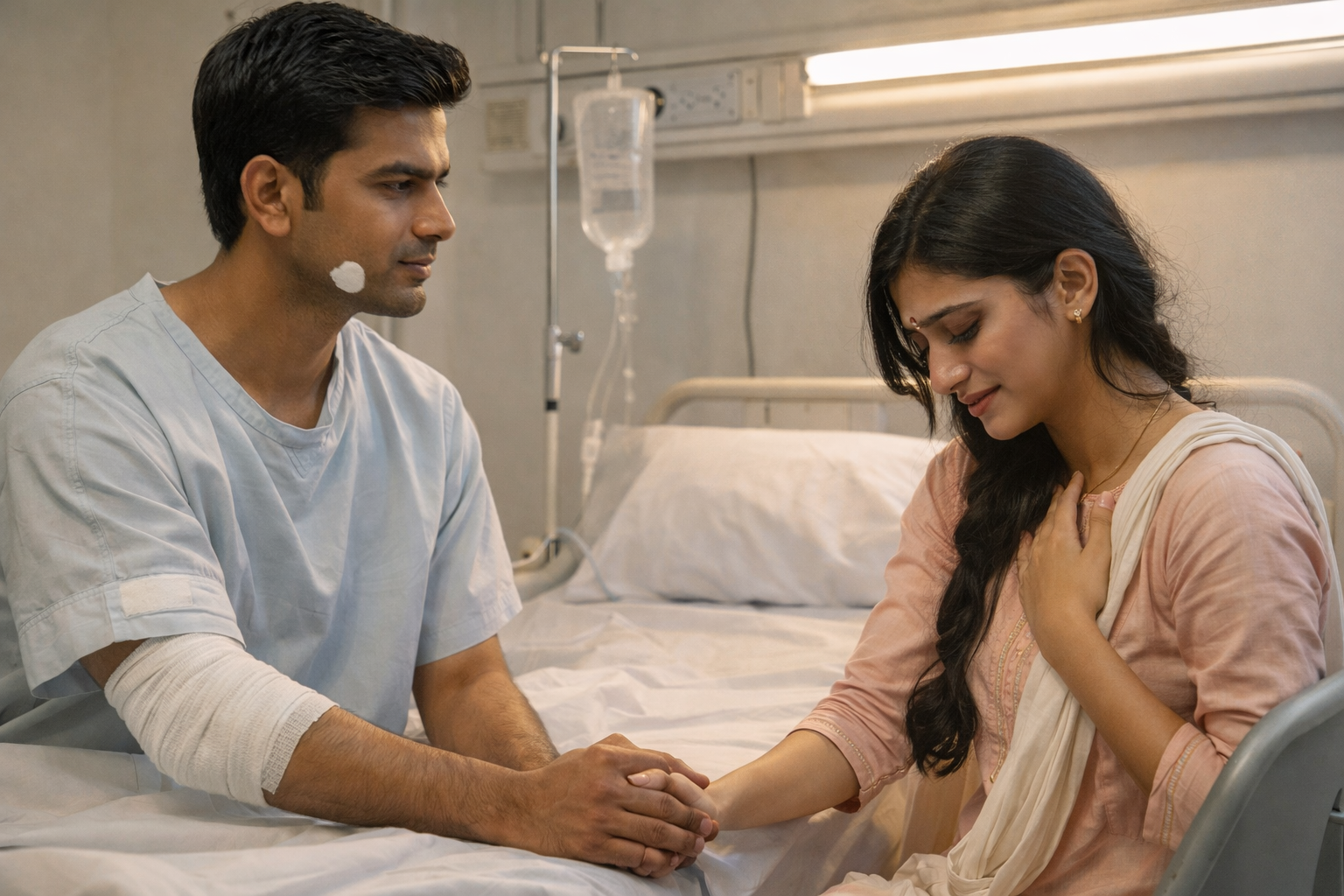
He was sitting up slightly in the bed — white bandage on his left arm, a plaster on his chin, the line of his jaw tight the way it went when he was dealing with something without showing it. He looked at her when she came in and something in his expression shifted — just slightly.
She sat in the chair beside the bed and said nothing for three seconds and then she was crying, which she had not planned. Not quietly. Not politely. The way you cry when you have been holding something for four weeks and a white hospital room takes away your ability to pretend.
You are my love, she said, through tears that surprised both of them. Please be careful always. Please.
He was quiet for a moment. Then his right hand — the one without the bandage — found hers on the chair armrest.
I love you, Simi, he said. Quietly. No preamble. No poetry. Just a fact he had been carrying and now set down in her lap. Very much.
She laughed through the crying, which felt ridiculous and also exactly right.
Silu, standing in the doorway, turned around and very carefully pulled the door shut behind her.
 Smruti Udayan Park, Paradip — morning chai, flower plots, and four inches of distance that said everything
The weeks after that had their own quality — lighter and heavier at once.
They walked together in Smruti Udayan Park in the early mornings before the heat settled in, along the paths between the flower plots and the musical fountain whose stone basin caught the first light. She would buy him chai from the small stall near the park gate. He would buy her roasted corn from the evening vendor outside the PPL gate. Small exchanges. Small certainties.
They ate fish curry at the small restaurant near the Paradip Port market complex — the kind of place with plastic chairs and no pretensions and the freshest pomfret in Odisha — and he told her about Ahmedabad, about his father’s hardware shop on Relief Road, the particular smell of metal and sawdust, the way his mother made dal baati churma on Sunday mornings. She told him about her father’s bungalow and the generator and the marble floors and the way she sometimes found it very quiet — the kind of quiet that has too much money in it.
Your world is very different from mine, he said. Not as a complaint. A fact.
I know, she said. She set a fish bone aside and looked at him. I don’t care about that.
He looked at her steadily. Your father will.
She didn’t answer. Because she knew he was right, and she had decided not to think about that yet.
She thought about it every day from August to December.
The training ended. They went back to their separate lives — she to Bhubaneswar, he to Ahmedabad and then back to Paradeep for his permanent posting. She called him standing in the stairwell of her house late at night, or walking to the corner shop with a reason that had nothing to do with the corner shop. His voice was the same on the phone as in person — steady, unhurried, present in a way that made her feel found.
Her family knew nothing.
Her father spoke of Arvind twice more. Her mother said good values, solid family — meaning: money like ours. Her aunt from Puri said Simi is not getting younger in the way that aunts say things that are meant to be helpful.
The proposal was set for a Sunday meeting. Simi was expected to sit in the drawing room in a nice saree and smile.
She called Rajesh from the stairwell the night before, past midnight.
She told him everything. The meeting. The date. The Cuttack family’s name.
On the other end of the line she heard him breathe in once, slowly.
I need you in my life, Simi. His voice was quiet and certain. Nothing else is needed. Please.
She sat on the cold stairwell marble and closed her eyes.
That was all she needed. Not a plan, not a promise she could hold in her hand — just that voice, just those words, just the knowledge that somewhere in a staff quarters flat near the PPL plant, a man with a scar on his chin was sitting in the dark saying I need you like it was the simplest truth he had ever spoken.
She went to sleep. She did not shake.
 The Bhubaneswar drawing room — the day Simi stopped asking for permission
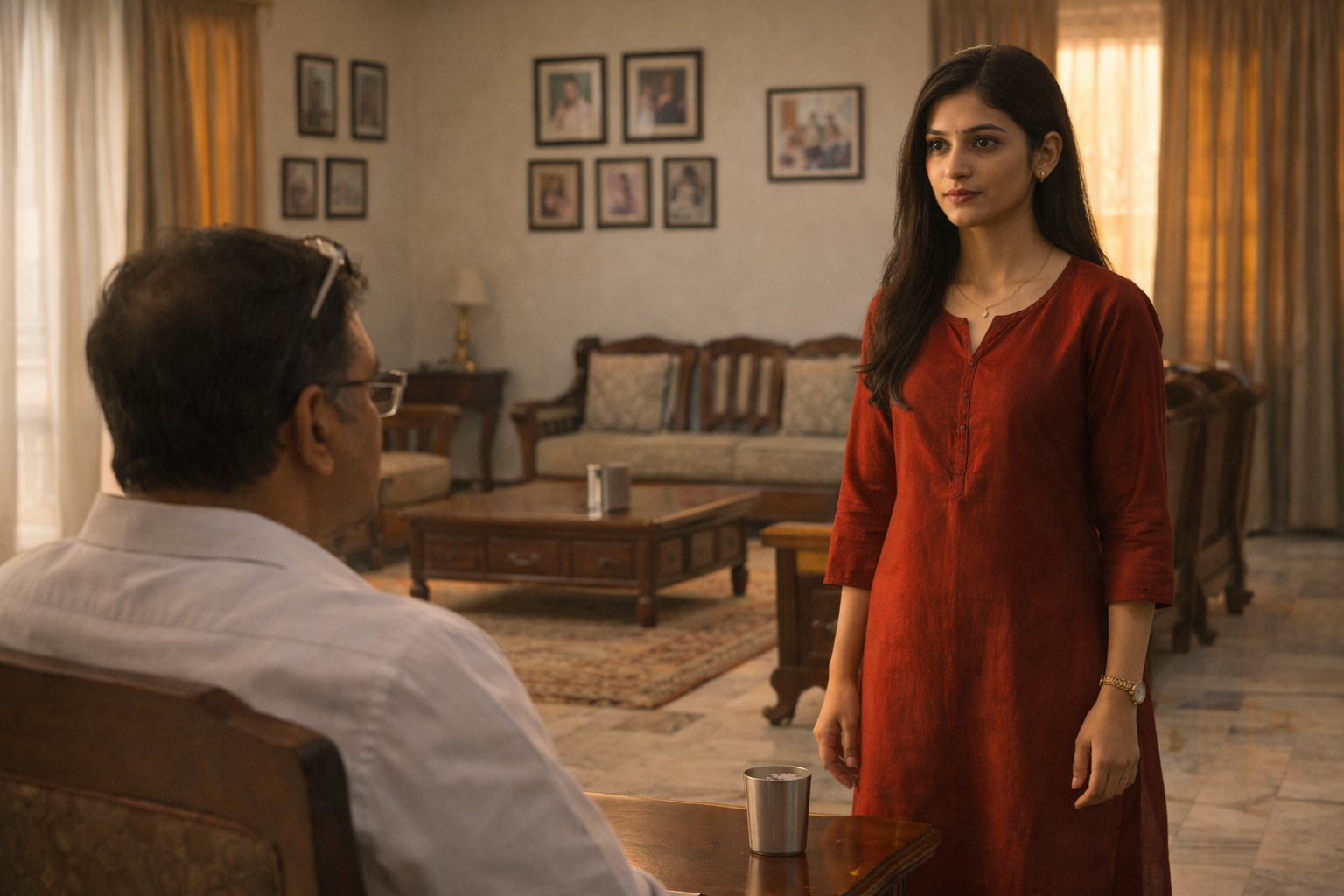
The Sunday meeting happened. Simi sat in the drawing room in a nice saree.
She waited until Arvind’s mother finished describing their property in Cuttack.
Then she said, politely and clearly, looking at her father: Papa, I love someone else. I want to marry him.
The room went quiet the way rooms go quiet in moments that change things.
Her father looked at her for a long time. Who, he said.
She told him.
It was not easy. Nothing that follows those words in an Odia household with marble floors and a guest generator is easy. There were weeks of silence that pressed against her like stone. There were conversations where her father said things she could see cost him something — his idea of what her life was supposed to look like.
But she did not waver. She had made a decision on a cold stairwell and she kept it.
Her father flew to Paradeep. He drove to the PPL staff quarters. He met a man in a plain white shirt who offered him tea from a gas stove and spoke honestly and did not try to be more than he was. Her father sat in that small flat — nothing like their Bhubaneswar house, nothing at all like it — and looked at the man his daughter had chosen.
He told Simi afterward, much later, that what changed his mind was the answer to one question.
What can you give my daughter?
Rajesh had thought about it for a moment. Then: Not everything she has now. But everything I have, always. That I can promise.
Her father looked at his tea.
Come to Bhubaneswar in two months, he said. With your parents.
The wedding was in February, in the month when Bhubaneswar is cool and the marigolds are heavy with gold. In the middle of the ceremony, while the priest recited something long and steady, Simi looked at Rajesh beside her and thought about a titration she had gotten wrong at 9 a.m. on a Thursday in May.
He caught her looking.
What? he mouthed.
She shook her head. Nothing. She looked forward again.
She was never going to tell him. That the first time she loved him was a parallax error on a burette.
Some mistakes, it turns out, are the most precise things you ever do.
Paradeep Phosphates Limited, where this story is set, is a real fertilizer manufacturing facility on the coast of Odisha, at the confluence of the Mahanadi river and the Bay of Bengal. The beaches, parks, and streets in this story are real places.
Reader Comments
Loading comments…
Leave a Comment