Raanu almost didn’t make it to the bed that night.
She had been sitting on the floor of her hostel room for an hour — back against the wall, knees pulled in, staring at the ceiling fan that made a soft ticking sound on every third rotation. Her roommate had gone home for the weekend. The silence was the kind that does not comfort you. It just shows you how much space a person takes up even when they are not there.
She thought about calling her mother. She didn’t.
She thought about crying. She wasn’t sure what she was sad about exactly, only that something had shifted somewhere inside her and hadn’t shifted back. Maybe it was nothing. Maybe she was just tired. Bhubaneswar summers were long and unkind, and she had been running on bad sleep and black tea for three weeks.
She finally made it to the bed at 1 a.m. and lay there staring at the same ceiling fan, thinking: if something doesn’t change, I will go mad.
Two days later, something changed.
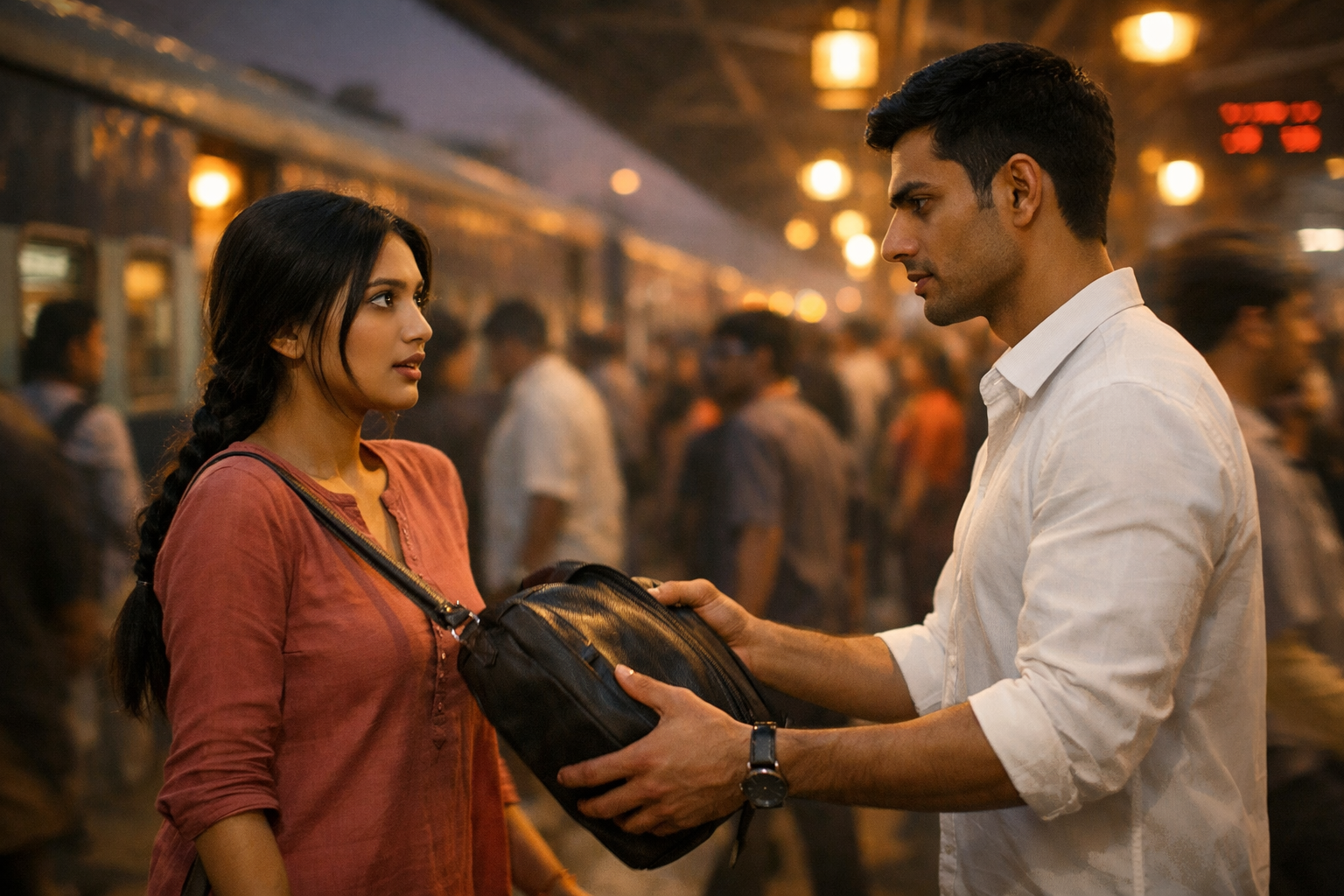
 An unexpected meeting — Raanu and Ranjan, a busy platform, dusk
The Bhubaneswar railway station at 6 p.m. is not a place designed for quiet introspection.
It smells of tea stalls and diesel and something fried that you can never quite identify. The announcements come in three languages and none of them are clear. People move like they are all slightly late for something. Raanu was late for something. She had a bag on her shoulder, a ticket in her hand, and a vague anxiety that she had left the gas on — she hadn’t, she almost never did, but she checked three times anyway.
She turned too fast.
The bag slid off her shoulder and took half her things with it — a book, her headphones, the small notebook she carried everywhere. She went to grab everything at once and ended up crouching in the middle of the platform like a person assembling themselves from pieces, and a man she had never seen before crouched beside her and handed her the notebook without a word.
She took it. She looked up.
He was tall, lean, with the kind of face that looked like it had made up its mind about most things. Short neat hair, clean jaw, eyes that were dark and steady in a way that felt almost rude to stare at.
“Your book,” he said, holding it out.
“I see that,” she said.
She took it. He stood. She stood. They looked at each other for a second that lasted slightly longer than a second should.
“Thank you,” she said, which was the correct thing to say, and she turned and walked to her platform before she could say anything incorrect.
On the train, she opened the notebook and found that one page had been folded accidentally in the fall. She smoothed it out carefully. She did not think about him again until she was almost home — and then she thought about him only briefly, in the absent-minded way you think about things that don’t matter.
She told herself this three times, which should have been a clue.
His name was Ranjan.
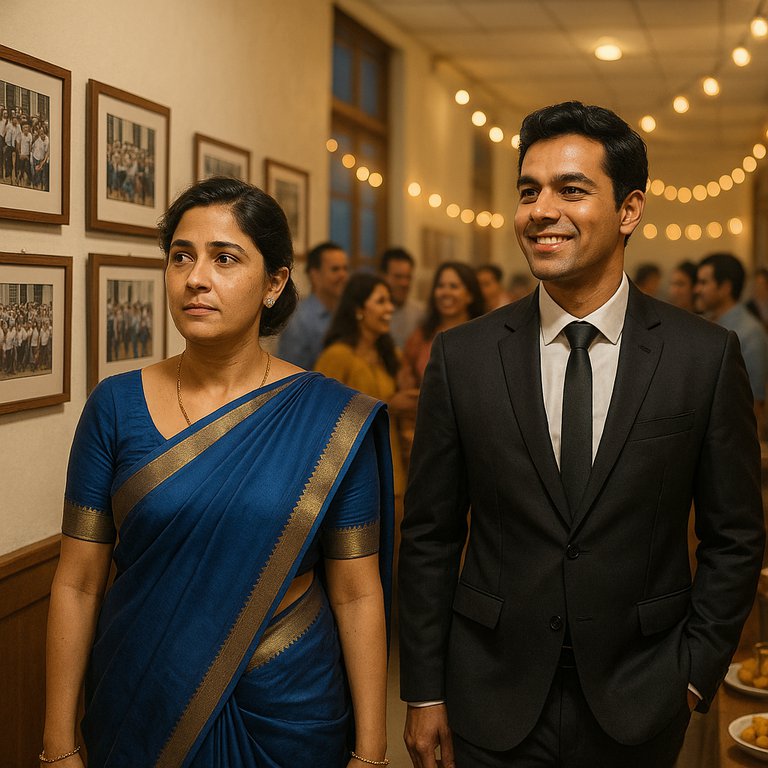
She found this out three weeks later when she saw him at a mutual friend’s birthday gathering — the kind where you don’t know half the people but you eat the cake anyway. He was standing near the window, a glass in his hand, talking to someone who was doing most of the talking. He had that quality of listening that some people have, where they are entirely still and you believe, genuinely, that you are the most interesting person in the room.
She was introduced to him by Priya, who said “this is Ranjan, he works in Ahmedabad but he’s here for a project” in the same tone she used for everyone, which was warm and slightly too loud.
“We’ve met,” Raanu said.
Ranjan looked at her for a moment. “The notebook,” he said.
“The notebook,” she confirmed.
Priya looked between them and decided this was interesting. She found somewhere else to be.
That evening they talked for two hours about nothing in particular — about the city, about whether filter coffee was better than chai, about a film he’d watched on the train that she’d read the book of. He had opinions about everything and stated them plainly, without performance, which she found either very confident or very honest and wasn’t sure which.
When she got home, her roommate asked how the party was.
“Fine,” she said.
“Just fine?”
“There was this person,” Raanu said, and then stopped, because she hadn’t decided yet what she wanted to say about him.
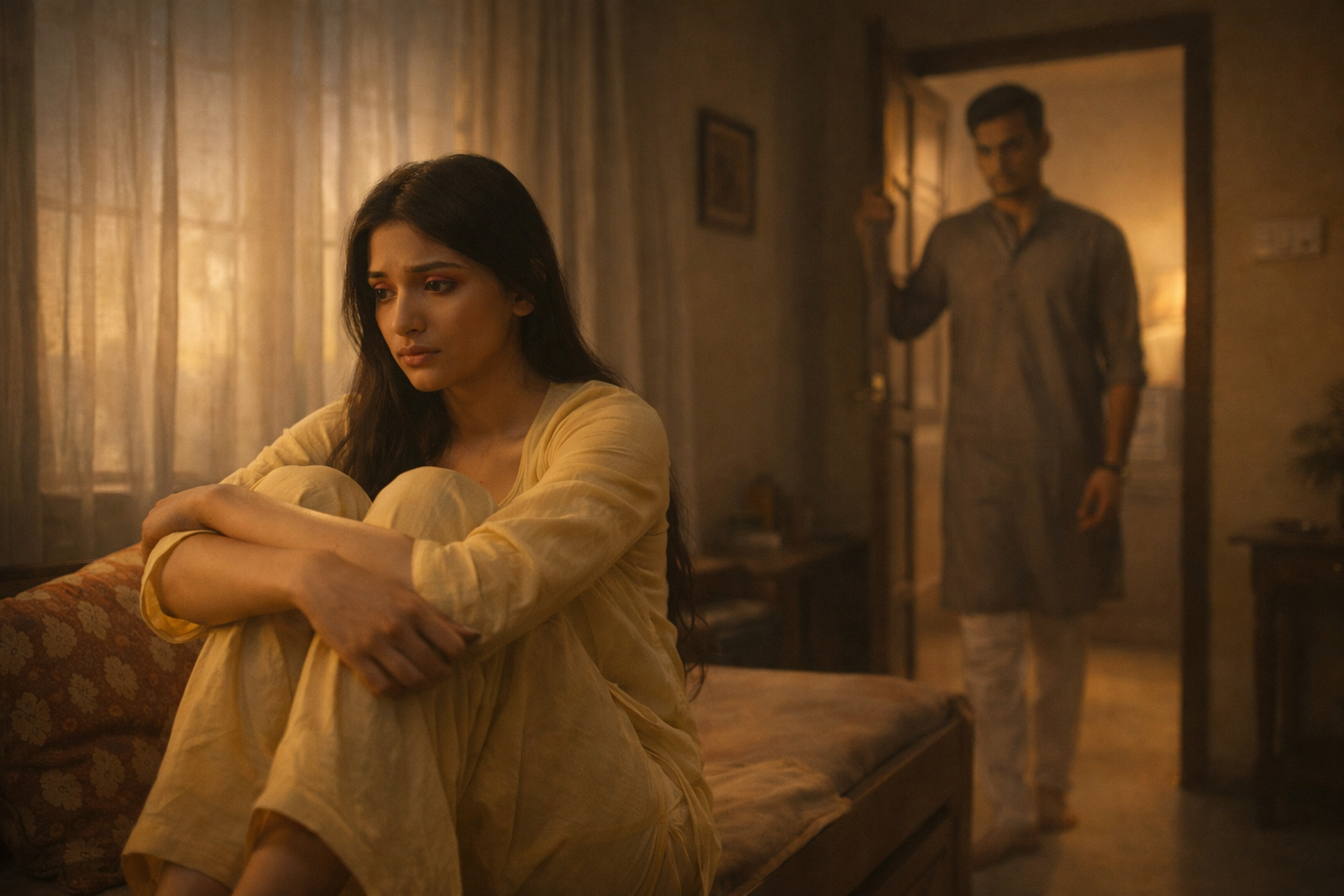 The quiet weight of something unspoken — Raanu, alone, evening
The next four weeks were what she later called the in-between time.
They had exchanged numbers at the party — Priya had orchestrated this cheerfully — and they texted occasionally. Not the way she texted her friends, which was a constant low hum of noise and jokes. It was quieter than that. He would send something thoughtful at odd hours; she would respond with either too much or too little. There was a conversation about an article he’d read about language and memory that lasted three days. There was a conversation about a rainstorm that lasted five minutes. There was no pattern to it and she tried not to read anything into that.
She tried not to read anything into most of it.
But she would be lying if she said she didn’t notice things. That he remembered small details she had mentioned once — that she drank coffee without sugar, that she always bought two books when she meant to buy one, that she found the rain more comforting than most people she knew. That when he was going to be away from his phone he told her, which was not a thing she had asked for and was not nothing.
She found herself looking forward to the messages and then being annoyed that she looked forward to them, and then looking forward to them anyway.
Her roommate said: “You’re very complicated.”
Raanu said: “I know.”
One evening she called him instead of texting.
She wasn’t sure why. She was standing on the balcony with a cup of coffee that had gone slightly cold, watching the street below, and she called him before she’d fully decided to. He picked up on the second ring.
“Hey,” he said. Just that.
“Hi,” she said. “I didn’t — I just wanted to talk. Is that okay?”
“Yeah,” he said. “It’s okay.”
She hadn’t planned anything to say. They talked for almost two hours. About his project and her thesis and a street in Bhubaneswar where there was a small bookshop that still had physical maps. About what it felt like to be far from home — he was from Ahmedabad; she was from a town two hours away that most people hadn’t heard of. About the particular loneliness of being in a city that isn’t yours.
At some point she was lying on the floor of her room with her feet against the wall, looking at the ceiling fan with its third-rotation tick, and she felt something in her chest settle, the way things settle after a long time of being unsettled.
She didn’t say anything about this to him.
She thought about it for a long time after she hung up.
 The rain said what they couldn’t — a moment of truth, monsoon
They fought in the rain.
It was July. The monsoon that year came in fast and stayed. Raanu had started to think that maybe, slowly, something between them was becoming something — not yet named, not yet claimed, but present, undeniable, the way a sound is present even before you can identify it.
And then he said, without warning, at a tea stall on a Tuesday evening, that he’d been offered an extension on his project. That he would likely be in Bhubaneswar until October at least.
She said: “Oh. That’s good.”
He looked at her. “Is it?”
She set down her cup. “What does that mean?”
“I don’t know,” he said, which was the first time she had heard him say that, and it unsettled her more than she expected. “I thought you’d say something.”
“I am saying something. I said that’s good.”
“That’s not —” He stopped.
“What do you want me to say, Ranjan?”
“I want to know what this is,” he said. “I think I’ve been clear about what I want. You haven’t been.”
She stood up. “I haven’t been clear because I’m not clear. I don’t just — I can’t just decide things and announce them like you do. Some of us need time.”
“I’m not asking you to decide tonight. I’ve never asked that. I’m asking you to say something real.”
They were outside by then. It had started to rain without either of them noticing. She had her hand pressed against his chest — she wasn’t sure when that had happened — and he was looking at her the way he looked at things he was trying to understand, quiet and entirely focused, and the rain was soaking through her kurta and she was furious and also not furious at all, which was worse.
“I’m scared,” she said. And she hadn’t known she was going to say it until it was out.
He didn’t say anything for a moment. Then: “Okay.”
“That’s all you have to say? Okay?”
“I’m scared too,” he said. “That’s not a reason to not do it.”
She took her hand back. She walked home alone. She didn’t cry. She sat in her room with wet hair and thought about the way he’d said okay — not dismissively, not gently, just straightforwardly, like it was a fact he’d already made peace with.
She hated that it made sense to her.
 Before a decision — Raanu, early morning, the letter she almost sent
She wrote him a letter.
Not a text. An actual letter, on paper, with a pen that ran out halfway through and she finished it with a different pen in slightly different ink. She wrote it at 5 a.m. on a Sunday, sitting at her desk with the window open and the early light still blue, and she wrote everything she hadn’t said — about the ceiling fan and the notebook and the phone call and what she felt in her chest when he picked up on the second ring.
She wrote: I think I have been trying to protect myself from you since the beginning. I don’t know what that says about me. It probably says something.
She wrote: The problem is I think about you when I’m not with you and I notice when I haven’t heard from you and I want to tell you things and I think these are all just different words for the same thing.
She folded it and put it in an envelope and addressed it and set it on her desk under her coffee cup.
She did not send it.
She went back to bed and lay there watching the ceiling fan begin to move as the morning heat built, and she thought: you know what you feel. You’ve always known. The letter was not about information. She already had all the information. The letter was about courage, and she hadn’t decided yet if she had it.
A jasmine she had bought from a vendor three days ago sat in a small clay cup on the desk, now mostly dried, still faintly fragrant. She watched the light change on the walls.
Then she picked up her phone.
She called him.
He picked up on the second ring — always the second ring, she had noticed — and before he could say anything she said: “I wrote you a letter. I’m not going to send it. But I wanted you to know it exists.”
A pause.
“What does it say?”
“Everything I should have said in the rain.”
Another pause, longer this time. Then he said: “I’ll be at Priya’s rooftop at six. Come if you want.”
“And if I don’t?”
“Then don’t,” he said. “But I’ll be there.”
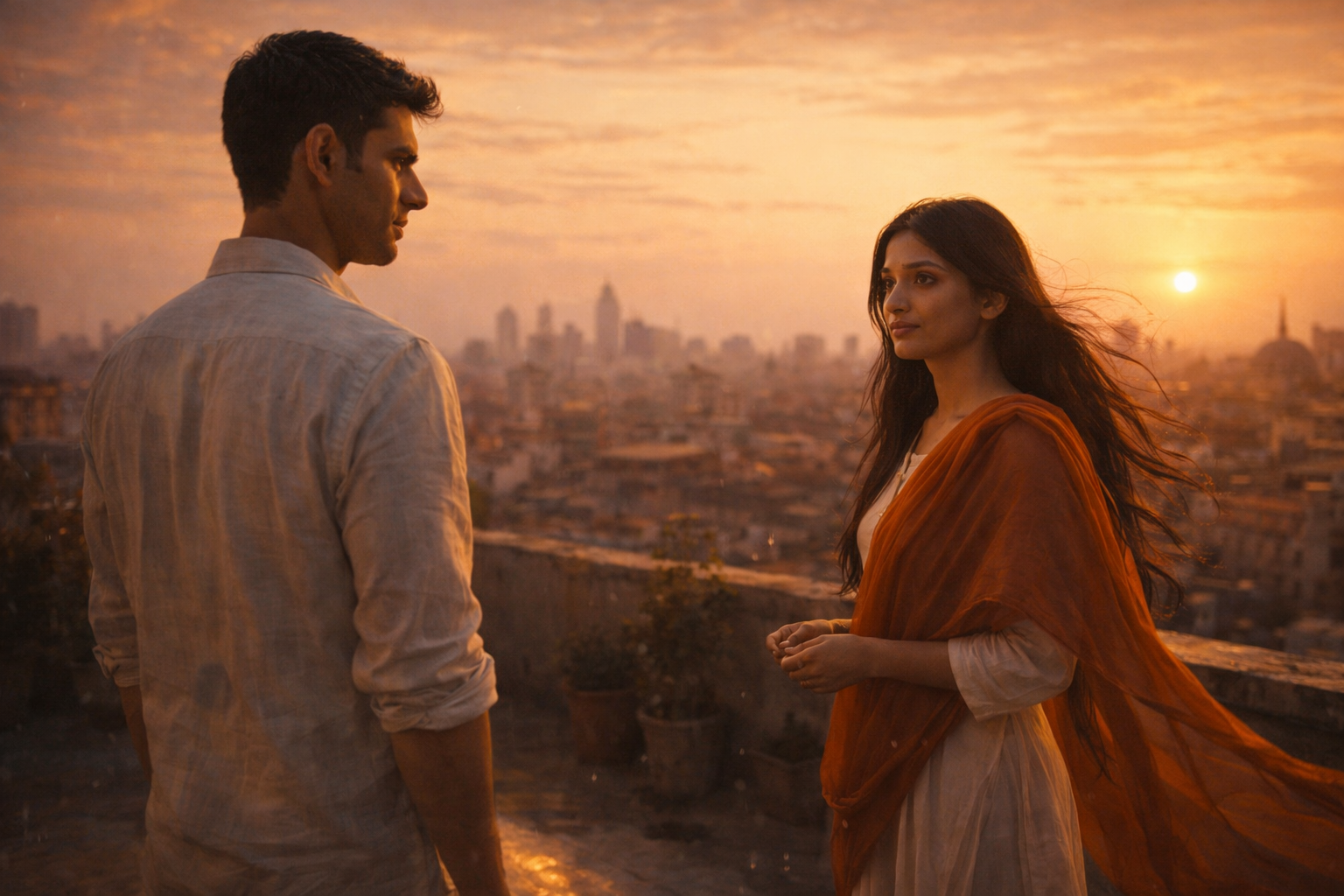 The rooftop at six — Raanu and Ranjan, golden hour, a silence that said everything
She came.
The sun was almost at the skyline when she stepped onto Priya’s rooftop, the city spread out below, orange and gold and the deep quiet blue of buildings in the far distance. He was already there, standing with his back half to her, sleeves rolled up, looking out.
He heard her come up and turned, and they looked at each other across the space between them — three feet, four feet, she was bad at distances — and neither of them said anything.
She thought about the letter on her desk. About the rain. About the ceiling fan and the second ring and the page that had folded in the fall.
She thought: here is the thing about mistakes. You don’t always know they’re mistakes while you’re making them. Sometimes you only find out what a thing was after it has already happened. After it has already changed you.
And sometimes what you thought was the mistake wasn’t the choice you made. It was how long you waited to make it.
She walked the last four feet.
“Hi,” she said.
“Hi,” he said.
The sun finished setting. The city lit up below them, a thousand small lights. He didn’t reach for her hand immediately; she didn’t say any of the things she’d rehearsed. They just stood there, close enough, looking at the same skyline, and after a while that was enough.
More than enough.
Some mistakes are worth keeping. Some of them — if you let them — become the thing you’re most glad you didn’t walk away from.
Reader Comments
Loading comments…
Leave a Comment