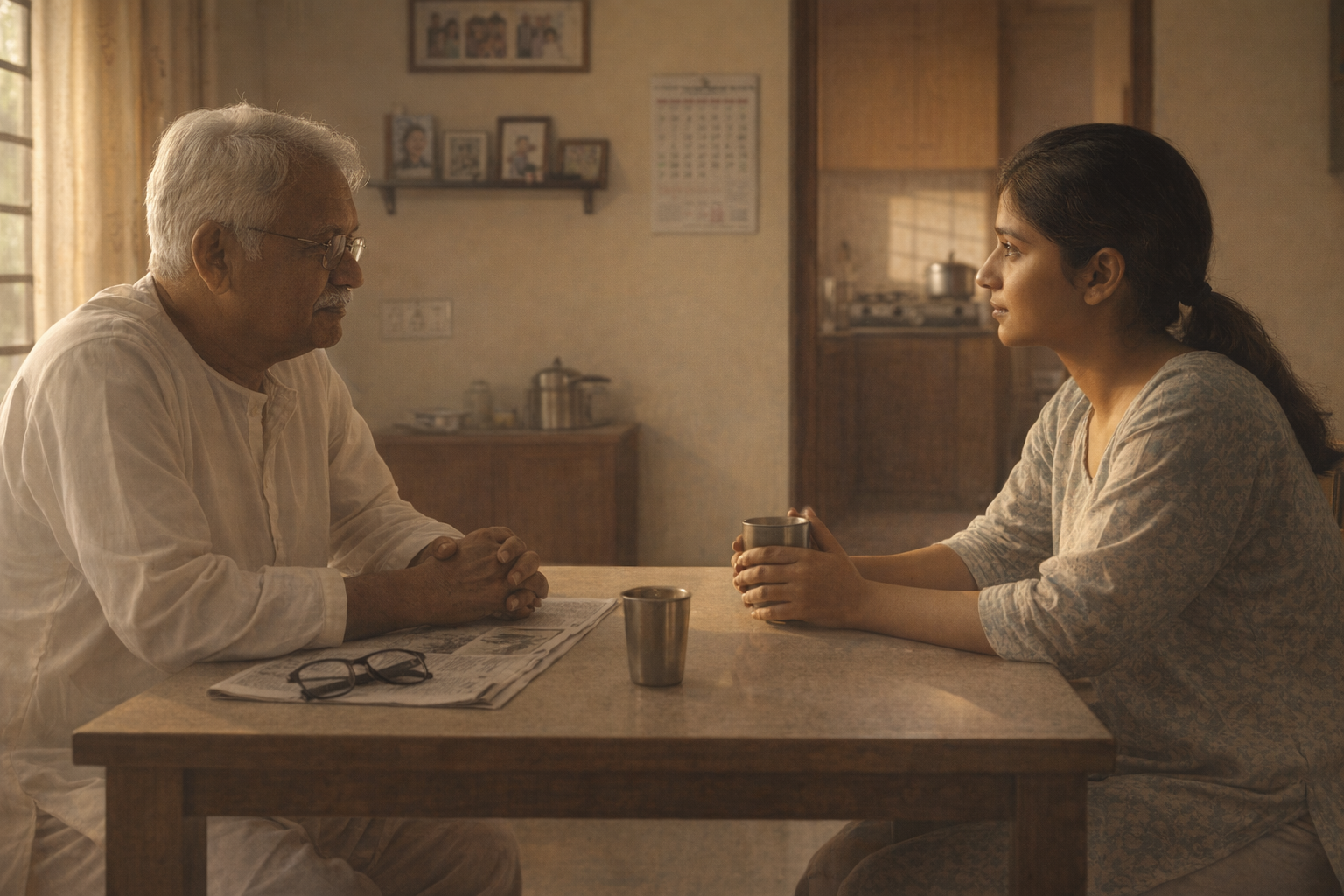
The right moment kept not arriving.
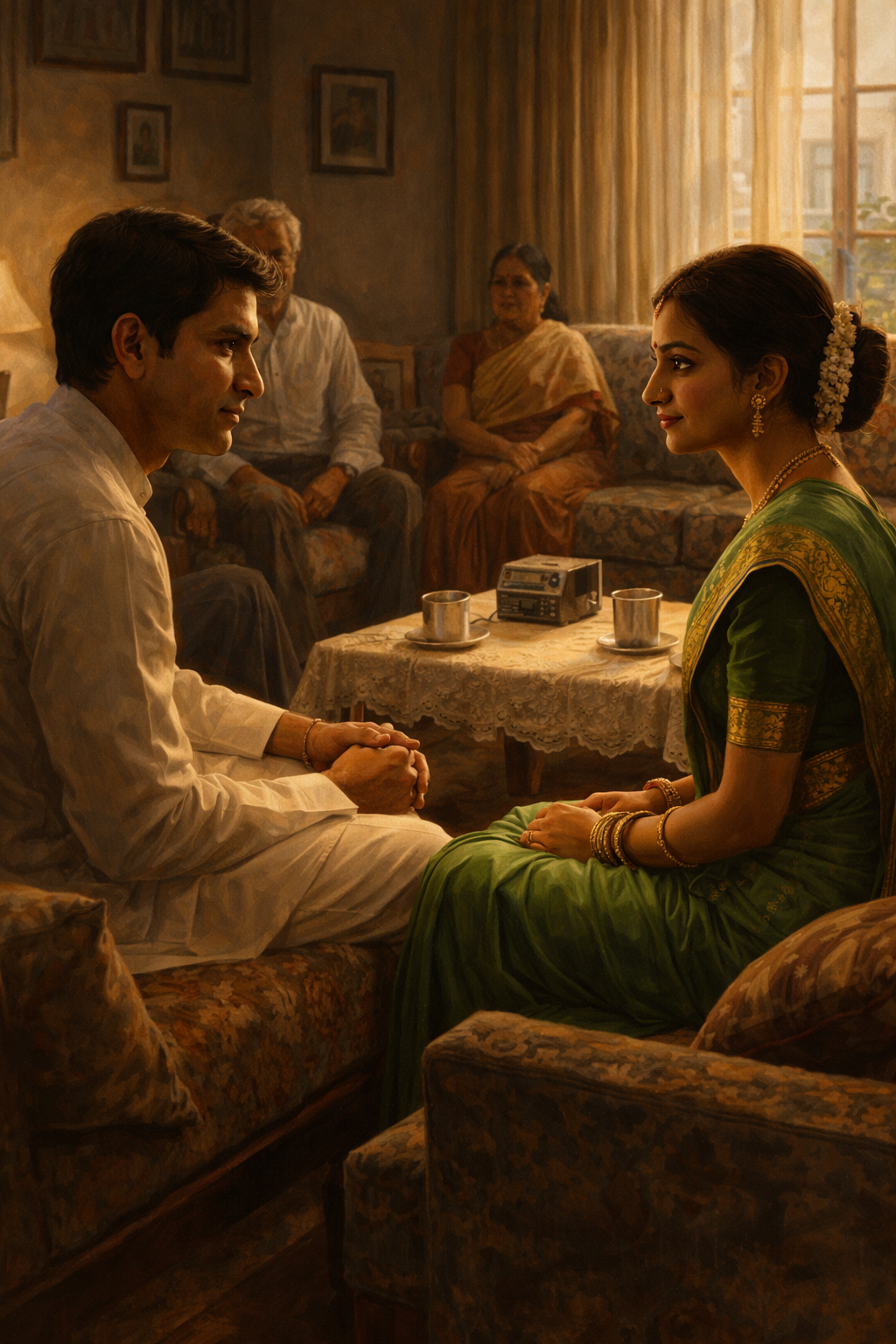
Her father had been making chai since six-thirty — a twenty-minute process involving the exact pressure on the ginger, the particular order of adding milk, a routine so unchanged in thirty years that Nandini could have done it with her eyes closed. She sat at the dining table with her phone face-down and watched him from the kitchen doorway and thought: not yet, not now, let him finish the chai first.
He brought two cups, sat across from her, and opened the newspaper to the sports page.
Not yet.
She had come home to Bhopal for the weekend ostensibly because it was her parents’ anniversary. This was true. It was also true that she had come home because she was thirty years old and she had been lying, softly and continuously, to the two people in the world she loved most, and she had decided on the train from Bangalore that she was done.
The chai was good. It was always good. Her father made it the same way every morning for thirty years — the same pressure on the ginger, the same order — and some mornings in Bangalore she would make herself a cup and it would taste almost right and she would stand at her kitchen counter with her eyes closed, working out what was missing.
She had never figured out what was missing.
She had met Abhinav in the second year of engineering.
Not dramatically. He sat two rows behind her in the Signals and Systems lecture and asked to borrow a pen on the first day because his had stopped working, and she gave him one, and she did not think about it again until three weeks later when he returned the pen and she noticed it had been refilled. He had bought ink for a stranger’s pen. She didn’t say anything about it. She thought about it for two days.
That was how it had started. Not with the borrowed pen, but with the refilled ink.
By the end of the second year they had been to every chai stall within two kilometres of the campus. By the end of the third year she had changed his contact name in her phone to Deepika — a college friend’s name, plausible, unquestionable — and felt, doing it, a small clean shame that she filed away alongside everything else she was filing away.
She told herself it was temporary. She would tell her parents soon. After graduation. After she had a job. After she was settled. After the timing was right.
The timing was never right. The years went by the way years do when you are busy and afraid — quickly, and all at once.
 The second year of engineering — the beginning of everything
Abhinav’s family was from Harda. His father had a small carpentry business. They were not poor — the business was steady, the house was pucca — but they were not Brahmin, and in Nandini’s family, which had never said this out loud and therefore believed it had transcended it, this was the thing that could not be undone.
She knew this the way she knew a lot of things about her family: not from anything said directly, but from the particular frequency of their silences, the specific way her mother had once described a colleague’s daughter’s marriage — “good match, same community, very sensible” — with the emphasis landing on same community the way emphasis lands when it is doing more work than the sentence admits.
She had carried this knowledge for eleven years.
Abhinav never asked her to hurry. She never asked him why he didn’t ask her to hurry. They had built, over eleven years, a life that fit entirely inside the space between what was real and what was admitted — a Bangalore flat they did not share, holidays logged as solo trips, his name in her phone still Deepika until three years ago when she changed it to his actual name and felt, doing it, not relief but a kind of defiance directed at no one.
 Three years ago — a small act of defiance directed at no one
Her father put down the newspaper. He picked up his chai and looked at her.
“You’re very quiet,” he said.
“I’m always quiet in the morning.”
“You’re more quiet than your usual quiet.”
He was sixty-two. She had not been watching him age, exactly — she had been watching something else, the newspaper, the chai cup, the middle distance — but she noticed now, in the specific light of a Bhopal morning in April, that his hair had gone fully white in the last two years, and that he was reading the newspaper with his glasses on, which he had not been doing the last time she was home.
She put her cup down.
“Papaji,” she said. “I need to tell you something.”
He looked at her over his glasses. Not alarmed. Just — attentive.
She told him.
Not everything at once. She started with the beginning — the second year of engineering, the borrowed pen, the refilled ink — because she wanted him to understand that it had not been reckless or sudden, that it was not a thing that had happened to her, but a thing she had chosen, slowly and repeatedly, for eleven years. She told him about Abhinav’s family, his father’s business, Harda. She told him the part she had been most afraid to say: that Abhinav had been waiting, patiently, without complaint, for eleven years, and that this patience was one of the things she loved most about him and also the thing she felt the worst about every day.
She stopped.
Her father was looking at his chai cup. She could not read his face. She had been trying to read his face for thirty years and she had never fully managed it — he kept his reactions somewhere interior, processed them in a silence that had always seemed, to her, either like wisdom or like distance, and she had never been certain which.
He was quiet for a long time.
Outside, the street was beginning its morning — the autorickshaw horn, someone calling for the doodhwala, the specific quality of Bhopal traffic at seven-thirty.
“He has been waiting eleven years,” her father said.
“Yes.”
“And in eleven years — has he been good to you? When things were difficult.”
She thought about this. She thought about the week she had lost her job in 2021, when Abhinav had taken two days off work and driven her around Bangalore to all the parks she liked because she couldn’t sit inside. She thought about her grandfather’s death and the train back to Bhopal and Abhinav at the Bhopal station, unexplained, with a bag of her favourite mithai from the shop near her college, saying nothing, just standing there. She thought about the small, undramatic constancy of eleven years.
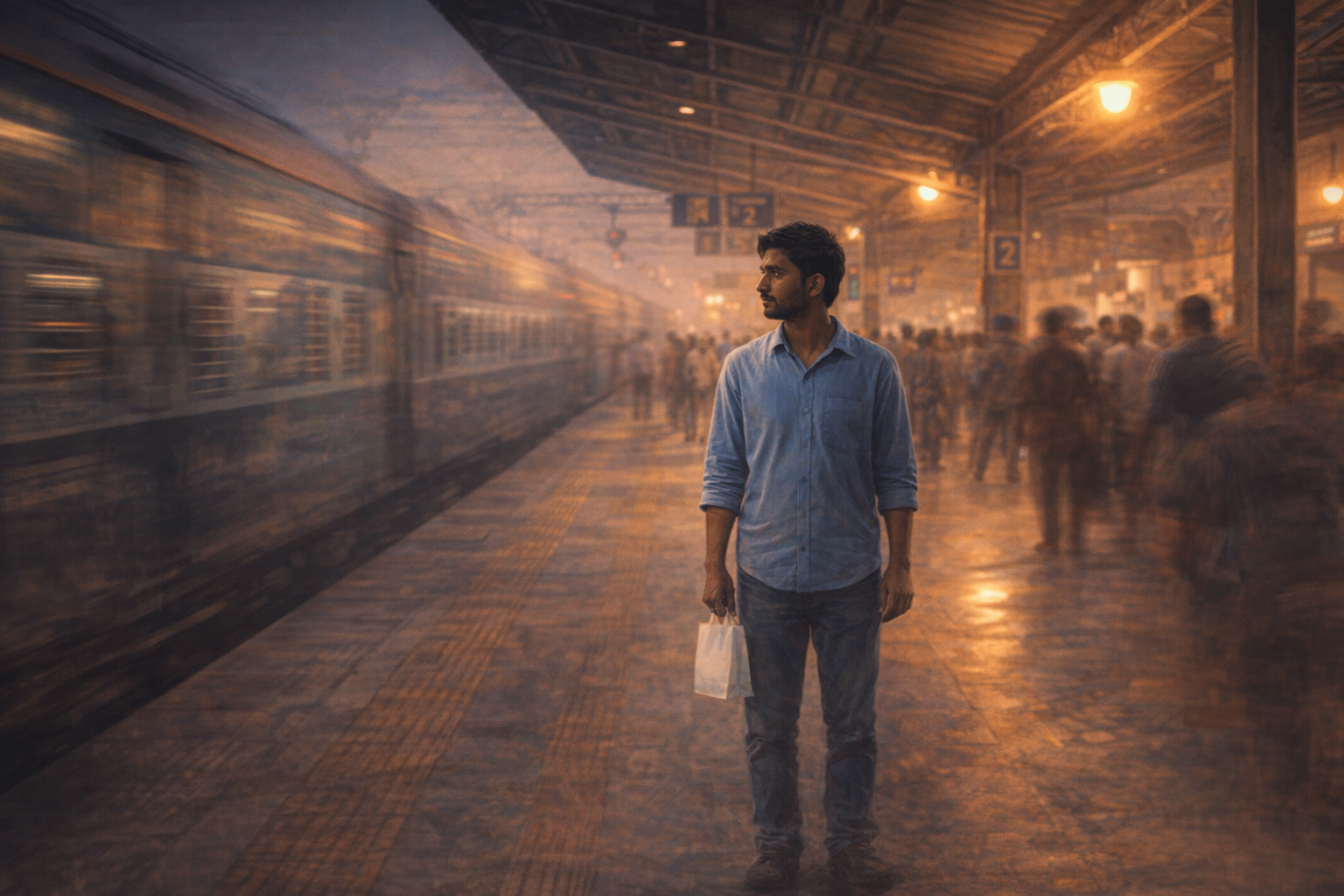 He showed up without being asked and didn’t make it a thing
“Yes,” she said. “When things were difficult, yes.”
Her father nodded. A small nod. The kind that means the real thinking is still happening.
“And you,” he said. “Are you good to him?”
The question caught her. She had not expected it.
“I try to be,” she said. “I have not always been fair to him.”
Her father looked at her. Not unkindly. The look of a man who knows that fair is a harder word than it sounds.
“Your mother will need time,” he said. “That is the truth. It will not be simple.” He picked up his chai. “But I have known you for thirty years. I know what kind of person you are. If you have chosen someone for eleven years — not in a month, not in a year, in eleven years — then I trust your judgement.”
He paused.
“Caste is people’s fear of the unfamiliar dressed up as tradition,” he said. “I have thought about this for a long time. I don’t want to be afraid of things that don’t deserve my fear.”
He said it simply. Not as a speech. As a man saying something he had already decided about himself.
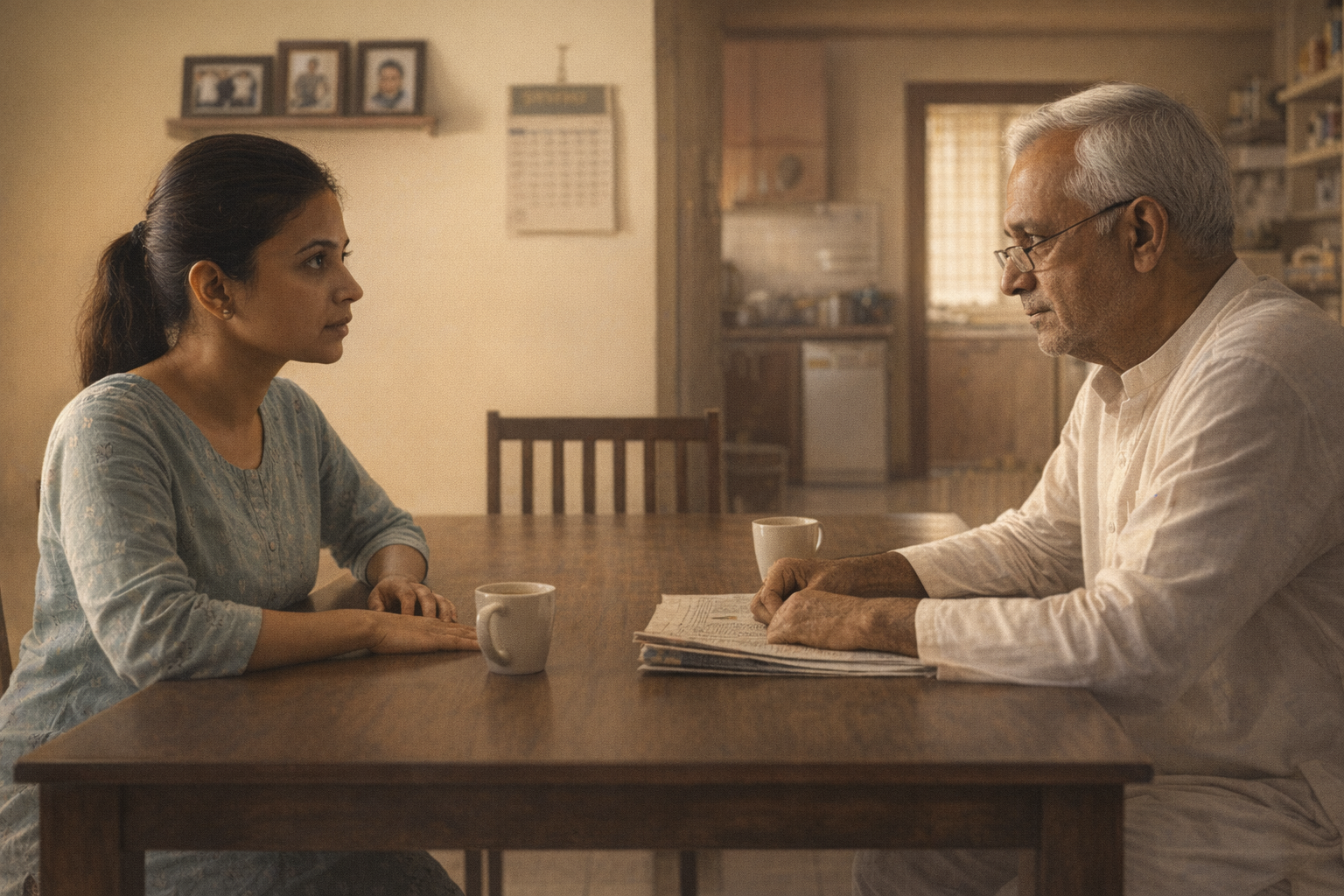 The conversation she had rehearsed a thousand times
She called Abhinav from the terrace an hour later.
He picked up on the second ring, the way he always did.
“How’s home?” he said.
She stood looking out at the Bhopal morning — the water tower in the distance, the neem trees on the road below going dusty in the April heat, a kite circling something invisible above the colony. She had stood on this terrace a hundred times. She had made a hundred calls from this terrace in eleven years and described it to him and he had listened and she had thought: someday I will bring you here, someday, not yet.
“I told him,” she said.
A silence on the line.
“And?” he said. His voice very still.
“And he asked if you had been good to me when things were difficult.”
She heard him exhale. Not dramatically — the specific, quiet exhale of a man who has been holding something for a very long time.
“What did you tell him?” he said.
“I told him yes.” She paused. “He also asked if I had been good to you. I told him I hadn’t always been fair.”
Abhinav was quiet for a moment.
“Nandu,” he said. His name for her. The one from the second year of engineering, from the two of them at a chai stall at nine PM with Signals and Systems notes between them, from a hundred unremarkable hours that had added up, without announcement, to a life.
“Don’t cry,” she said.
“I’m not crying,” he said.
She looked at the kite above the colony, circling.
“He wants to meet you,” she said. “When you’re ready.”
Another silence. Shorter this time.
“I can come next weekend,” he said.
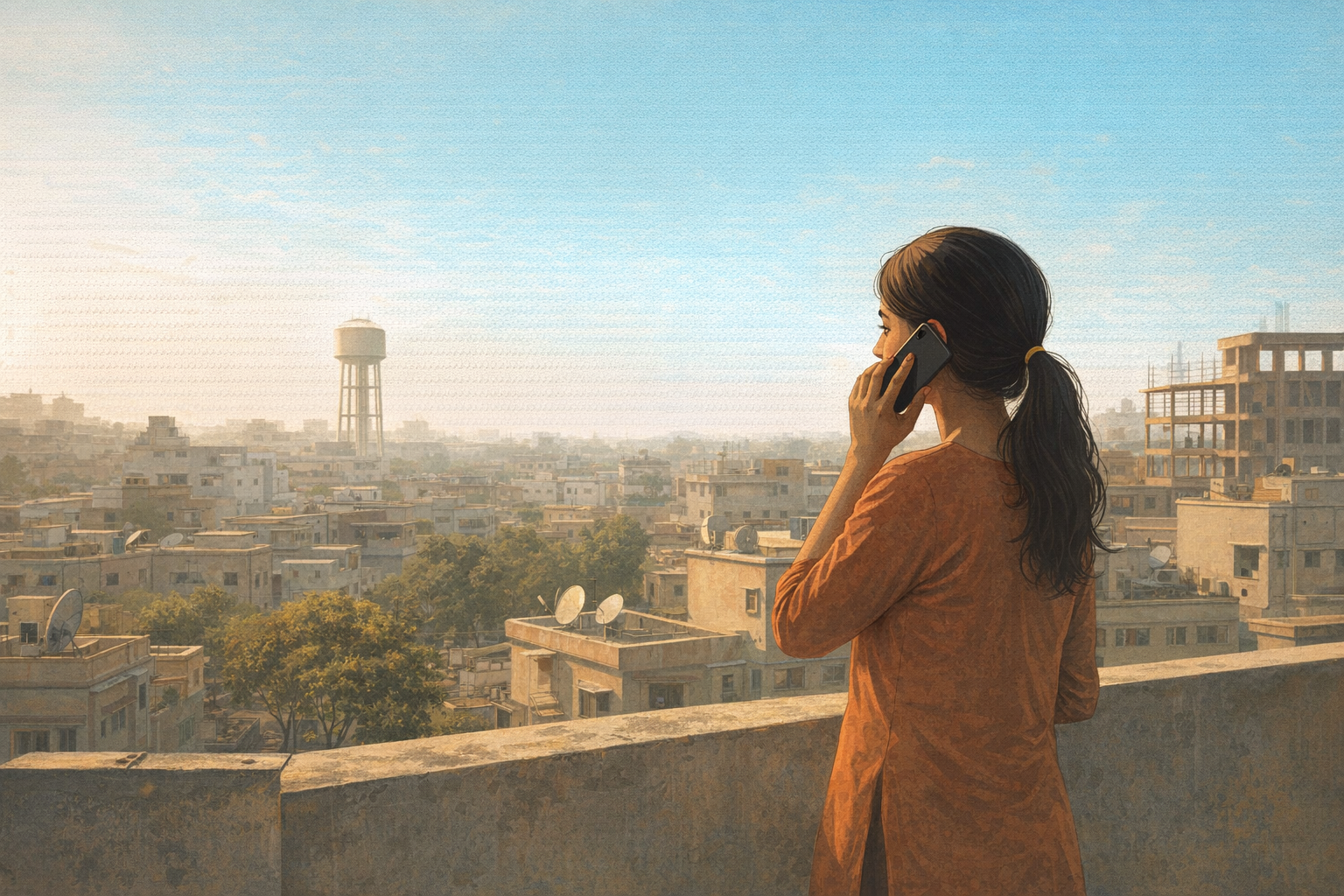 One person and an open sky and a phone call that changed something
She went back inside. Her father was at the kitchen counter, making a second round of chai, the same way he always made it. Her mother would be up soon. That conversation would be its own thing — harder, slower, requiring more time, as her father had said. She knew this. She was not under any illusion that everything was resolved.
But something had shifted. Not everything. Just the weight of the thing she had been carrying.
She sat back down at the dining table. Her father brought two cups and set one in front of her without comment.
She took a sip.
She still couldn’t identify what it was that made his chai taste different. She had been trying to figure it out for thirty years. She did not think she was going to solve it today.
Some things you just accept.
Reader Comments
Loading comments…
Leave a Comment