“Maharaj.”
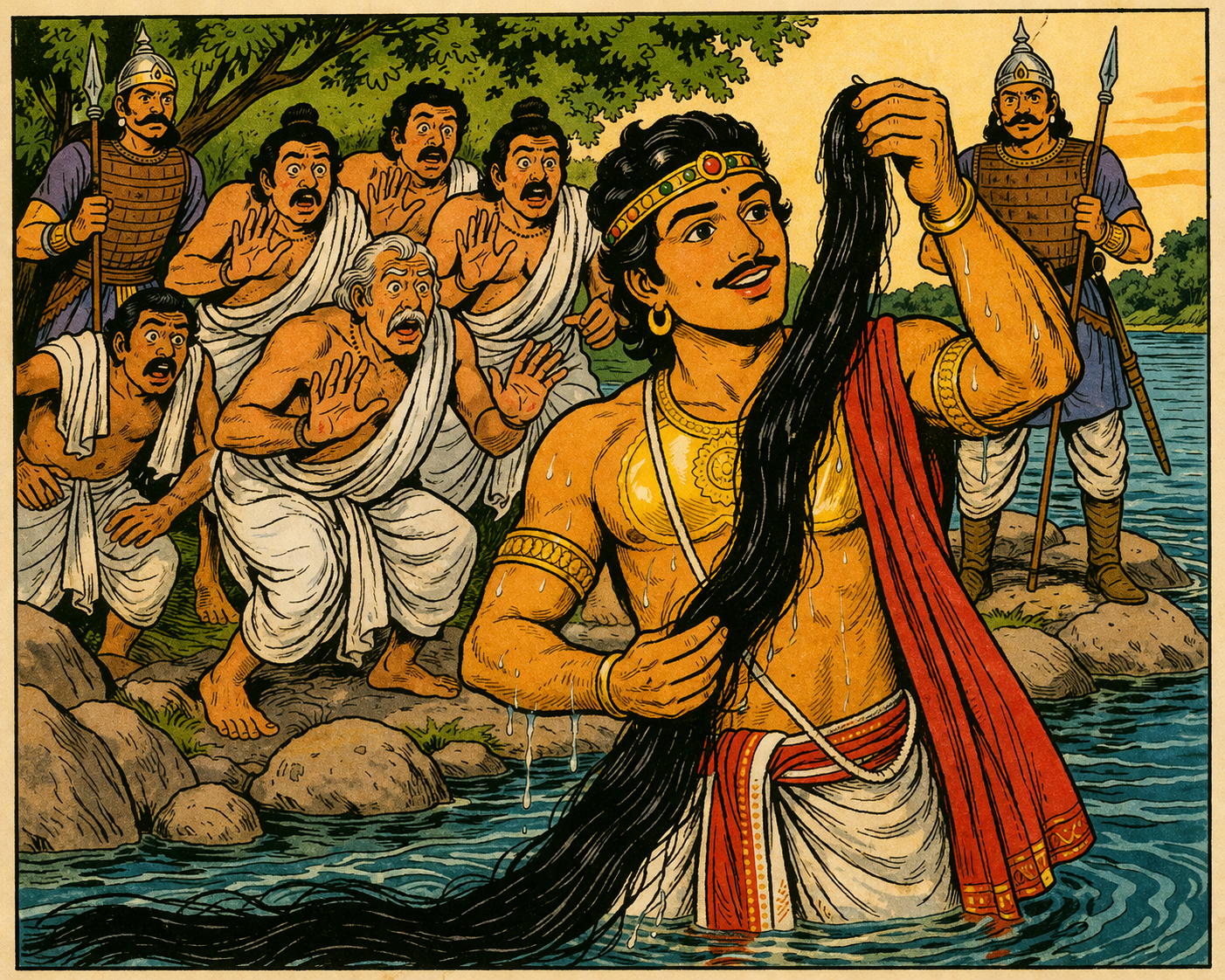
The word came out as barely a whisper. Dhanupani, the king’s chief sevayat, had been in royal service for thirty years. He had stood beside three kings in four battles. Nothing made him flinch.
But this made him flinch.
King SuryaVamshi had just risen from the cold green waters of the Mahanadi, water streaming from his arms and shoulders, and there — stuck across his face from forehead to chin — was a strand of hair. One single strand. Black as monsoon clouds. And so long it still trailed in the river behind him, a full arm’s length and more, moving with the water’s slow current.
The six guards at the bank looked at each other. One of them actually stepped back.
The king reached up and peeled the strand from his face slowly, carefully — the way you handle something fragile. He held it up against the afternoon sky.
And smiled.
Not a polite smile. Not a kingly smile. The smile of a man who has just found something completely unexpected and found it wonderful.
 At the banks of the Mahanadi near Manamunda — the strand that started everything
“How long,” he said quietly, more to himself than anyone.
Dhanupani cleared his throat. “Maharaj, I can remove it—”
“You will not touch it.” Still quiet, but the kind of quiet that means the decision is already made. “Bring me a clean cloth. Fold it inside carefully.”
The sevayat obeyed. The guards exchanged glances. Around them, the Mahanadi moved on indifferently — the great river at Manamunda carrying its silt and its secrets south toward the sea, unbothered by the king standing in it holding a strand of someone’s hair like it was made of gold.
He measured it against the ground. Twelve feet. Two dandas, as they counted length in those days — each danda the length of six feet.
Somewhere upstream — between here and the hills where the Mahanadi came down from — there was a girl whose hair was twelve feet long.
He had never seen such a thing. He had attended the courts of three kingdoms, seen queens draped in silk and jewels and ceremony. But no one arranged twelve feet of hair as decoration. This was simply how she lived. The river was her bathing place and her hair floated through it freely, and she didn’t know that on this particular afternoon it had crossed the path of a king.
He wanted to find her.
He wanted — if he was honest with himself, and at twenty-three, sitting alone at a river at dusk after three days of battle, a person tends toward honesty — to make her the queen of Kosala.
Back in the capital, the palace darbar was long and high-pillared, with sandalwood oil burning in the stone lamps. The king stood before his Senapati and court and made his announcement.
“She lives on the Mahanadi bank. Upstream from Manamunda. That is all we know.” He held up two fingers. “Two dandas of hair. Someone in this kingdom must know of her.”
Senapati Vikramaraju — a broad man with a scar across his left eyebrow and a voice like gravel — nodded. He had led armies across three river systems. Finding one girl on a riverbank was not a complicated problem.
“Divide the upstream stretch into sections. Three groups. Work from Manamunda northward. Ask the village headmen, the fishermen, the river traders.”
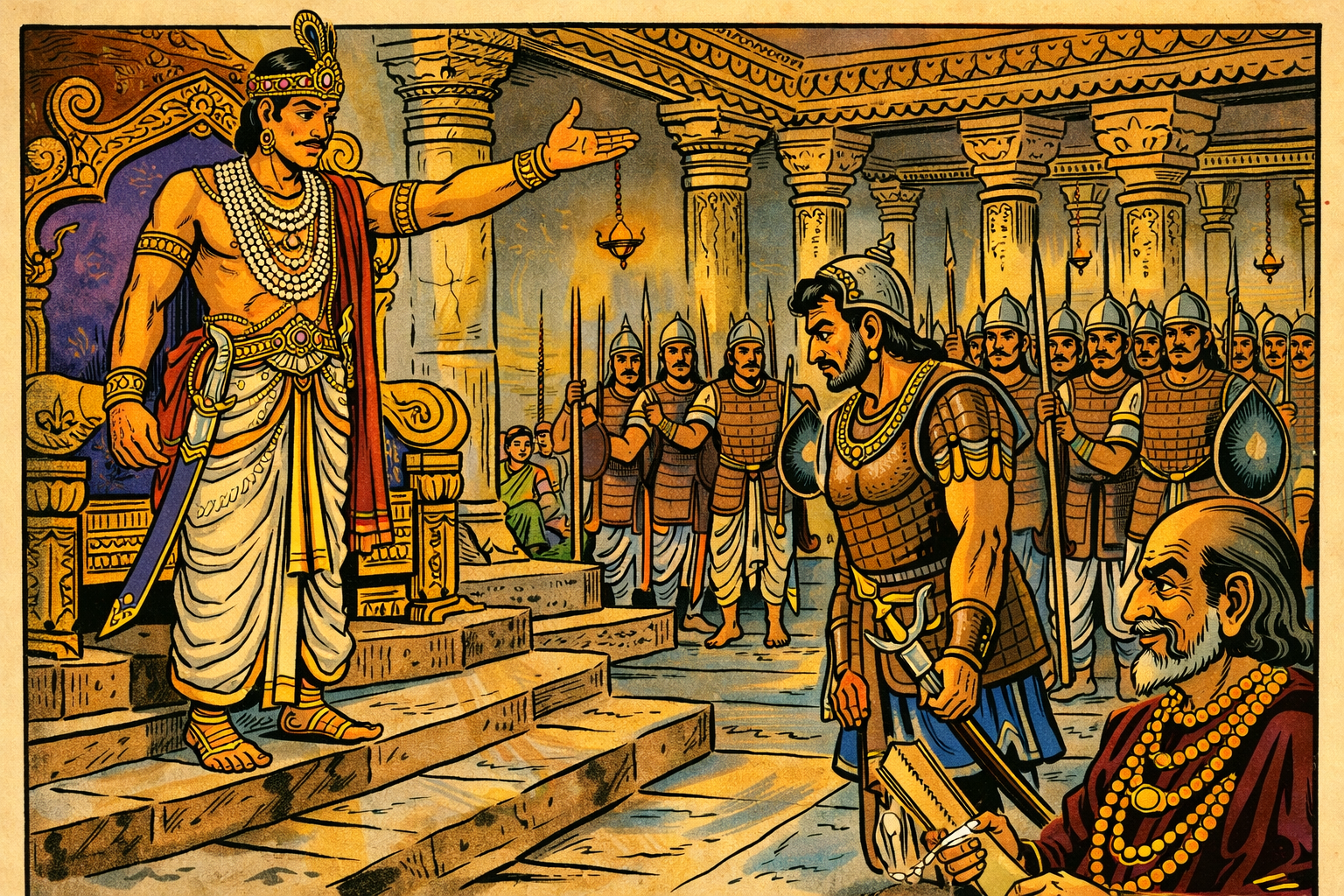 The darbar of Kosala — a search is ordered, and a scheme begins
The darbar murmured with approval. Soldiers began calculating their routes.
In the third row, seated behind the senior ministers, Minister Bruhananda said nothing. He adjusted his uttariya. He tapped his palm-leaf scroll twice against his knee. His smile was warm and interested, as it always was.
His eyes, beneath their heavy lids, were thinking very fast.
He had a plan of his own.
Bruhananda had spent twenty years collecting power in the Kosala court the way some men collect land — quietly, steadily, always looking for the next piece. He had a niece — the daughter of a distant cousin — named Panchakanya. If Panchakanya became queen, the minister’s influence would sit at the center of the palace for the next thirty years. He had been waiting for the right moment.
And now the king wanted to marry a river girl. That would not do.
He called his Gudhapurushas — his network of secret watchers, trained in the old ways of the Arthashastra — that same evening in his private courtyard. Five of them, shadows in the lamplight.
“Find this girl before the Senapati’s men do,” he said. The rest of the sentence he left as silence.
The Gudhapurushas understood silence. They left before he finished his tea.
They found her in eleven days.
Her name was Shrutisukala. She lived with her elderly father near a village called Deulpada, three days upstream from Manamunda. The villagers knew her well. She was the girl who went to the river every morning when the mist was still on the water, and her hair — her impossible, astonishing hair — floated behind her on the surface as she bathed, so long that the women washing clothes upstream sometimes had to step aside to let it pass.
The minister’s men brought her to his house at night, quietly. When Bruhananda saw her, even he was briefly silent.
The hair was real. It coiled on the floor around her feet. In the lamplight it was like black silk, like something from an old story. Even the Gudhapurushas were staring at it.
He recovered quickly. He called his Napita — the royal hair-worker Suvarnakar, who had served the palace for two decades — and gave his instructions.
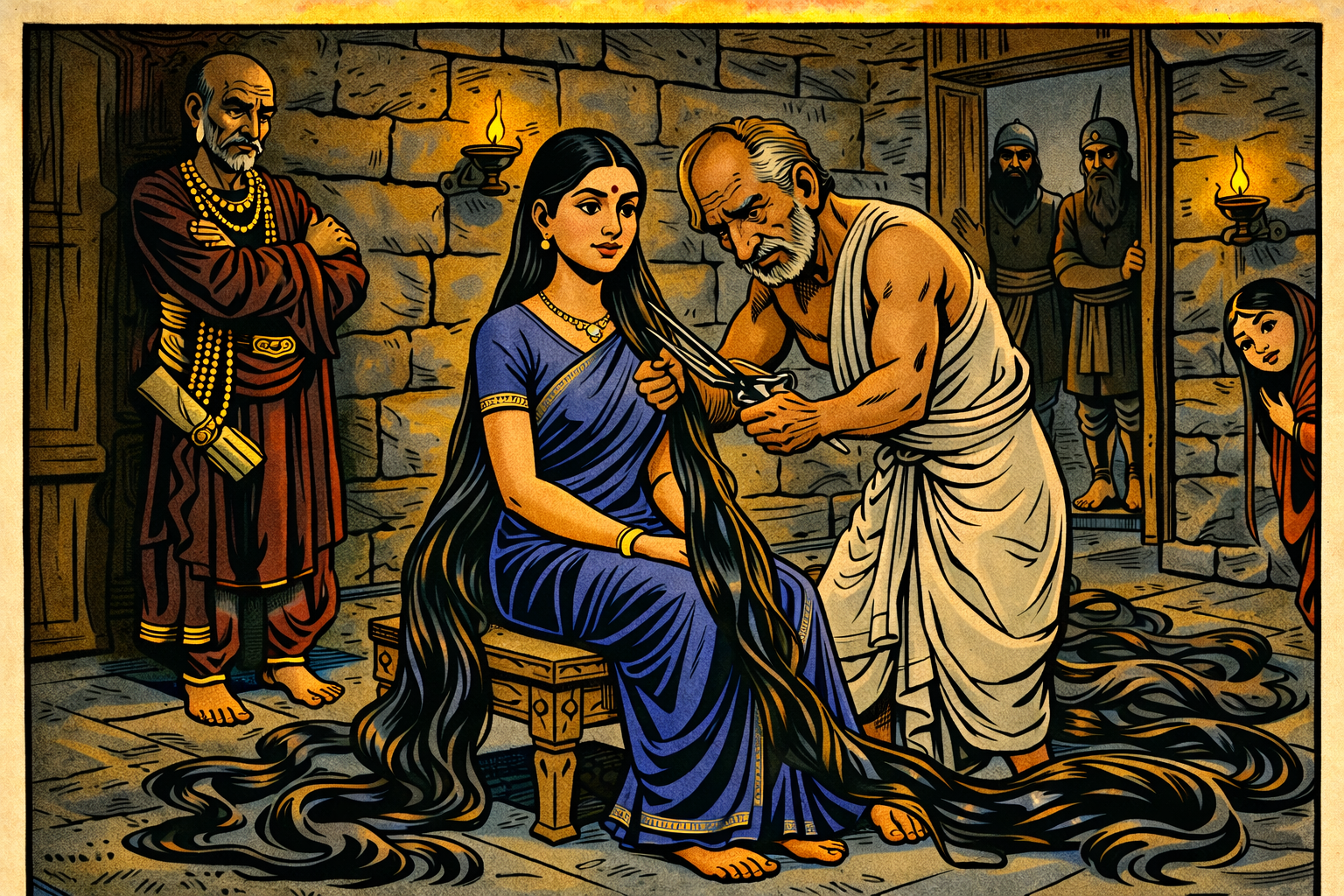 The minister’s house, late at night — the cruelest part of the plan
Shrutisukala understood what was happening. She looked at Bruhananda without fear, which irritated him greatly.
“Your hair will be cut,” he told her.
“It will grow back,” she said.
He had not expected that answer.
Suvarnakar worked through the night with great skill and great unhappiness. The twelve feet of hair were cut, washed, dried, and shaped into an elaborate hairpiece — a false plait attached to a base of sandalwood clips and silk threads that could be pinned firmly to shorter hair. It was extraordinary craftsmanship used for an ugly purpose.
Shrutisukala was moved to a locked room in the minister’s lower house.
In the morning, Panchakanya sat before the Prasadhika — the royal cosmetician — and the false hair was pinned and arranged and dressed. When the work was done, Panchakanya looked at herself in the polished copper mirror and saw something she had always wanted: importance.
She did not ask where the hair had come from.
The minister walked into the darbar the next morning with the girl at his side and the expression of a man delivering something priceless while trying to look modest about it.
“Maharaj,” said Bruhananda, with his deepest bow. “Your servant has searched without rest. This is the girl.”
The king descended the dais steps. He walked toward her slowly — looking at the hair, then at her face, then at her eyes. Something in him shifted, the way a compass shifts near iron. The reading didn’t settle.
He looked at the minister. Bruhananda smiled his careful smile.
“She will be received with honour,” the king said. “Prepare the royal quarters.”
The darbar erupted in celebration. The Sutradhara — the royal herald — called out the announcement. Musicians began. Flowers were ordered. The whole of Kosala seemed to go into a festival.
But in the middle of it all, the king stood very still and watched the back of Panchakanya’s head as she was led away — and felt something he couldn’t name.
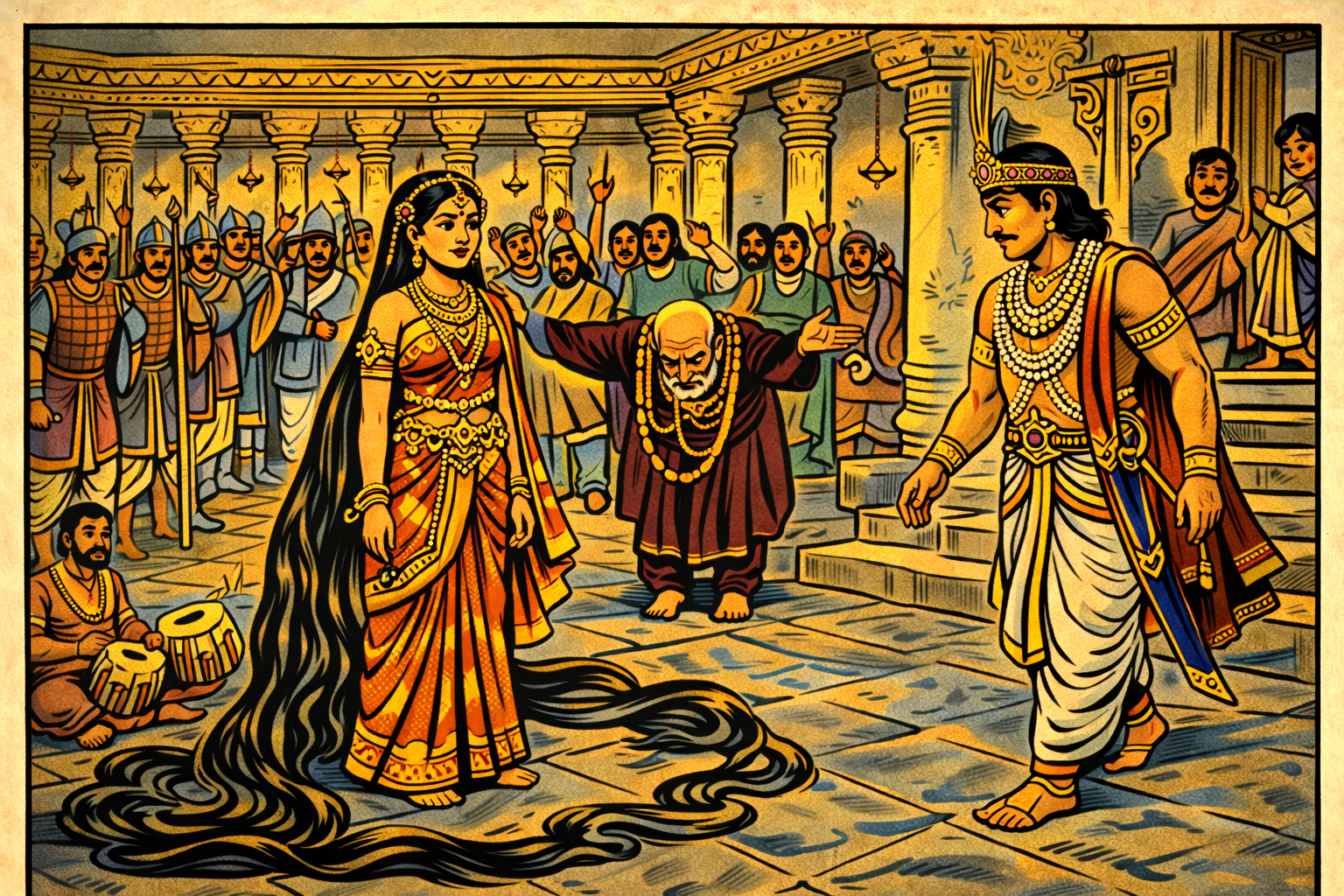 The darbar full of celebration — but the king’s eyes hold a question no one is answering
The days that followed were full of wedding preparations and empty of something he couldn’t identify. The palace cooks worked through the night. Merchants brought silk from Varanasi, flowers from the hills. Everything was as it should be.
And yet every evening the king sat alone and tried to connect the image in his mind — the girl of the river, whose hair had found him at Manamunda — with the face of Panchakanya. And every evening it didn’t work.
His mother noticed.
Rajmata Sandyadebi had been reading her son since he was three years old. She found him one evening on the stone parapet of the eastern balcony, staring at the river in the distance, and sat beside him.
“Speak,” she said.
He told her everything. The hair at the river. The image he had carried all these months. And the girl before him now — adorned and correct — who gave him the feeling of looking at a portrait rather than a person.
“Something has gone wrong somewhere,” he said. “I feel it, Aai.”
She stood. She straightened her saree.
“Leave it with me,” she said.
Kusuma had been the Rajmata’s personal maid for sixteen years. She was not given to drama, which was exactly why she was trusted. The Rajmata told her only: watch the girl carefully, and tell me what you see.
Kusuma watched for three days. On the third morning, just before Panchakanya’s bath, she saw it — set carefully on the stone ledge beside the bathing area: sandalwood clips, silk thread ties, elaborate and unmistakable. The apparatus for attaching false hair.
She came to the Rajmata that evening.
“The hair,” she said quietly. “It is attached. It is not hers.”
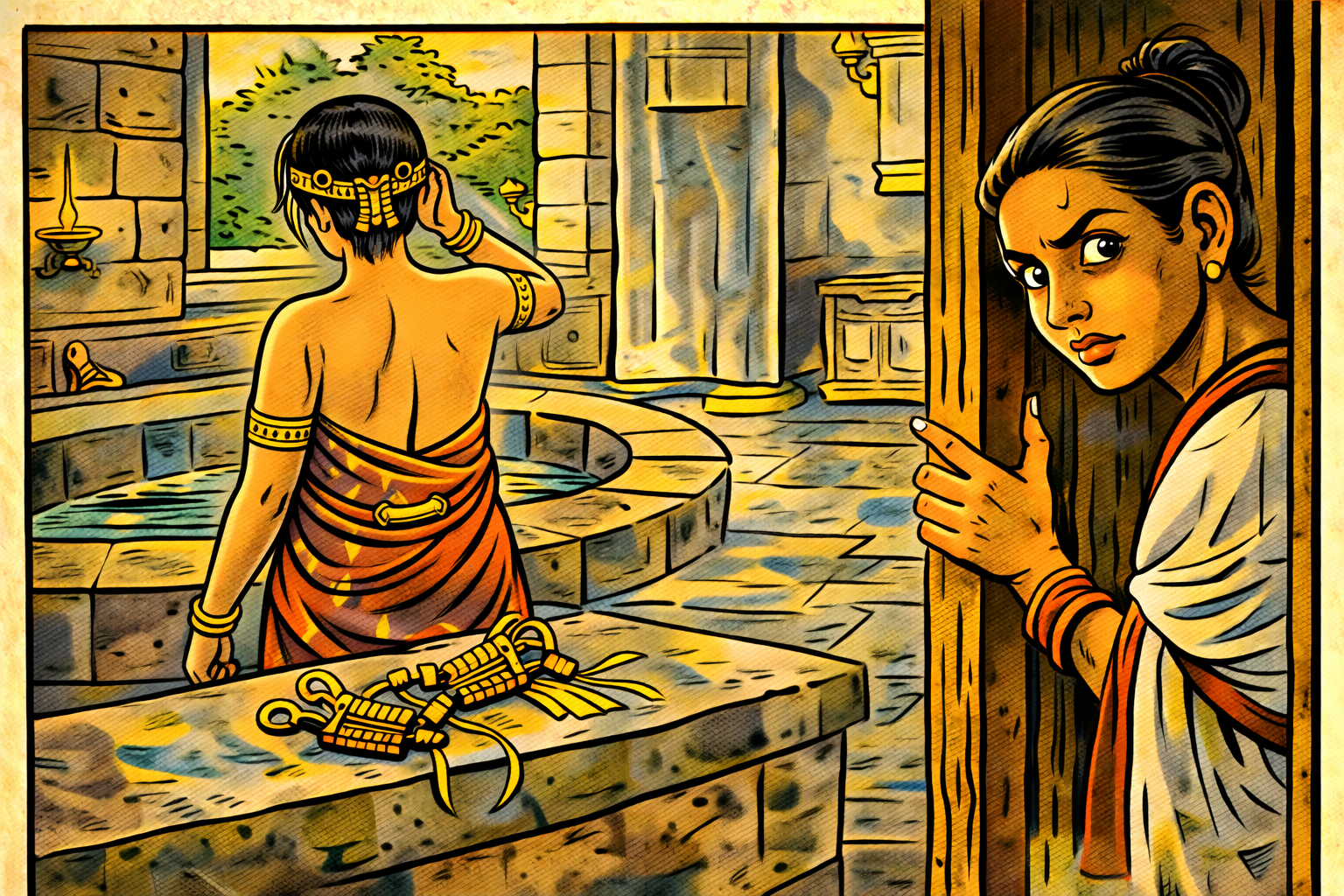 One sharp-eyed maid, one set of sandalwood clips — and the truth comes undone
The summons to the darbar came without warning.
Bruhananda walked in to find the king standing — not seated, which meant something had changed. He saw Panchakanya at the side of the hall, the false hair half-loose, the clips visible at her temples. He saw Kusuma standing near the Rajmata. He saw the Senapati with guards at the door.
“Speak the truth,” the king said. His voice was very quiet. “All of it.”
For a long moment the minister stood. Then Bruhananda — who had bent every rule of Kosala for twenty years — made a calculation. The truth, in this room, was safer than a lie.
He spoke. All of it. Shrutisukala. Deulpada. The Napita’s work through the night. The locked room.
The darbar was silent.
“Bring her,” said the king.
She came in without ornament. Her hair was short now — growing back from the cut, falling just past her shoulders — still glossy, still beautiful, but nothing like the twelve feet that had once trailed the river. She wore a simple white cotton saree. She walked to the center of the darbar and stood without looking around.
She looked at the king.
And the king — for the first time in all the history of the Kosala darbar — came down from the dais completely. He walked across the floor, past the senior ministers, past the Senapati, past his mother. He stopped before Shrutisukala and lowered himself to one knee.
Every person in that hall stopped breathing.
“I am sorry,” he said, looking up at her. “For what was done to you in my name.”
Shrutisukala looked at him for a long moment. Her expression didn’t change — that same quiet steadiness she had shown even in the minister’s locked room, even when the scissors moved through her hair.
Then she said: “Will you be a just king?”
“I will try to be,” he said. “Every day.”
She was quiet for another moment, as if measuring something. Something she found satisfactory.
“Then yes,” she said.
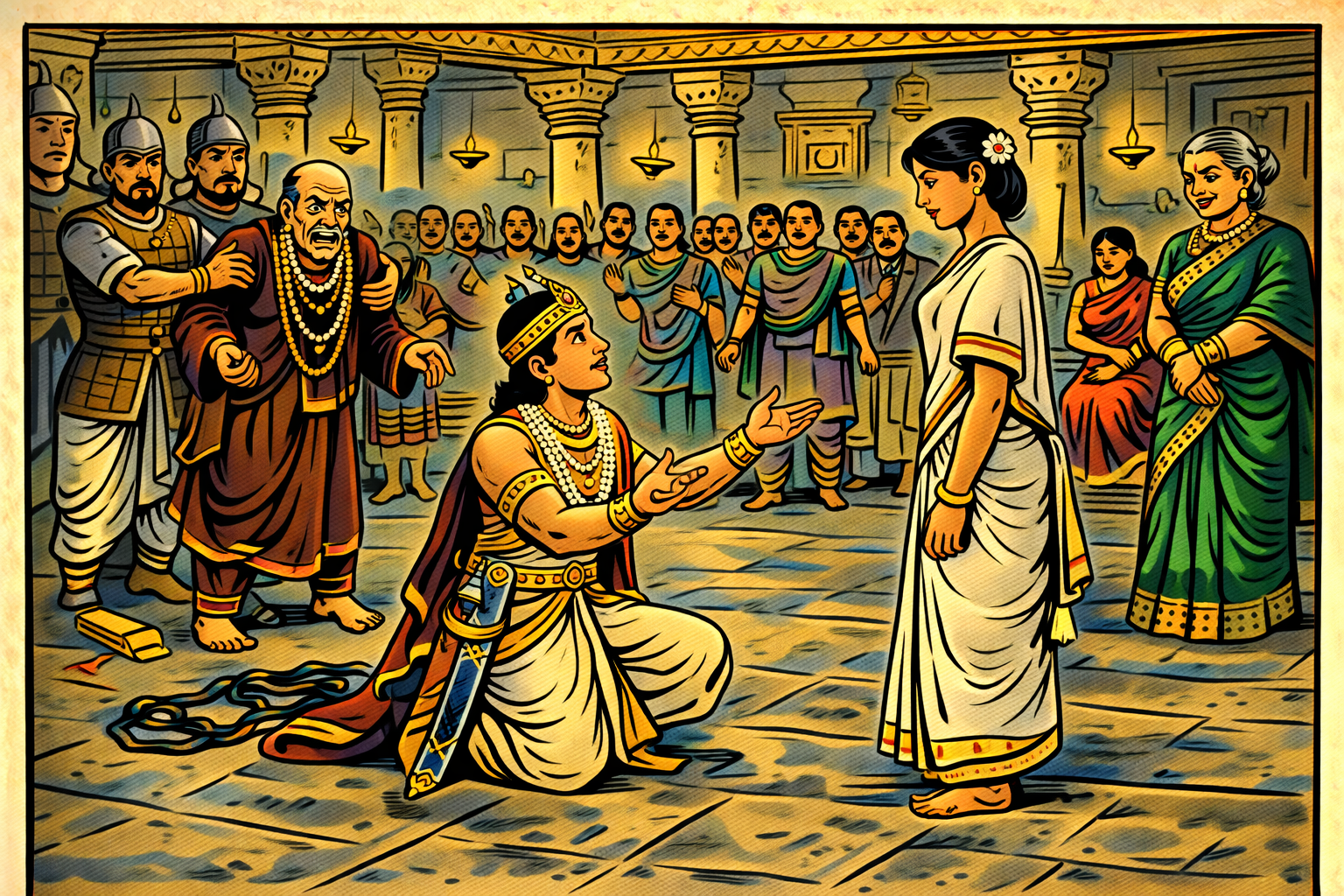 A king on one knee — and a kingdom that would never forget this day
Minister Bruhananda was escorted from the darbar that same hour, stripped of his title and lands, and sent into exile before the week was out.
The wedding was quiet and without show — the opposite of everything that had been planned before. Just the sacred fire, the priests’ chanting, and the two of them, and the Mahanadi visible in the distance from the palace’s high window.
Shrutisukala became the queen of Kosala. In time, people who passed through the kingdom noticed something unusual — the queen was seen in the villages, listening to farmers and the women who drew water from wells. Reforms came slowly and surely: better grain storage, wells dug in three dry districts, a fund for the daughters of poor families. She understood need the way someone understands it when they have lived simply themselves.
And year by year, season by season — her hair grew.
Slowly at first. Then longer. By the third harvest festival it was past her waist again. By the fifth year it reached the floor. And by the time the first of their children was old enough to run through the palace gardens, Shrutisukala’s hair trailed behind her once more — twelve feet of it, black as monsoon clouds, moving with the breeze of the Mahanadi.
The river had given it back to her.
Two dandas. Every strand.
This story is set in the ancient Kosala Rajya — the historic kingdom of western Odisha, which flourished around the 5th century CE in the region of present-day Sambalpur, Bargarh, and Subarnapur districts. The Mahanadi, the great river of Odisha, flows through this land as it has for thousands of years.