Long ago — long before the rivers had names, long before the villages had songs — there was a great jungle. It stretched from the foothills of the mountains all the way down to where the sea touched the land. In that jungle lived every kind of plant the earth had thought to make: tall, short, climbing, creeping, fragrant, fierce, sweet.
But the jungle had a king.
His name was Banyan.
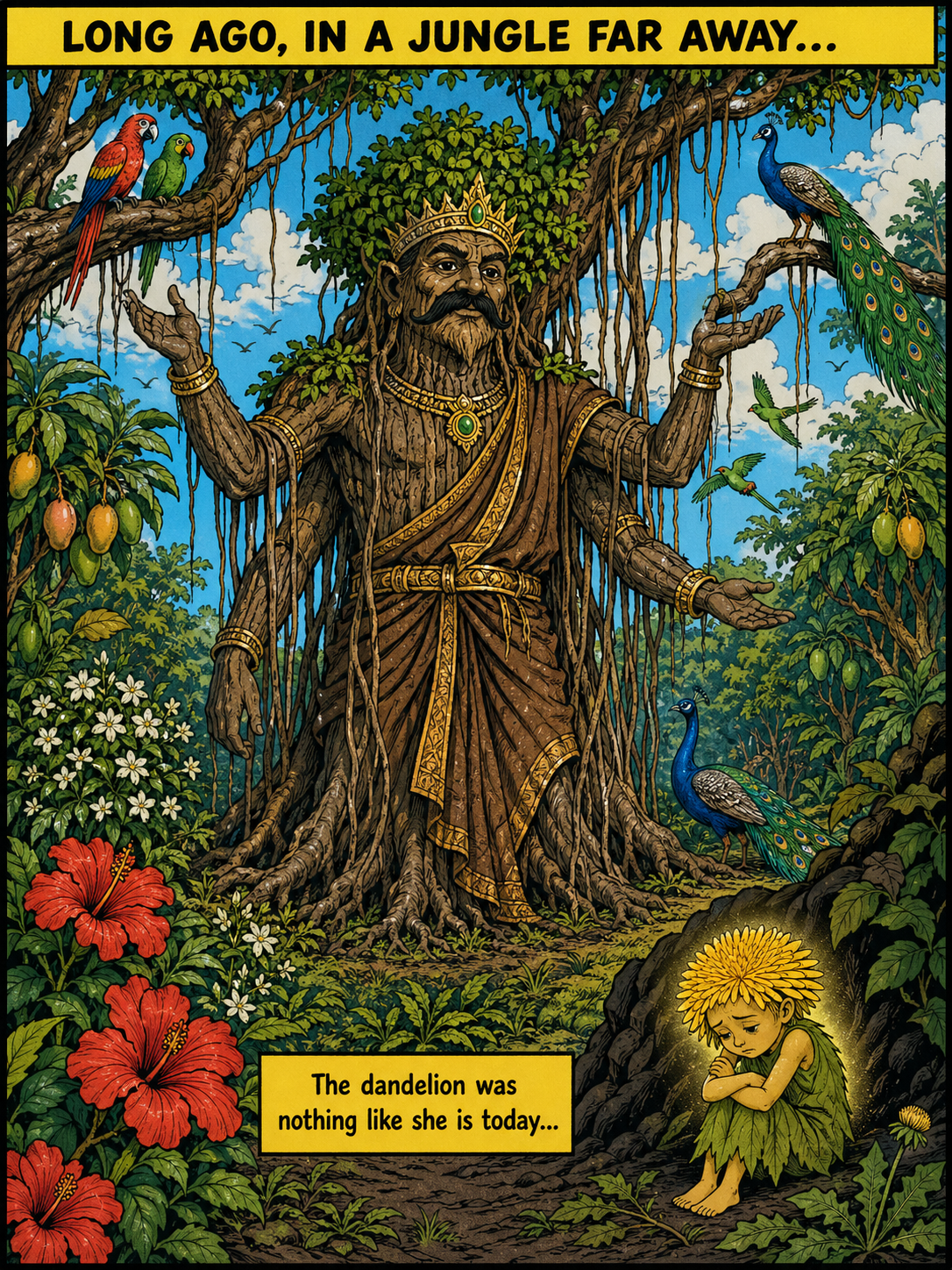
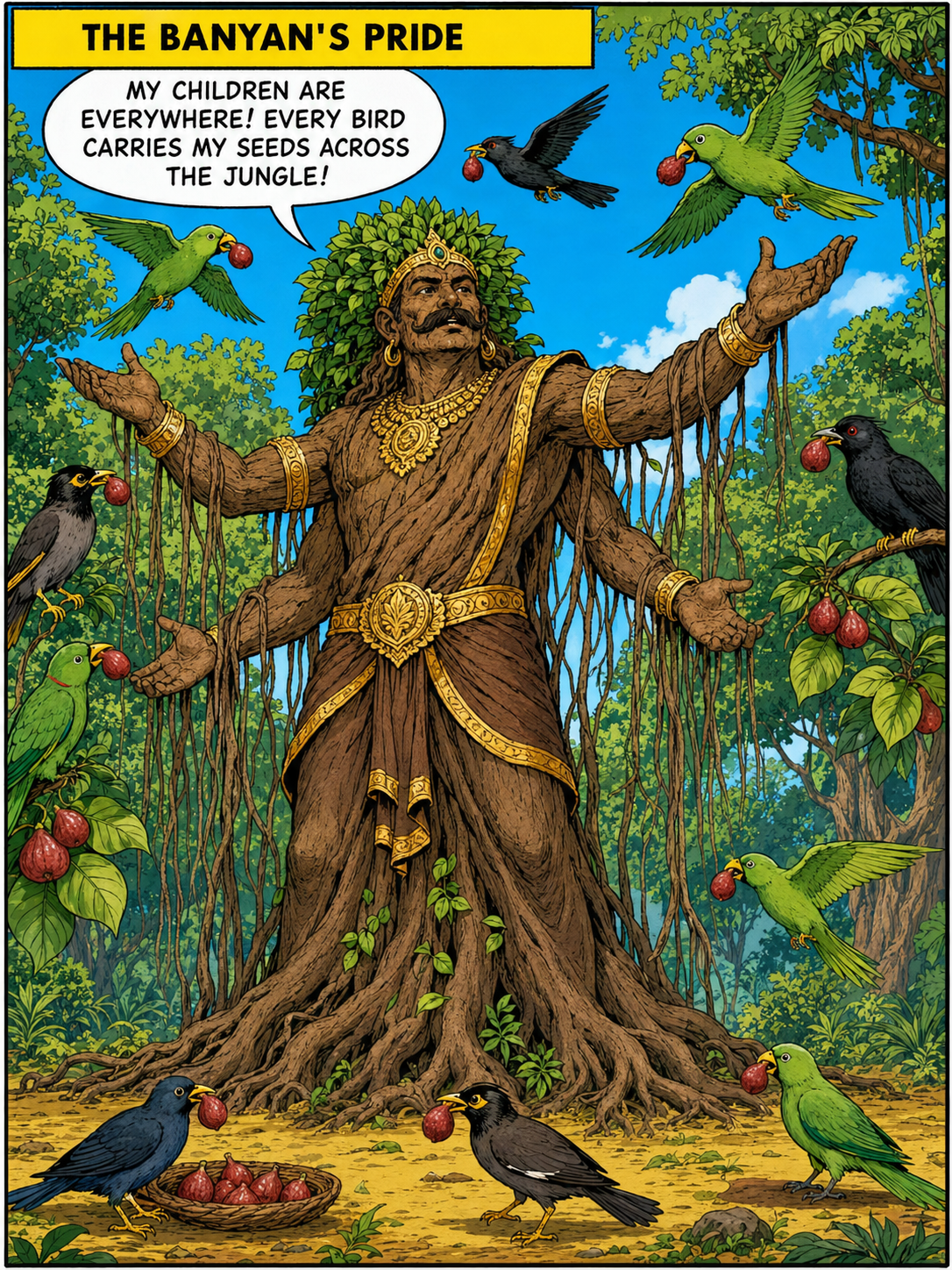
Banyan stood in the centre of the great jungle. His arms reached out, dropped down to the earth, and grew there — becoming new trunks. His shadow could shelter a village. His children — small banyan saplings — grew in every clearing, as far as a bird could fly.
“My children are everywhere!” Banyan said proudly to the other plants. “Every bird in this jungle eats my sweet fruits. Every bird carries my seeds across rivers. There is no corner of this jungle that does not belong to me!”
The other plants nodded politely. The birds, perched on his many branches, sang his praises.
In a small corner of the jungle, where the sun reached only briefly each day, there lived a small yellow flower called Dandelion.
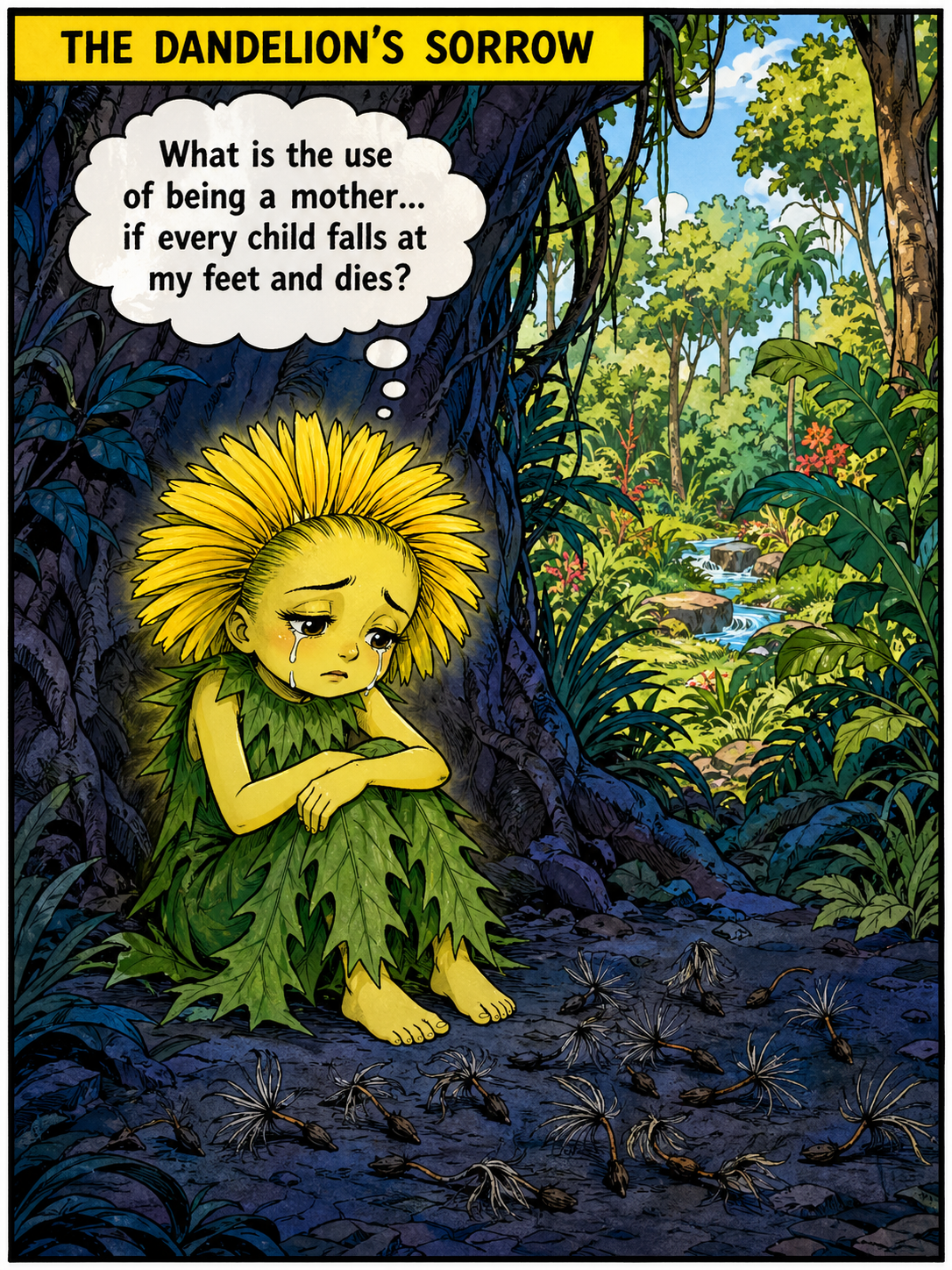
Dandelion was not like the other plants. She had no fragrance to attract the bees. She had no sweet fruit for the birds. She had only a small bright face that looked up at the sun, and small dark seeds that were heavy.
When her seeds were ripe, they fell.
They fell straight down. They fell at her feet. They tried to grow there, in her own shadow, in the soil that was already crowded with her own roots — and they died.
Dandelion had watched a thousand of her seeds fall and wither at her feet. She did not know what it was to see a child of hers grow up.
She did not speak much. She kept to her corner. The other plants did not notice her.
What is the use of being a mother, Dandelion would think to herself, if every child you have falls at your feet and dies?
Then one day, the goddess came.
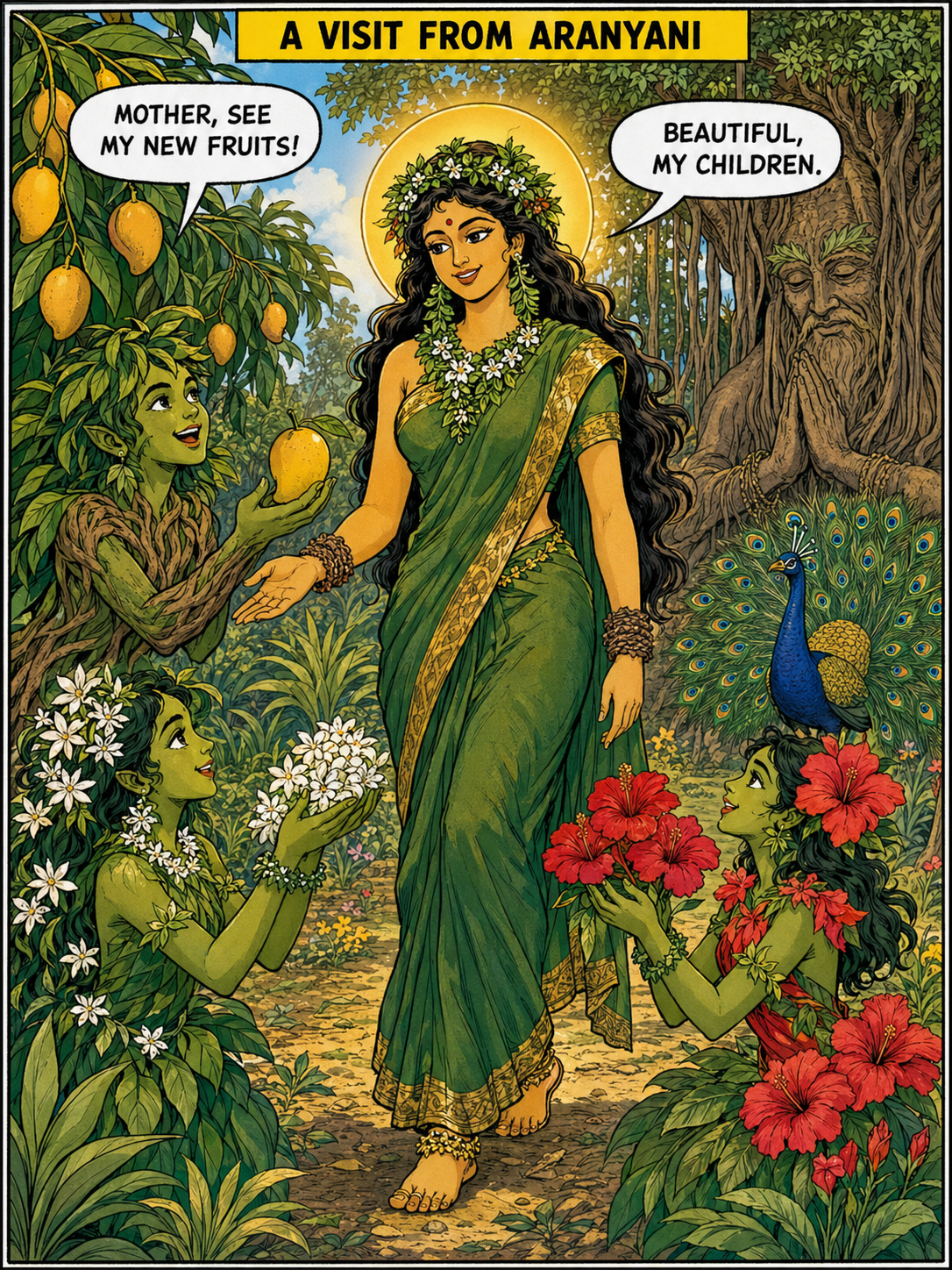
Her name was Aranyani — the Goddess of the Forest.
She did not come often. She did not stay long. But when she came, every plant in the jungle could feel it before she arrived. The air would smell of jasmine where there were no jasmine flowers. The wind would carry the soft sound of anklets where there were no anklets.
Banyan straightened himself and bowed his great head. The mango trees raised their fruits to her. The hibiscus bushes opened their reddest flowers. Every plant came forward, eager to thank her — for the rain, for the sun, for the soil, for the eco-system, for everything.
“Mother goddess, see my new fruits!” said the mango. “Mother goddess, smell my new flowers!” said the jasmine. “Mother goddess, see my latest sapling — already taller than the deer!” said Banyan.
Aranyani walked among them, smiling, blessing them, listening.
But as she walked, she noticed something strange.
In a small corner of the jungle, where the sun reached only briefly each day, there was a small flower who was not coming forward.
The flower was crying.
Aranyani turned and walked toward her. The other plants fell silent. They watched.
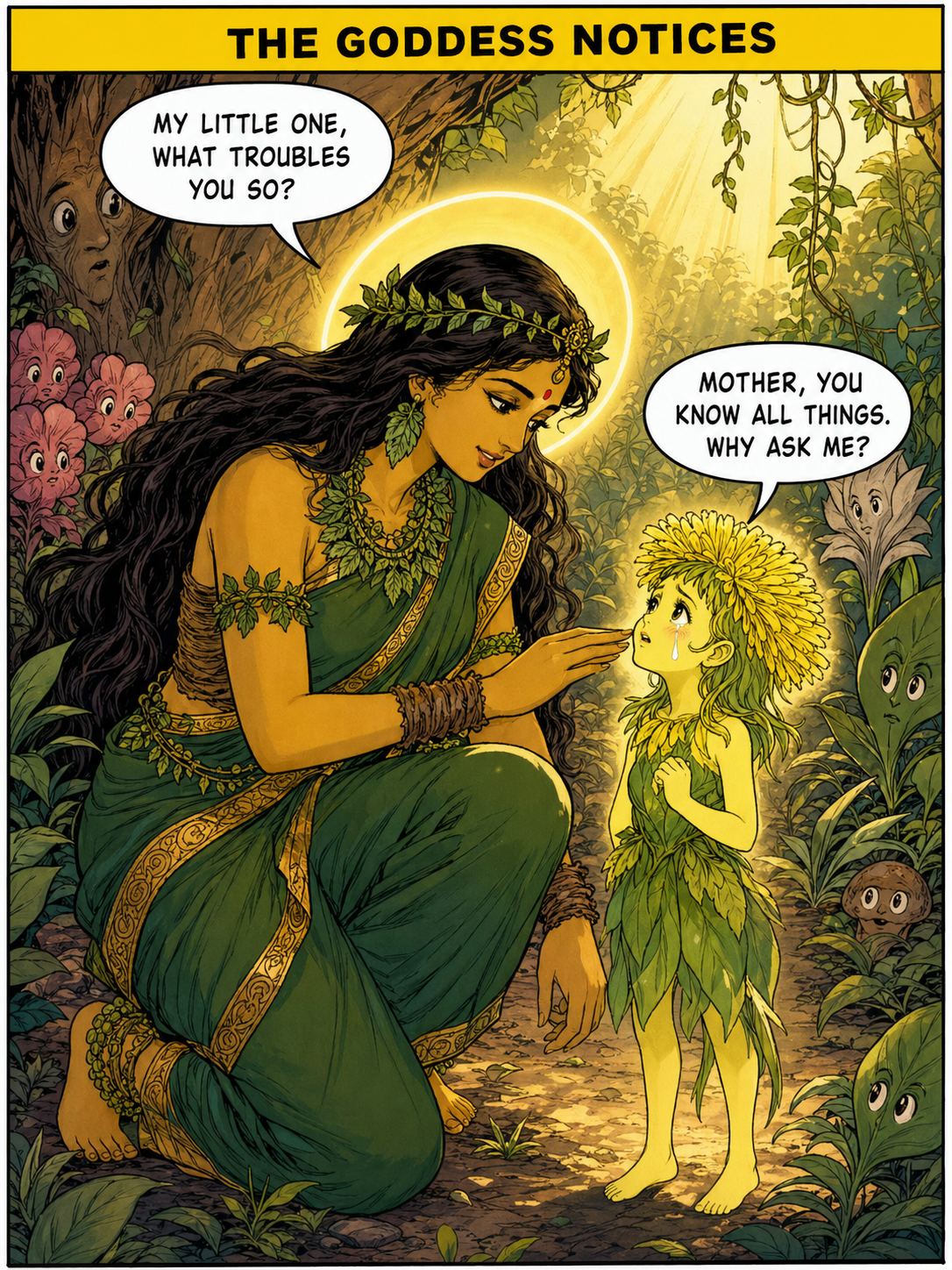
She knelt beside the small dandelion.
“My little one,” she said, very softly, “what troubles you so?”
Dandelion looked up. Her small yellow face was wet with tears.
“Mother goddess,” she whispered, “what is not known to you? You know all things. Why ask me?”
“Because, my child,” Aranyani said gently, “I want you to tell me yourself.”
So Dandelion told her. About the seeds that fell at her feet. About the children that died in her own shadow. About being a mother who had never seen a child of hers grow.
“A thousand of my seeds I have watched die,” she said. “Can a mother be happy, mother goddess, watching this?”
Aranyani heard her. She was quiet for a long moment.
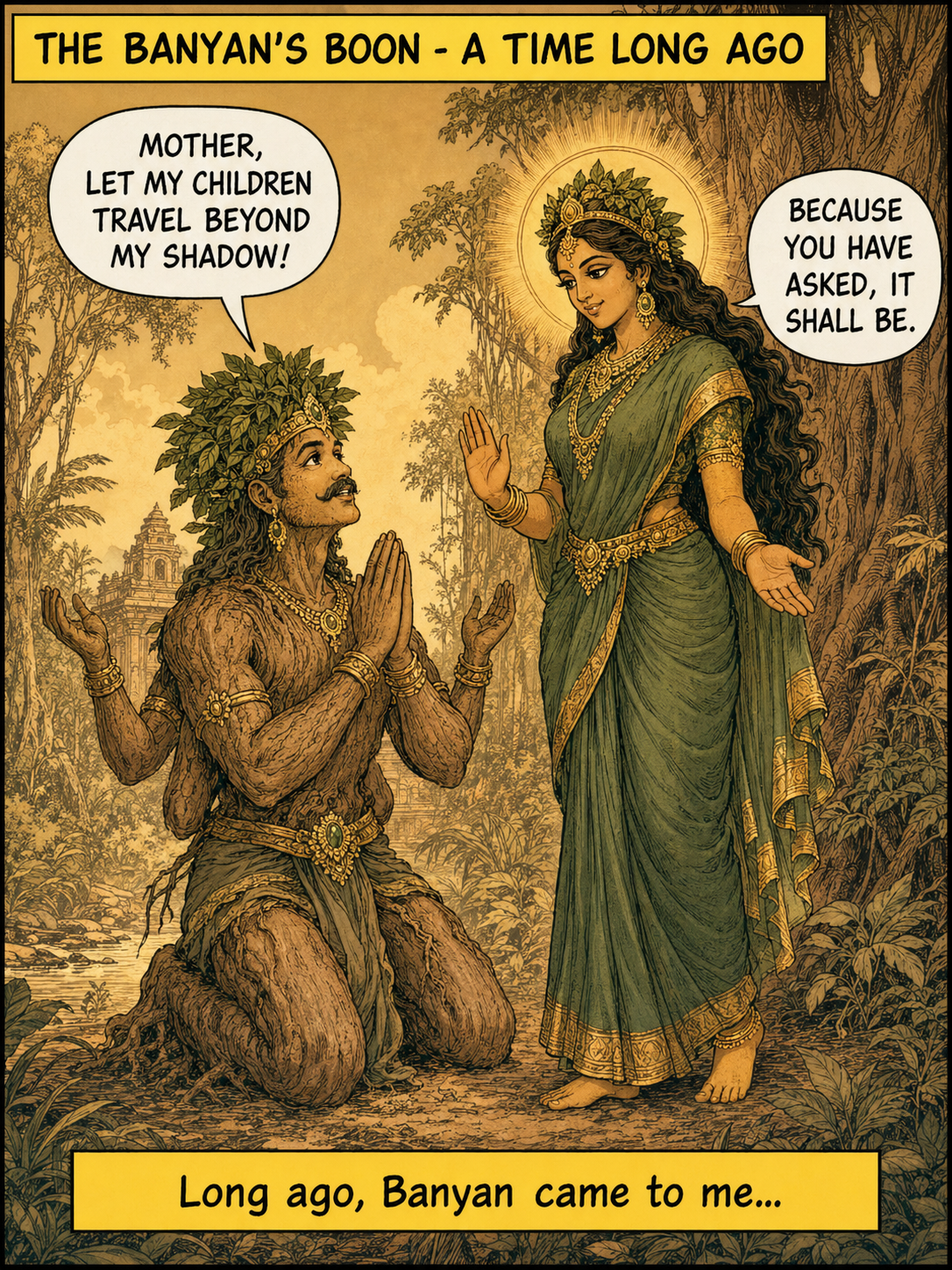
Then she said: “My child, I know everything. But I cannot give what is not asked for. Long ago, Banyan came to me. He said —”
The goddess’s voice carried the memory.
“Mother, my fruits are heavy and red, and they fall at my feet. What is the use of a fruit that does not travel? My children grow up in my own shadow and choke. What is the use of a forest if it can only grow where I already stand?”
“And so I made his fruits sweet beyond all other fruits,” Aranyani said. “Sweet enough that birds came from every direction. The birds carried his seeds in their bodies, far across the jungle. That is why Banyan’s children are now everywhere — because he asked.”
She turned back to Dandelion.
“My child, tell me. What does your heart want? Speak it. Do not weep it.”
Dandelion took a deep breath.
“Mother goddess,” she said. “Can my seeds be given wings? Can they fly when they fall? Can they cross the jungle so that I may grow in every nook and every corner — and the world will be amazed by their beauty?”
Aranyani smiled.
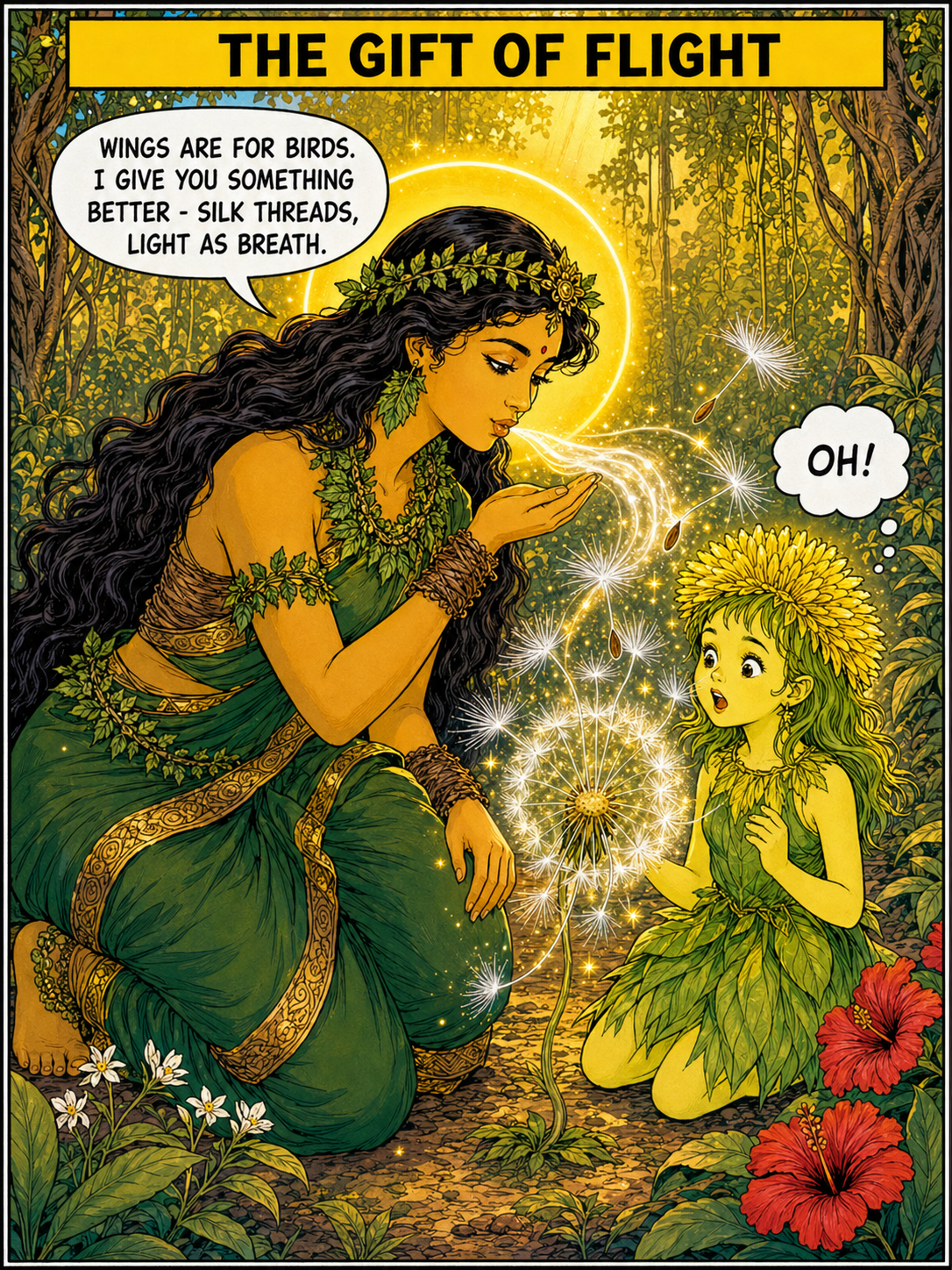
“Wings, my child? Wings are for birds. Wings push against the air. They cut it. They fight it. You are too small for wings — you would be tired before you crossed the first clearing.”
She knelt closer.
“But I will give you something better. Wings are for those who fly. I will give you what is for those who travel — silk threads, light as breath, that the wind itself will carry. Your seeds will not push against the air. The air will choose to lift them.”
She breathed softly upon the dandelion’s seedhead.
And where each seed met her breath, a tiny crown of fine silver threads opened — like a small umbrella, like a soft white star, like a child’s first wish made visible.
Dandelion looked down at herself. For the first time, she saw that she was beautiful.
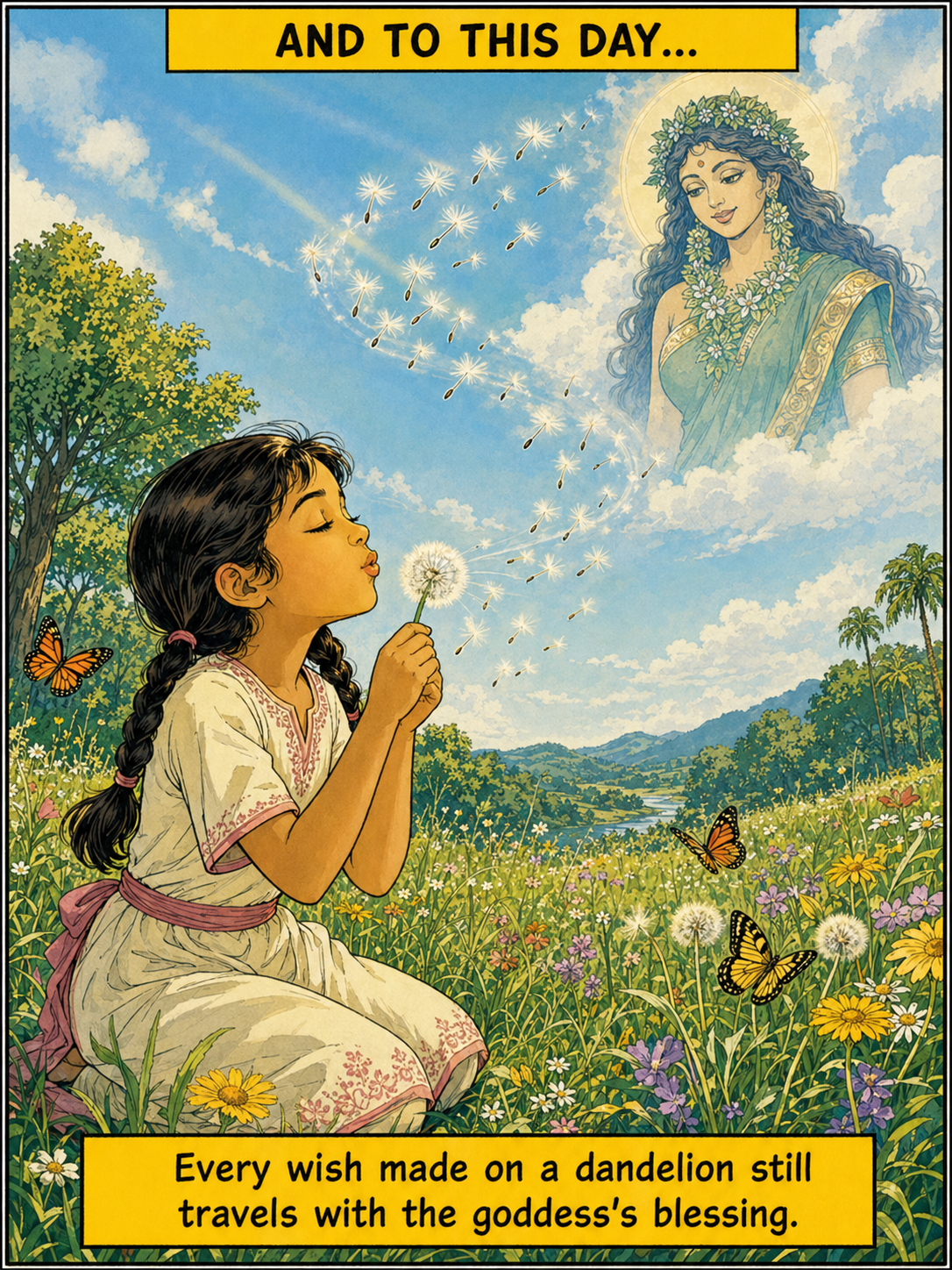
“There is one more thing,” Aranyani said. “From this day, when children come upon you in your puffball season, they will pause. They will close their eyes. They will make a wish. And they will blow. Your seeds will travel with their wishes. You — who thought you had no children — will be the carrier of every child’s hope, in every corner of the world.”
Dandelion did not have words. She bowed her small yellow head.

But before Aranyani turned to leave, she paused.
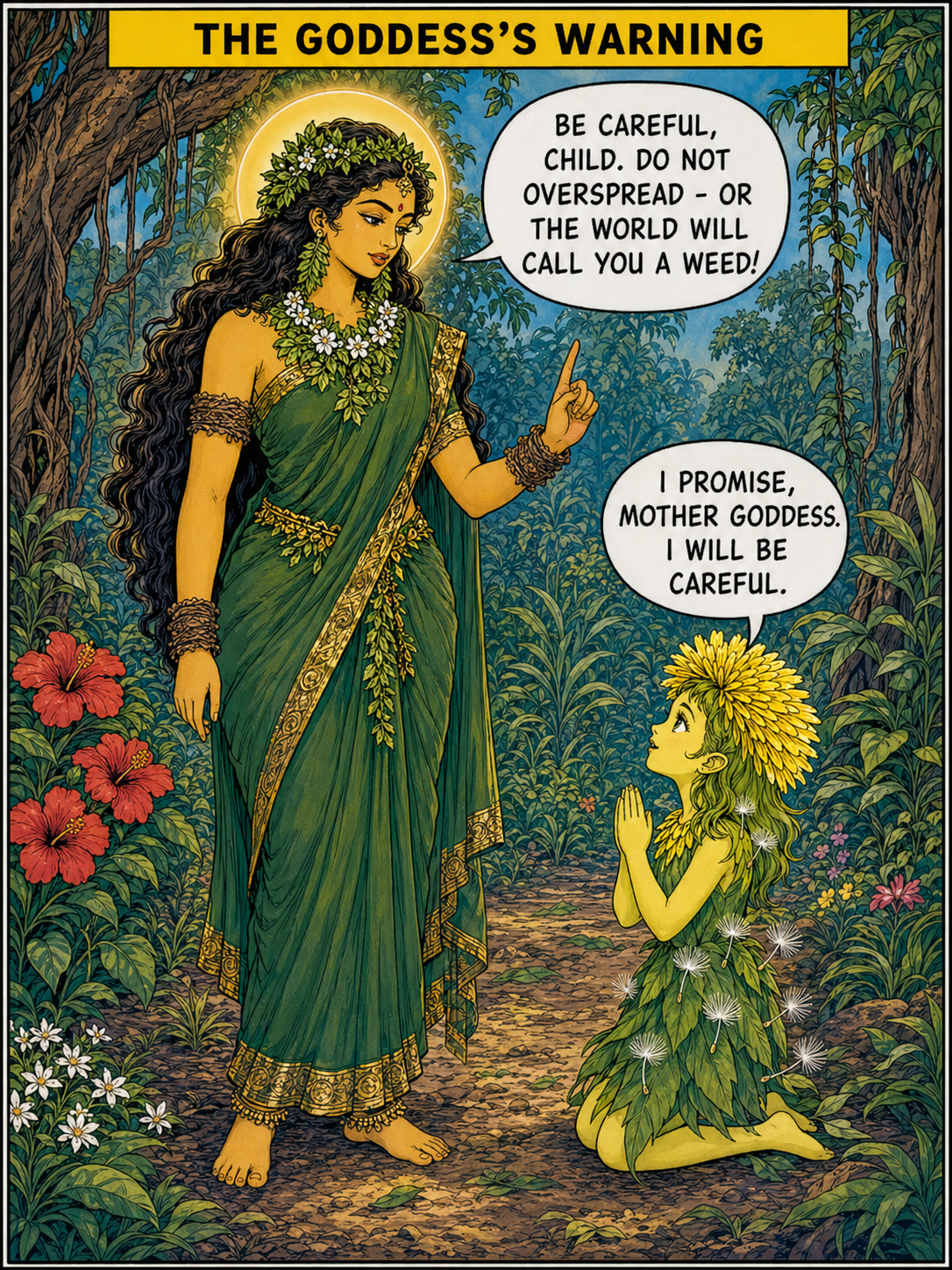
“Listen carefully, my child,” she said. Her voice was kind, but firm. “A gift must be carried with care. Do not overspread. Do not crowd every place. If you forget yourself — if you grow where you are not wanted, where you are not needed — the world will not call you beautiful. The world will call you a weed.”
Dandelion nodded eagerly. She was so overwhelmed that she could barely speak.
“I promise, mother goddess. I will be careful. I will only travel where I am wanted.”
Aranyani smiled — the smile of a mother who knows what her child does not yet understand.
She did not say anything more. She walked on through the jungle, and the air smelled of jasmine where there were no jasmine flowers.
That summer came. Dandelion’s seeds ripened. Her seedhead turned from yellow to a soft white globe — the first puffball ever seen on earth.
The wind came.
And her seeds rose.
They danced upward — small silver stars on tiny umbrellas — and they travelled across the jungle. Some landed in the next clearing. Some landed beyond the river. Some travelled further than the dandelion had ever known a thing could travel.
From the sky, Aranyani watched her, and the goddess was happy.
Many summers passed. Then many lifetimes. Then more lifetimes than the jungle could count.
The dandelion’s children travelled in every direction the wind blew. Across jungles. Across rivers. Across fields. Across oceans, on ships that did not know they carried passengers. Into countries that had no name for her.
In some places, they remembered the goddess’s warning. They stayed at the edges of paths, beside rivers, in small clearings — small bright stars in the green, then small white puffballs, gone with the next breeze.
In other places, they forgot. They grew in every garden. Every lawn. Every crack between stones. People who had no folk tales about them began calling them weeds. They pulled them up. The dandelions came back.
But this — even this — Aranyani had foreseen.
Because somewhere in the world, every single day, a child bends down beside a dandelion. The child closes her eyes. She makes a wish she has told no one. She blows.
And the seeds rise.
The goddess in the sky still watches them.
Even now.
Especially now.
This is a folk-tale retelling inspired by Aranyani, the Goddess of the Forest from the Rigveda (10.146). While Aranyani herself is from authentic Vedic tradition, the specific story of how the dandelion received her silken parachutes is a literary invention by the author. Banyan, Dandelion, and other characters here are folk-tale personifications, not formal Hindu deities.