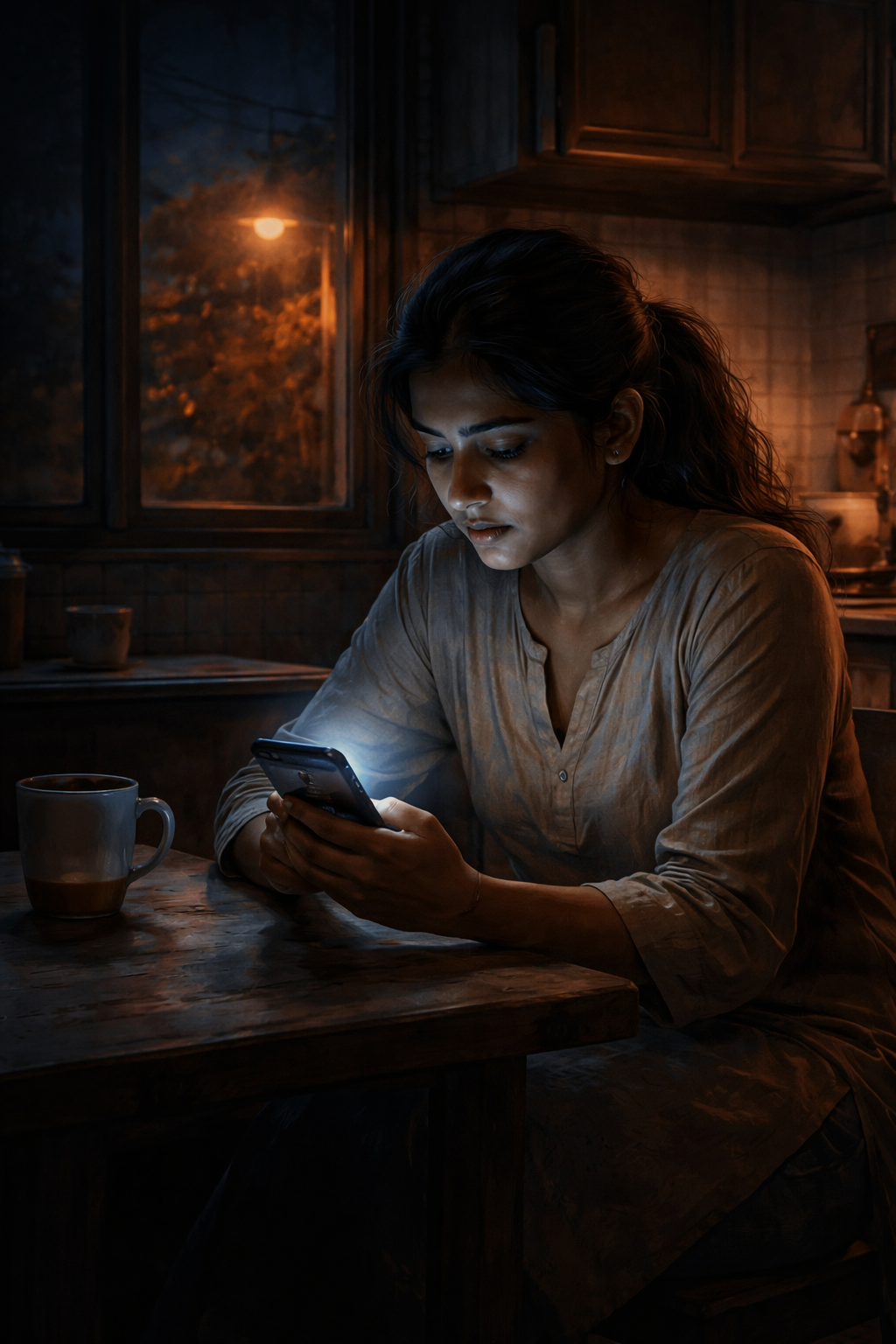
The notification came at 12:47 AM.
Meera was already awake — had been for an hour, lying in the dark with the ceiling fan doing its slow indifferent work above her. She picked up her phone out of habit, not expectation.
The chess Twitter feed had gone completely still for ten seconds and then erupted all at once.
Historic. First ever. Indian woman. FIDE Women’s Candidates.
She read it three times. Set the phone face-down on the mattress. Then picked it up and read it again.
She got up quietly — her parents were asleep, Kiran’s room dark under the door — and went to the kitchen. She filled a glass of water she didn’t drink. The Chennai night came through the window: distant dog, the hum of the street lamp, the smell of a city that never fully goes to sleep.
She sat at the kitchen table with her phone and read everything.
 12:47 AM, Chennai — the night the chess world changed
The academy WhatsApp group had 47 unread messages. Her old coach Venkataraman Sir — seventy-one, still running the academy off Nungambakkam High Road — had sent three voice notes and a string of crying-happy emojis. Former teammates she hadn’t spoken to in years were tagging each other. Someone had posted a photo of the old board room where a hand-painted banner still hung: CHESS IS LIFE. LIFE IS CHESS.
Meera had trained in that room every evening from age twelve to twenty-two.
She put the phone face-down and looked at the wall.
She had been, at sixteen, the best Under-18 girl player in Tamil Nadu. Not the quiet kind of exceptional — the kind that gets noticed in rooms full of people who know what they’re looking at. At eighteen she won the National Women’s Under-20 in Nagpur, beating a girl from Maharashtra in 47 moves with a Sicilian her coach still used as a teaching example. At twenty she was being discussed — carefully, the way chess people discuss these things — as a future IM candidate. A FIDE arbiter who’d watched three generations of Indian talent come through had told Venkataraman Sir that with two serious years, the GM title was not unreasonable.
Her father had heard this secondhand. He said nothing. On the drive home that evening, he stopped at a bakery on Anna Salai and bought a full Black Forest cake, which he brought home and set on the dining table without explanation. Her mother looked at it, looked at him, and understood. Meera understood too.
That was how her family said things — not in words, but in a Black Forest cake at eleven PM on a Thursday.
Her father had the stroke when she was twenty-two. The doctors called it not catastrophic, as if the word they weren’t using was doing everyone a favour. He recovered to roughly seventy percent. He walked with a drag on the left side. Tired easily. Could not go back to the government office job that had run the household for twenty-six years.
Meera did the calculation the way she had been trained — without attachment to a preferred outcome. What does the board demand?
The board demanded that someone earn. Her mother could manage the house. Kiran was eighteen and, as Venkataraman Sir had once said, in the critical development window — pulling him out would be like pulling a sapling in its third year. Meera was twenty-two and the oldest and nearly done with her degree.
She told the Sir she needed a break. Six months, maybe.
He looked at her across his desk — the same desk she’d sat across a hundred times with a board between them — and was quiet for a moment. Then: “The board will be here when you come back.”
She nodded. She believed him. She also knew she wasn’t telling him the truth about the six months, and that he knew it too. Neither of them said so.
She applied to a mid-size IT services company in Sholinganallur. Data analyst. The salary was enough. Forty minutes each way on the MRTS. She told herself she’d keep her game sharp in the evenings, review openings on weekends, return to competition when things settled.
Things settled. Into a different shape than she had planned.
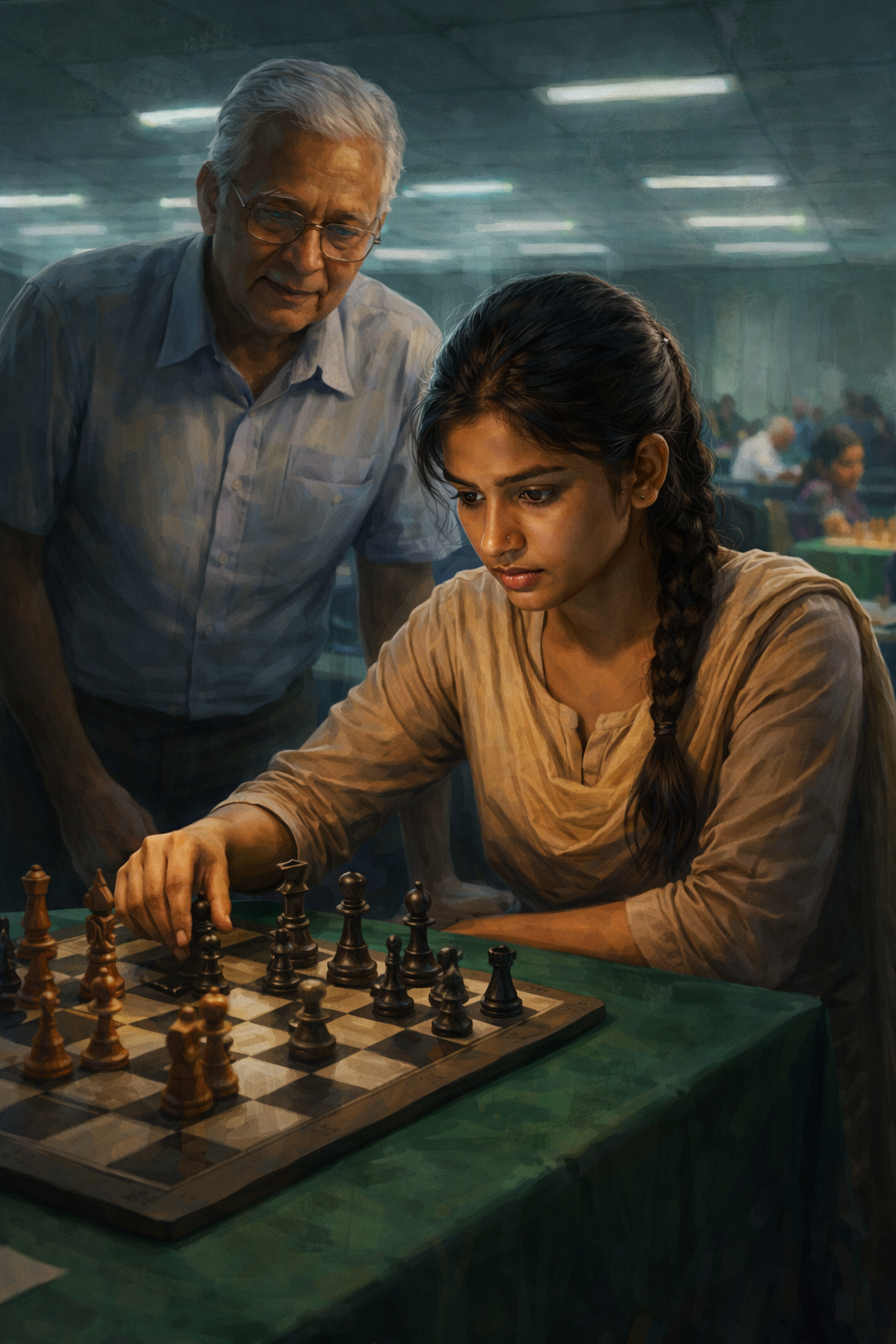 Meera at nineteen — the girl her coach said could go all the way
Three months became six. Six became twelve. The chess apps on her phone went unplayed. The openings she had memorised — the Sicilian, the French, the Nimzo-Indian she had been building for two years — began to blur at the edges, the way fluency blurs when you stop speaking a language. She told herself she was maintaining.
She was not maintaining. She was grieving, without ceremony, in the margins of a life that had filled itself with other requirements.
Kiran kept playing.
She drove him to the Saturday sessions on her Activa — past the same chai stall, through the same underpass that flooded every monsoon. She sat in the waiting area while he trained. Evenings she reviewed his games with him at the dining table, pointing out lines with the authority of someone who had been through all of it. She gave him what she knew, and then a little more than that — things she had only begun to understand at twenty herself, the deeper strategic intuitions that don’t come from books. She gave them to him the way you give away something you can no longer use and cannot stand to waste.
He took them.
He was twenty-four now, ranked in the top thirty nationally. Two IM norms. A trajectory Venkataraman Sir called genuinely promising when he called on Kiran’s behalf for tournament support. Two months ago he had qualified for his first international open in Budapest.
She had ironed his clothes for the trip.
She heard him before she saw him — the soft drag of feet on kitchen tiles, the click of the refrigerator light. He stood in the doorway in his old NIT Trichy hostel t-shirt, blinking at her.
“Akka.” He looked at her face, then at the phone face-down on the table, and she could see the moment he understood the shape of what was happening.
He got his water. He didn’t go back to bed. He pulled out the chair across from her and sat down.
The street lamp hummed. The refrigerator settled.
“You saw,” he said.
“Yes.”
“First Indian woman ever.”
“I know.”
He turned his glass slowly on the table. Kiran was not someone who filled silence — too much like their father for that — but she could see him working toward something.
“You should have been there,” he said.
Not tonight. All of it — the Candidates circuit, the hall in Nagpur, the path that had been there and then was not. He had been carrying this, she realised, longer than she knew. It was in how he said it. Not an accusation. A weight being set down after a long walk.
“I was needed here,” she said.
“That’s not the same as choosing it.”
She opened her mouth. Closed it. He was right. It wasn’t the same.
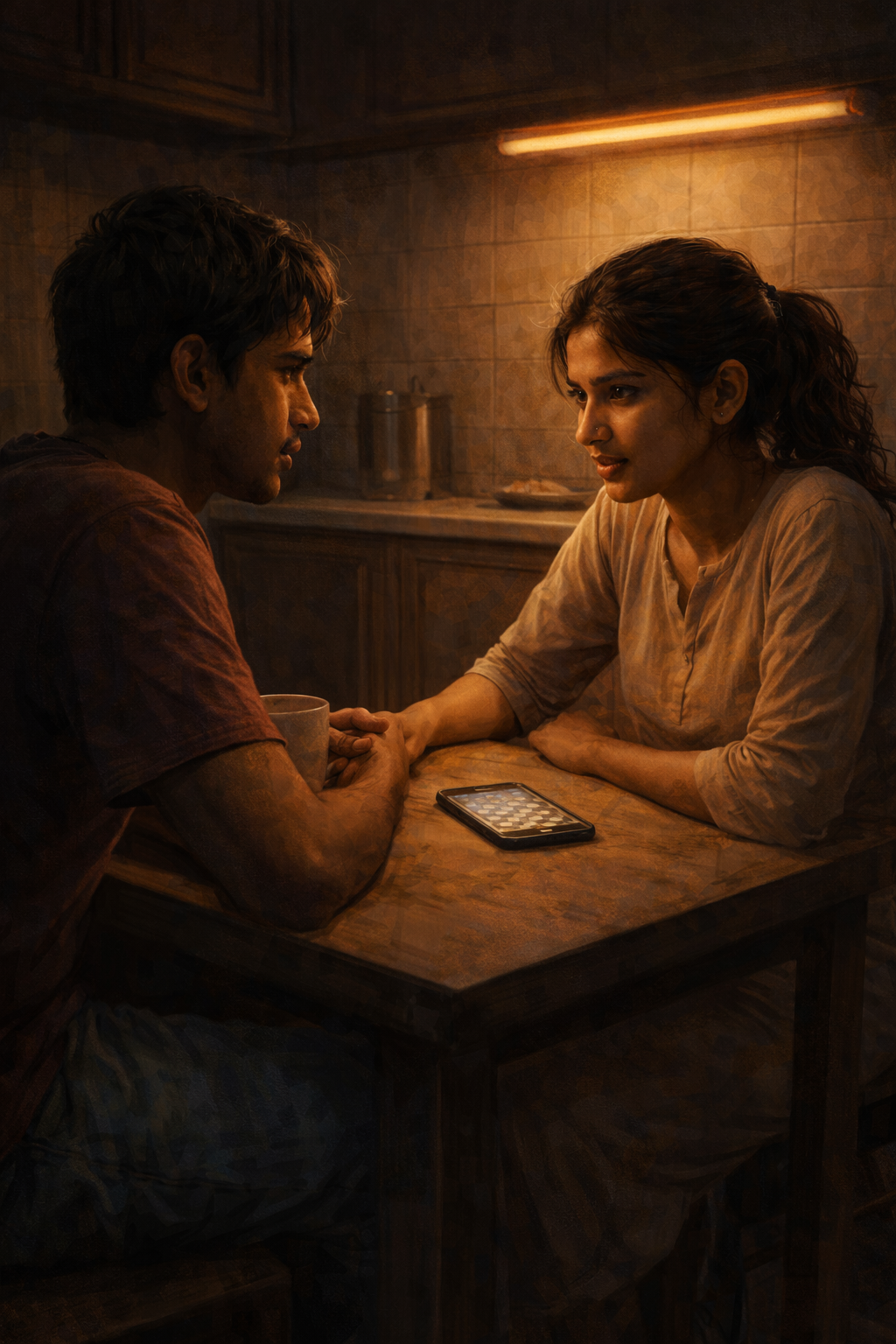 The kitchen, 1:30 AM — six years of unspoken things finding words
“I think about it at tournaments,” Kiran said. His voice had gone careful. “When I’m sitting across from someone and I find the right move — I think about where I learned to look for it.”
“You worked for everything you have.”
“With your openings. Your annotations. You reviewed every game I played from 2021 to 2023. After twelve-hour days.” He stopped. “Akka, do you understand what that—”
“You would have found your way.”
“Maybe.” He looked at her. “But I didn’t have to.”
She looked at the table. At the cold cup of tea she didn’t remember making.
The thing was — and this was something she had barely let herself think with any precision — she did not regret it in the clean, simple way that a story like this is supposed to end. There was grief. Real grief, the kind that visits on nights when the chess world erupts and you are in your kitchen in Sholinganallur at forty minutes past midnight. She had stopped pretending otherwise.
But there was also something else. She didn’t have a word for it exactly — the particular steadiness of having looked at a hard problem and made a decision and not collapsed under it. The way her father had looked at her once in the hospital corridor — not with the Black Forest cake language, but directly — and she had seen that he understood what she had done.
And there was Kiran. Sitting across from her right now, at 1:30 AM, looking at her the way you look at someone you owe more than you know how to say.
“Your rating is 2287,” she said.
“What does that—”
“I was never going to be 2287. I knew the board. I always knew the board.” No bitterness in it. Just the fact. “I was going to be very good. I was not going to be what you saw tonight. I knew that at twenty and I know it now.”
He said nothing.
“The sacrifice was not as large as the one you’ve been carrying,” she said.
He looked at her for a long moment.
“Show me,” she said.
“What?”
“The Budapest preparation. What you’ve been working on.” She nodded at his phone. “Show me.”
He hesitated. Then he unlocked it, opened the chess app, and turned it toward her. A Ruy Lopez, exchange variation, a line she recognised from years ago.
Something shifted in her — not emotion exactly, but attention. The specific quality of attention that chess asks for and that she had not felt, clearly, in a long time. She reached across and angled the phone toward her.
“You’re thinking d4 here,” she said.
He looked up. “How did you—”
“Because it’s the obvious move and you go for obvious under time pressure. Don’t. Nc3 first. Give yourself the square. Then d4 when he’s committed.”
Kiran studied the board. Studied her.
“You haven’t played in six years,” he said.
“No,” she said. “But I never stopped seeing it.”
They stayed at the kitchen table until three in the morning, the phone between them, working through the Budapest lines. The Chennai night went quiet around them — the dog, the street lamp, a goods train somewhere on the suburban rail. Under the kitchen tube light, with cold tea and Kiran’s notation open, working through positions in the language she had spoken since she was twelve, something that had been held tight for a long time quietly let go.
She had not undone anything. The years were the years. The decision was the decision.
But here, at this table, with a board to read and a brother who needed one more move found — she was not someone diminished.
She was someone who knew exactly where the knight belonged.
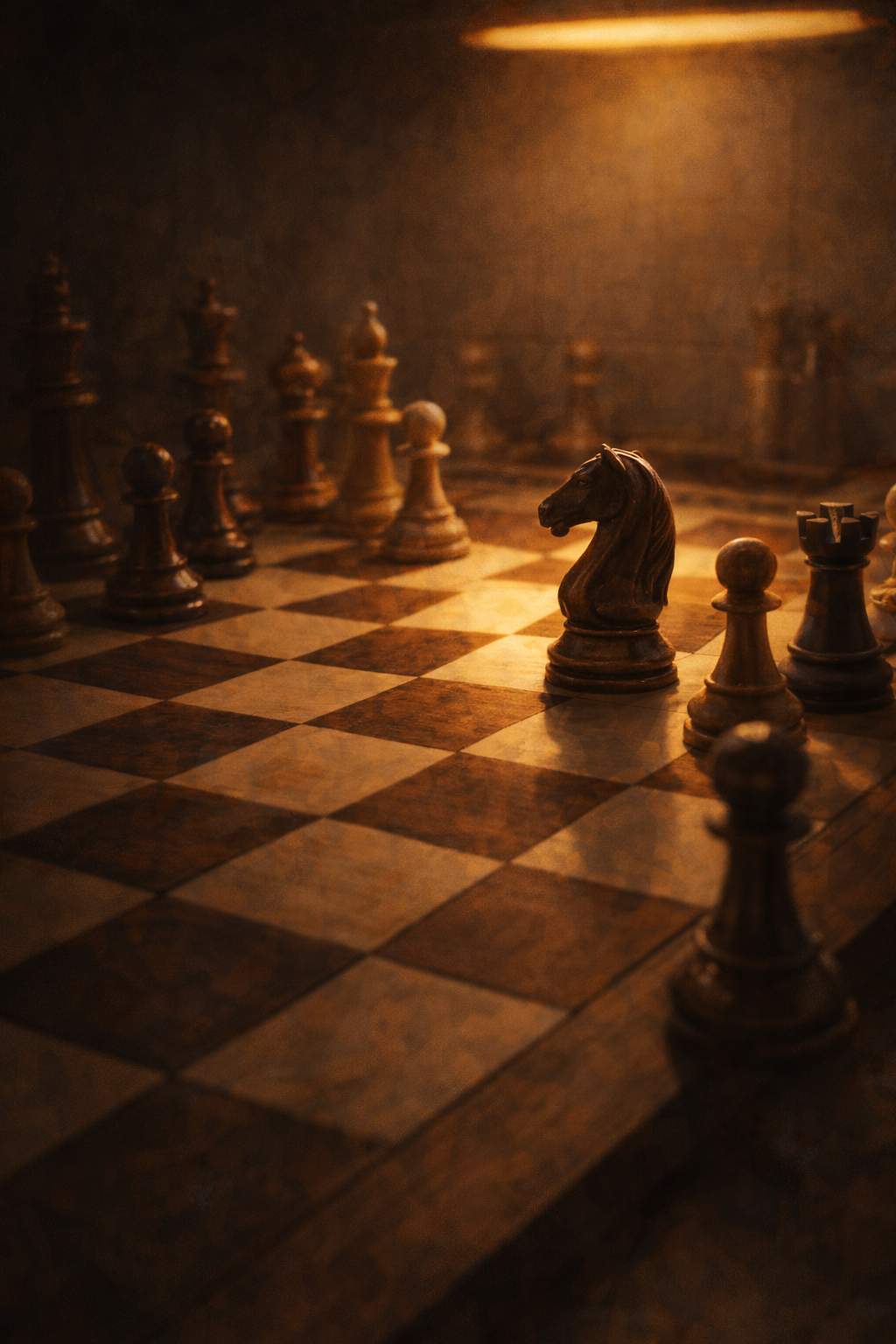 Sixty-four squares — the language she never stopped speaking
Inspired by a historic night in Indian chess — April 2026. Meera and Kiran are fictional. Any resemblance to real persons is unintentional.
Reader Comments
Loading comments…
Leave a Comment