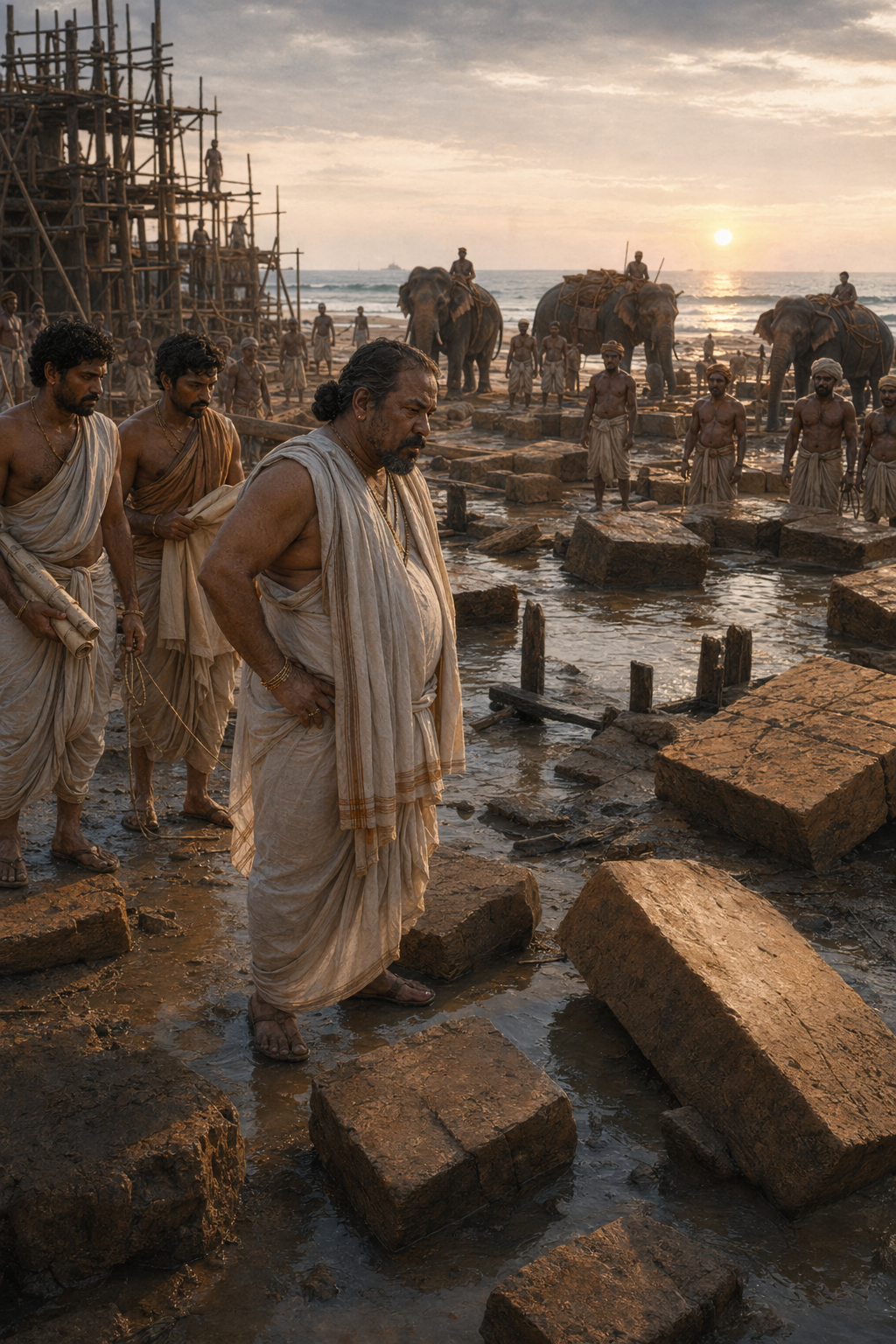
The sea at Konark had no interest in what men were trying to build beside it.
Every morning it made this clear.
The previous day’s work — dressed stone blocks placed with precision by teams of men and the organised strength of twelve elephants, each block weighing more than a man could think about, set according to Hamija’s design at the angles he had determined — lay by morning in configurations that no human hand had arranged. The tide came in the night, moved through the foundation zone, and the hydraulic pressure it carried — not the wave force, not the surface current, but the deep lateral force of water finding every channel between stone and earth — shifted the base blocks. Not far. Sometimes only the width of a thumb. But on a foundation that had to carry the weight of a structure not yet imagined at its full height, a thumb was a conversation about catastrophe.
This had been happening for a month before Bishu arrived.
Hamija was from Yawadvipa — the island kingdoms far across the eastern water, where men had been building on coastlines for longer than Kalinga had written records of doing so. He had been brought to Konark specifically because the king wanted a man who knew the sea. He knew the sea. He had built on three coastlines of his islands. But those shores were different — gentler tides, different earth, stone that behaved according to different rules.
The Chandrabhaga here was not gentle.
Each morning began the same way. The Biram of the previous evening had barely settled before the stone teams were back at the foundation zone, measuring the overnight displacement, recording which blocks had moved and by how much. The elephants waited. The mahouts waited. The stone cutters waited. Hamija walked the zone in the early light, studying, adjusting his calculations, conferring with his senior men in the language they shared — a mixture of his island tongue and the court Sanskrit that served as common ground.
They had tried weighted anchoring. The tide moved the anchors. They had tried deeper setting. The tide found the new depth. They had tried different angles of placement. The tide did not care about angles.
Below the waterline, the work already completed was sound — a framework of hardwood piles and dressed stone, set before the rains, which sat in the earth below the tide’s reach. That foundation was not moving. Everything above the waterline was.
 Every morning the sea answered. Every morning the answer was the same.
Bishu had watched this for two weeks before he said anything.
He had learned the pattern. He had asked careful questions of the junior stone cutters — not about Hamija’s method, but about the tide timing, the foundation earth, the depth at which the displacement stopped. He had lain awake two nights in the assembly area making calculations in the small pothi.
What he understood, by the end of those two weeks, was that Hamija was fighting the tide. Placing mass against force. The tide was stronger than any mass they could place in the time available.
The solution was not to fight it.
He tried to say this.
The first time was at the assembly area, to a group of senior stone cutters during the midday rest. He drew the principle in the dust — not resistance but channels, cut into the foundation zone, that would allow the tidal pressure to pass through rather than accumulate. Give the water a path. Remove the force that was doing the damage.
They listened for a moment. Then one of the older men — twenty years with Hamija, from the first island posting — looked at the dust drawing and looked at Bishu.
“Hamija Maharana is from Yawadvipa,” he said. “He has built on three coastlines across the sea. If he cannot solve this, what will a local boy from some village do with a drawing in the dust?”
The others smiled. Someone said something in Hamija’s island tongue. Its meaning required no translation.
Bishu smoothed the drawing with his palm and went back to his work.
He tried again, a week later, to a junior supervisor who had shown some independent thought. The supervisor listened more carefully. But when Bishu finished he looked at the ground.
“I understand what you are saying,” he said quietly. “But if I bring this to Hamija — a local sthapati telling the Head Maharana from Yawadvipa that his method is wrong—” He shook his head. “I would rather not.”
He walked away.
Bishu went back to the small pothi and kept writing.
It was on the forty-third day that the Biram sounded and the messenger arrived.
The conch and the drum — Biram — the end-of-work signal that moved across the Konark site every evening like a slow wave, section by section, until the last hammer fell silent and the elephants were walked to their ground. Workers setting tools down. The site transitioning from its daytime self — fires being lit, the smell of cooking, men washing stone dust from their hands at the water troughs.
Into this came the horse.
A royal messenger, Kalinga insignia, riding hard from the direction of Cuttack. He did not dismount at the perimeter. He rode to the centre of the site. The letter he carried was sealed with the king’s personal wax.
He did not hand it to Hamija. He broke the seal himself, unrolled the letter, and read it aloud.
His voice was practiced and formal — the voice of a man whose duty it was to carry the king’s words and deliver them with the weight they deserved. The letter began as all royal letters began: with the full titles of the king. His victories at Ulanghi. His divine lineage from the sun itself. His greatness that illuminated all of Kalinga and caused the neighbouring kingdoms to bow before his shadow. It went on at length — paragraph upon paragraph of composed praise — and the assembled workers stood in the evening quiet and listened to the language of power.
Then, near the end, wrapped in words so gracious they almost softened the meaning beneath them:
His Majesty, in his boundless generosity and his deep devotion to the sacred work being undertaken in his name, has resolved to bless the workers and learned architects of Konark with the divine grace of his presence. Tomorrow, at the second prahar, Maharaja Narasimhadeva shall arrive at the site, that his light may fall upon the great endeavour and that all assembled may be honoured by his sight. Let all prepare themselves worthy of receiving this blessing.
The messenger rolled the letter. The site was silent.
Those close to Hamija watched his face do something it had not done in all the weeks they had known him. It became uncertain.
Within the hour, every senior man on the site understood what the gracious words meant: The king arrives tomorrow. He will see what has been done — and what has not.
The meeting was held in the stone store at the northern edge of the compound — the most enclosed space on the site, guards posted outside. Hamija’s core circle: six senior sthapatis, two from Yawadvipa, the rest from various kingdoms. Lamps burning. The plans of the foundation zone unrolled on the floor.
They had nothing to show.
The wooden framework below the waterline — that was real. But the king had seen the wooden framework. What he had not seen was a single course of the above-water foundation completed and holding. Because it had not held. Not once.
The arguments went in circles. Someone suggested telling the king the truth — that the problem was harder than anticipated, that more time was needed. Someone else pointed out that more time was what they had asked for at the last visit.
Outside, Bishu walked to the guard at the entrance.
“I need to speak with Hamija Maharana,” he said. “It concerns the foundation. Tell him the sthapati from Kalinganagar has a solution to the tidal displacement.”
The guard looked at him. But something — the timing, or simply boredom — made him turn and speak through the entrance gap.
Inside, the conversation stopped.
Hamija heard it. The local sthapati. A solution. He had been listening to proposed solutions for weeks and they had all failed, and he was in a room full of people who had no answer for tomorrow and a voice outside was offering one.
Something about that — the timing, the presumption, or the simple exhausted pressure of a man whose thirty-year reputation was crumbling one tide at a time — something broke through.
“Remove him,” Hamija said. His voice entirely flat.
The guard came back. And with him, two more.
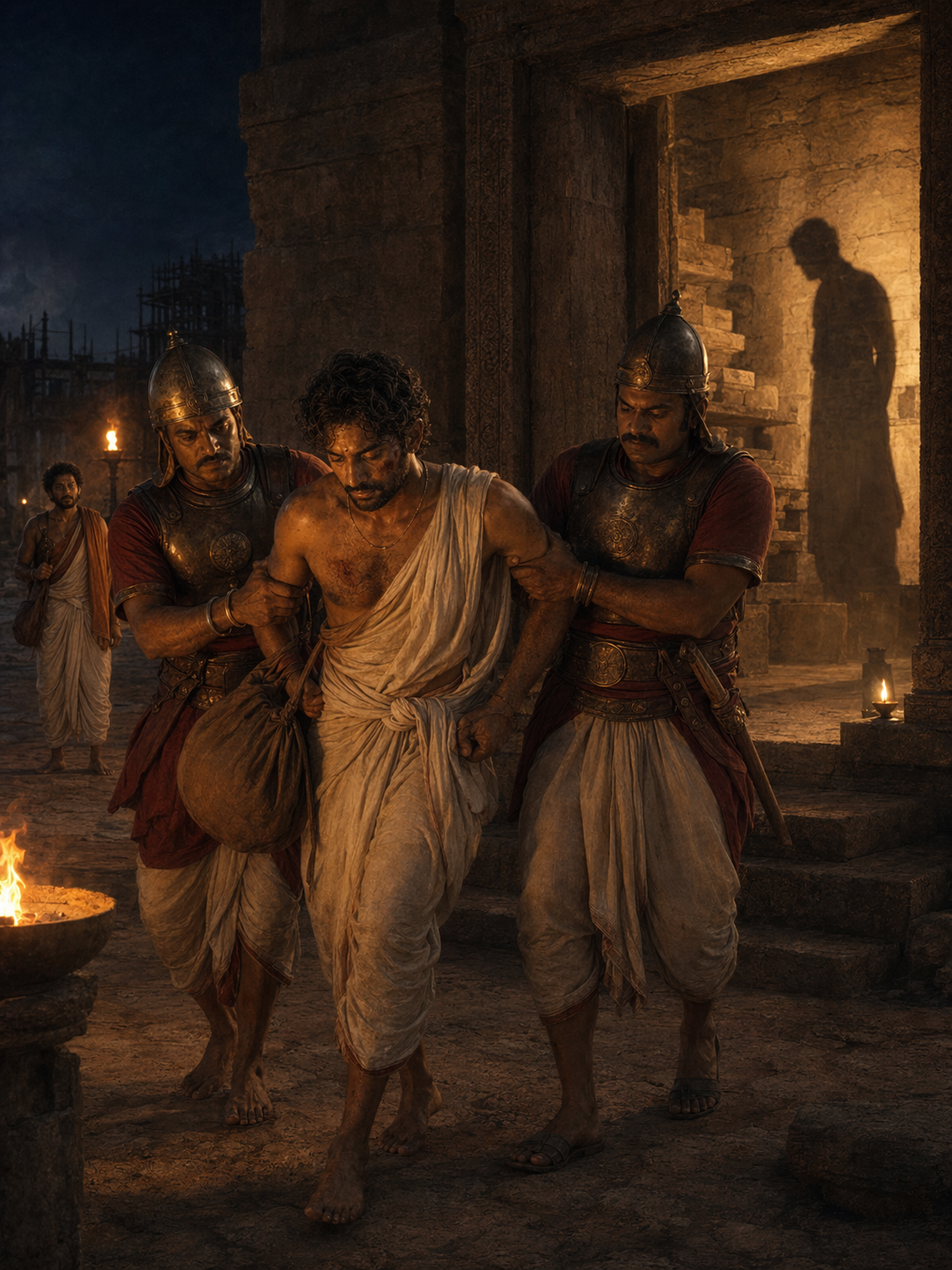 “Remove him.” — The night before the king’s visit.
The workers’ jail was a stone enclosure at the western edge of the site — low walls, open to the sky, used for those who stole from the stores or started fights. Bishu was put inside without ceremony. The gate was latched.
He sat in the corner.
The moon was past full but still bright. Its light came through the open top of the enclosure and fell on the stone floor in a long pale rectangle. Bishu sat at its edge. His pothi bag had been taken at the gate. His hands had nothing to do.
He had left UshaRani and the bara koli and everything that was home. He had walked four days through forest and coastal plain. He had come to build something the world had not seen. And he was sitting in a jail, bruised from the handling, without his pothis, with a solution in his head that no one would hear.
He pressed the heels of his hands against his eyes.
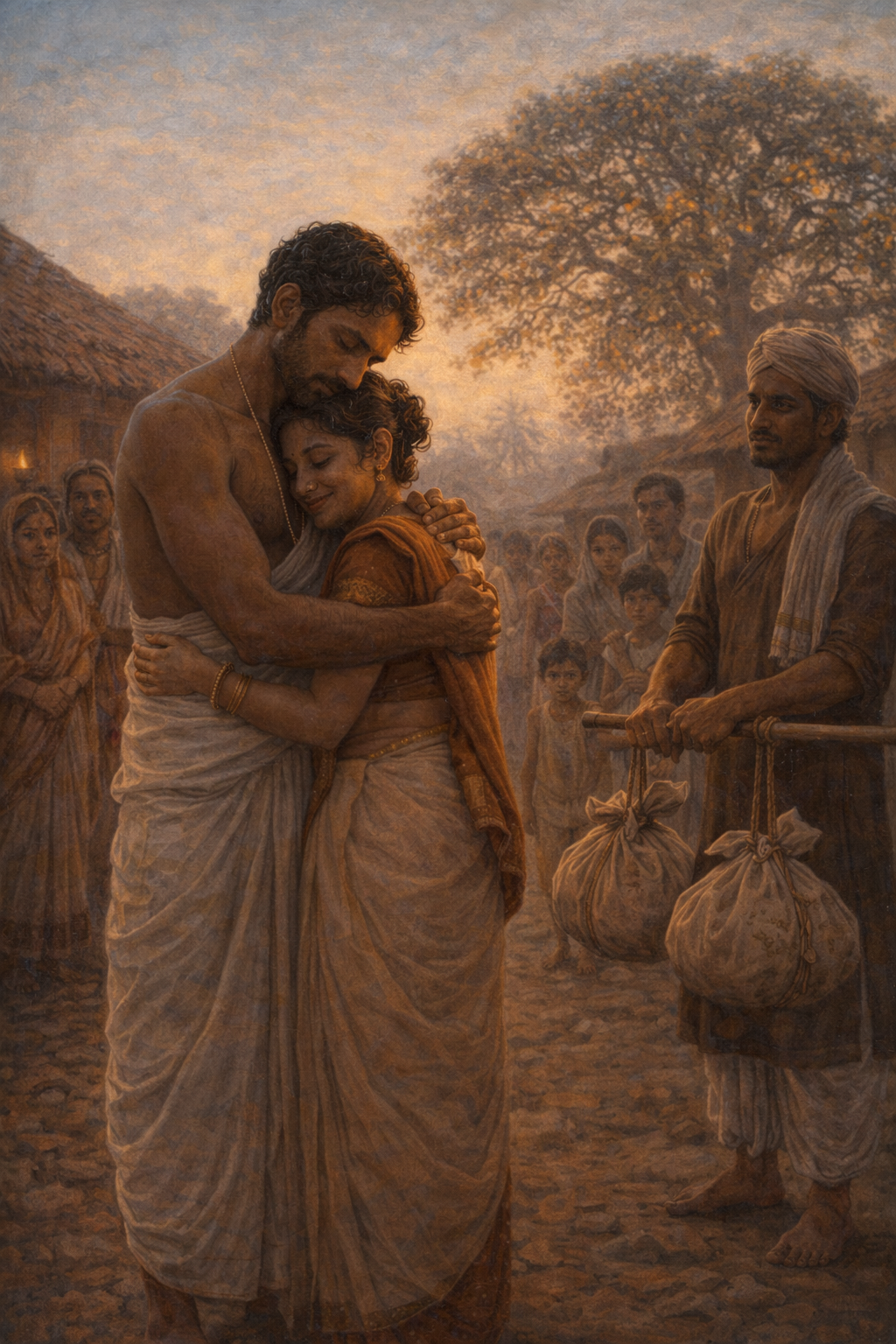
In Kalinganagar, the same night.
UshaRani had been under the bara koli since the light failed.
The house without Bishu was large in all the wrong ways — his mat empty, his pothi corner empty, the smell of him fading from the rooms no matter how carefully she did not disturb anything.
The pregnancy was showing now. She could not hide it and had stopped trying. The village had made its own calculations and arrived at its own conclusions. She had tried going to her father’s house — the Pradhan’s house, the house she had grown up in. Even there, no shelter. Even there, the doubt had arrived before her. She had come back to her own house and closed the door and sat for a long time.
She had her back against the bark of the koli, her arms around the trunk as far as they would reach. Her face pressed against the wood. The bark rough against her cheek. It smelled of earth and sea and everything that had been here before either of them.
She was not crying easily. She was crying now.
The moon moved above the koli’s upper branches. Its light fell on the courtyard. Far to the south, four weeks’ walk away, the same moon fell through the open top of a stone enclosure onto the floor beside the man she had sent into the world with her own hands and her permission and the instruction to build something that lasts.
She pressed her face harder against the bark.
“Come back,” she said. Very quietly. To the tree, to the night, to him.
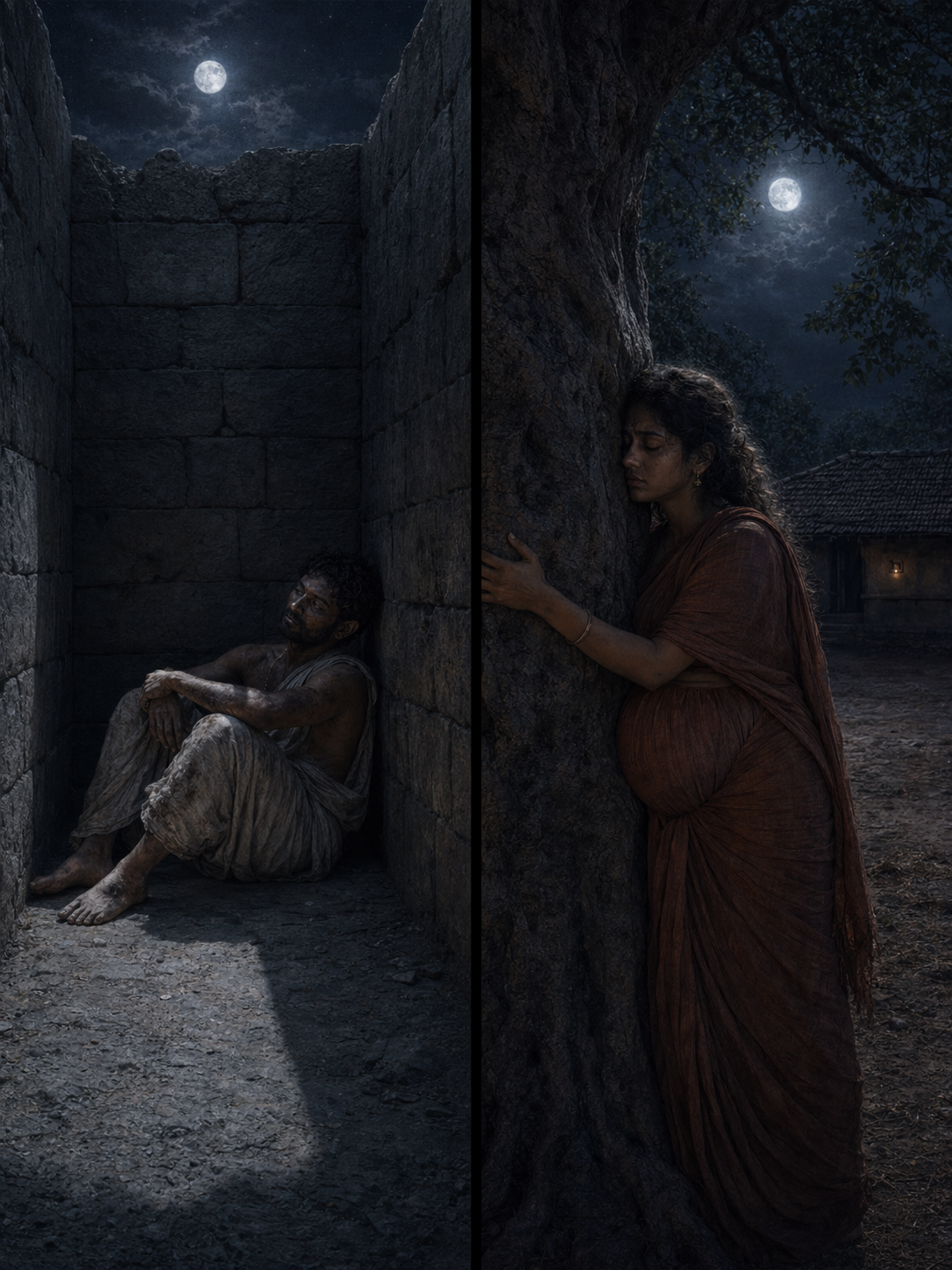 Same moon. Same night. One against cold stone, one against bark that remembered him.
The king arrived at the second prahar of the morning.
His procession was visible from the site before it arrived — the royal standard of Kalinga carried ahead, cavalry flanking, the ministers’ palanquins, the foot soldiers. The site had been arranged in what order was possible since before dawn.
Bishu stood at the enclosure wall and watched through the gap between the stones.
He had heard stories of Narasimhadeva since he was a boy in Kalinganagar — his father’s voice at night, the way stories of great men travel from city to village on the lips of merchants and pilgrims. The warrior king. The builder. He had constructed Narasimhadeva in his mind from those stories: large, imposing, the face of someone accustomed to being obeyed.
The man who dismounted at the site entrance was not that construction.
He was of middle height, lean, with the movement of someone whose body had been trained over a lifetime to be useful rather than impressive. His face in the morning light was sharp and present — not the remote authority of a man who has decided everything, but the particular attention of someone who is still measuring what he sees against what he was promised. He did not look like someone who could be told comfortable things and remain comfortable.
He walked into the site and looked at the foundation zone. For a moment he said nothing.
Then he turned to face the assembled workers — hundreds of them — and he spoke.
“You want to know why I am building this temple.”
Not a question. He asked it again anyway and let it stand.
“Why here. Why on the sea. I could have put this temple at Cuttack, at Puri, anywhere in Kalinga where the earth is stable and the stone does not move at night.” He looked across the compound. “I will tell you why.”
He spoke about what Kalinga was and what it could become. About Odia hands and Odia knowledge and what it meant to raise something the world could not look away from. About art and mathematics and the divine combined — a structure that was not only a temple but a statement, a calendar, a cosmological image in stone, a chariot of the sun frozen at the moment of sunrise for all of time. About the impossible made perfect. About how the world would write of Odias for a thousand years if they built this.
Bishu listened from behind the wall.
Something moved in him that he had not felt since the morning he left Kalinganagar. He was standing in a jail with no pothis and bruised hands and he was listening to the king of Kalinga describe exactly the thing Bishu had wanted to build since he was old enough to hold a reed. The wanting rose up through the humiliation and the broken feeling and the ache for UshaRani and stood there in his chest, alive and undefeated.
He was Odia. This was his temple too.
He pressed his forehead against the stone wall and closed his eyes for a moment.
The king had finished speaking and turned to Hamija. The tone changed.
Hamija stepped forward. He bowed with the practiced ease of a man who had stood before rulers before.
“Maharaj,” he said, “what your eyes see today is not delay. It is preparation. This foundation will carry the greatest shikhara ever raised in living memory — it must be set with a precision that has never been attempted before. We have been testing each approach, perfecting our method, rejecting what fails. Every day spent here in preparation is a day that ensures Maharaj’s temple will stand not for one generation but for a thousand years.”
He paused. Then, carefully:
“The sea presents challenges unlike any I have encountered. But I have built on difficult coastlines before and I understand what must be done. We are close. When Maharaj visits next, he will see not just stone above the waterline — he will see stone that will never move again. That is the only result worthy of this dream.”
He folded his hands and waited.
The king looked at Hamija for a long moment. Then he looked at the foundation zone. At the displaced blocks. At the absence of anything that had not been there on his last visit.
A minister spoke.
“Maharaj has not come to hear beautiful words about a thousand years. He has come to see stone above the waterline. That is the measure of progress — not promises, not preparation, but stone that stands.” He paused. “We will visit again. And we expect to see the sea has been answered, not only spoken about.”
“It will be answered,” Hamija said. His voice controlled. His chin slightly up.
The minister looked at him. “See that it is.”
The silence that followed was complete.
The king turned and walked back to his procession without another word.
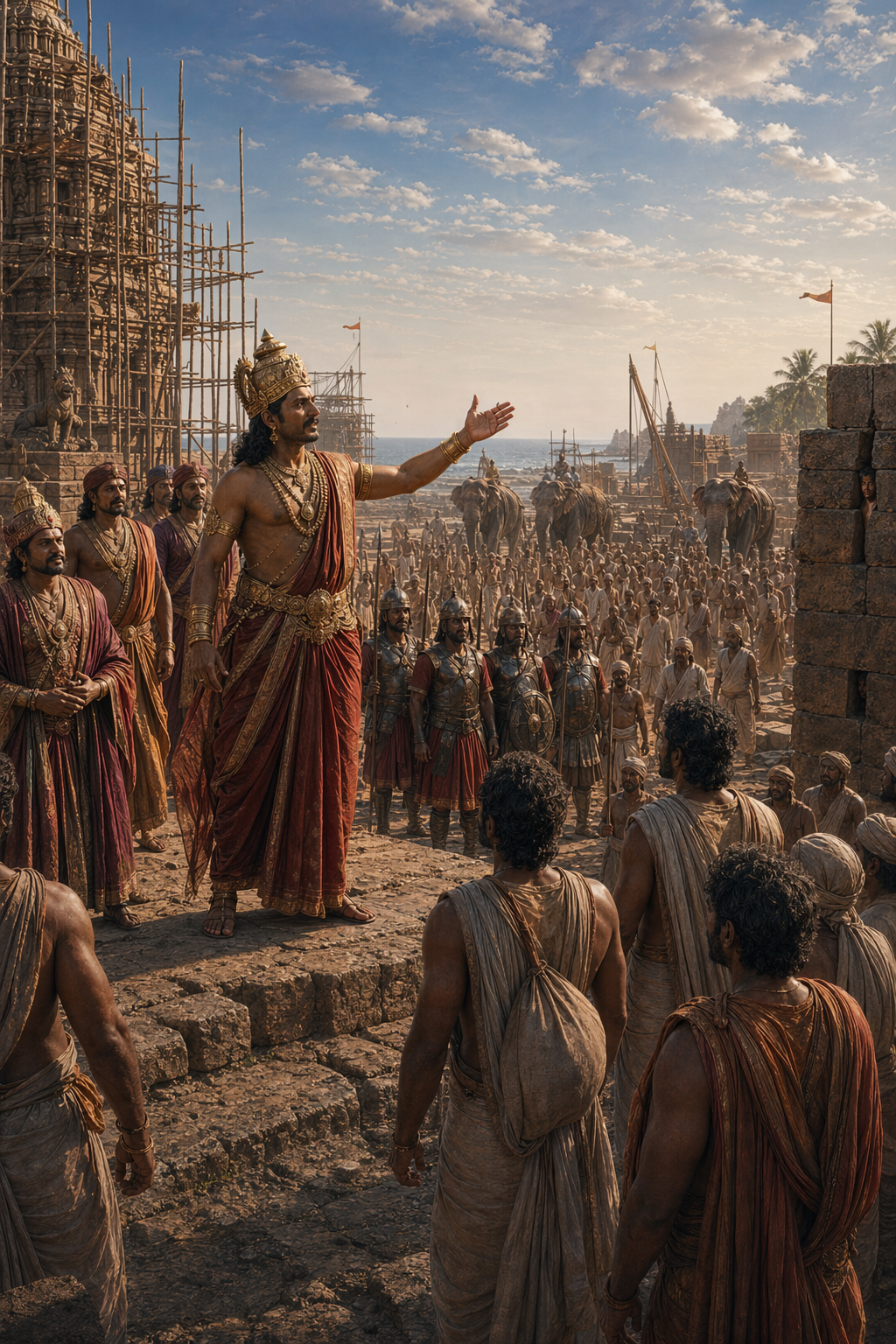 “The impossible made perfect.” — Bishu listened from behind a wall.
Three days in the jail followed the king’s visit.
Madhu came each evening — slipping food through the gap at the base of the gate, speaking in low voices.
“Is the pothi bag safe?” Bishu asked the first evening.
“I have it,” Madhu said.
“Good.”
“The king left without—”
“I know.”
A pause. The fire somewhere on the site. The sound of the sea.
“What did Hamija say to him?” Bishu asked.
Madhu told him. Word for word, as he had heard it.
Bishu was quiet for a long time.
“He is not wrong,” Bishu said finally. “About the thousand years part.”
“He is wrong about everything else,” Madhu said.
“Yes,” Bishu said. “That too.”
The Daku came on the ninth night.
No warning. The site perimeter was long and the guards spread thin — Hamija had never considered a raid a serious threat this close to the royal road.
They came from the western tree line — perhaps thirty men, armed, moving fast. They hit the food stores first: grain, dried fish, oil. The alarm from the perimeter guard gave the soldiers two minutes before the Daku were inside.
What followed was not a battle. It was a fight — fast, confused, brutal — swords in torchlight, men shouting, the elephants disturbed and beginning to trumpet, the watch-fires throwing uncertain shadows across men who could not always tell which side they faced. Three soldiers went down. Five Daku. The rest took what they could carry and moved back into the western dark before the full soldier contingent could form up.
When it was over the grain store had lost half its contents. The oil store was empty.
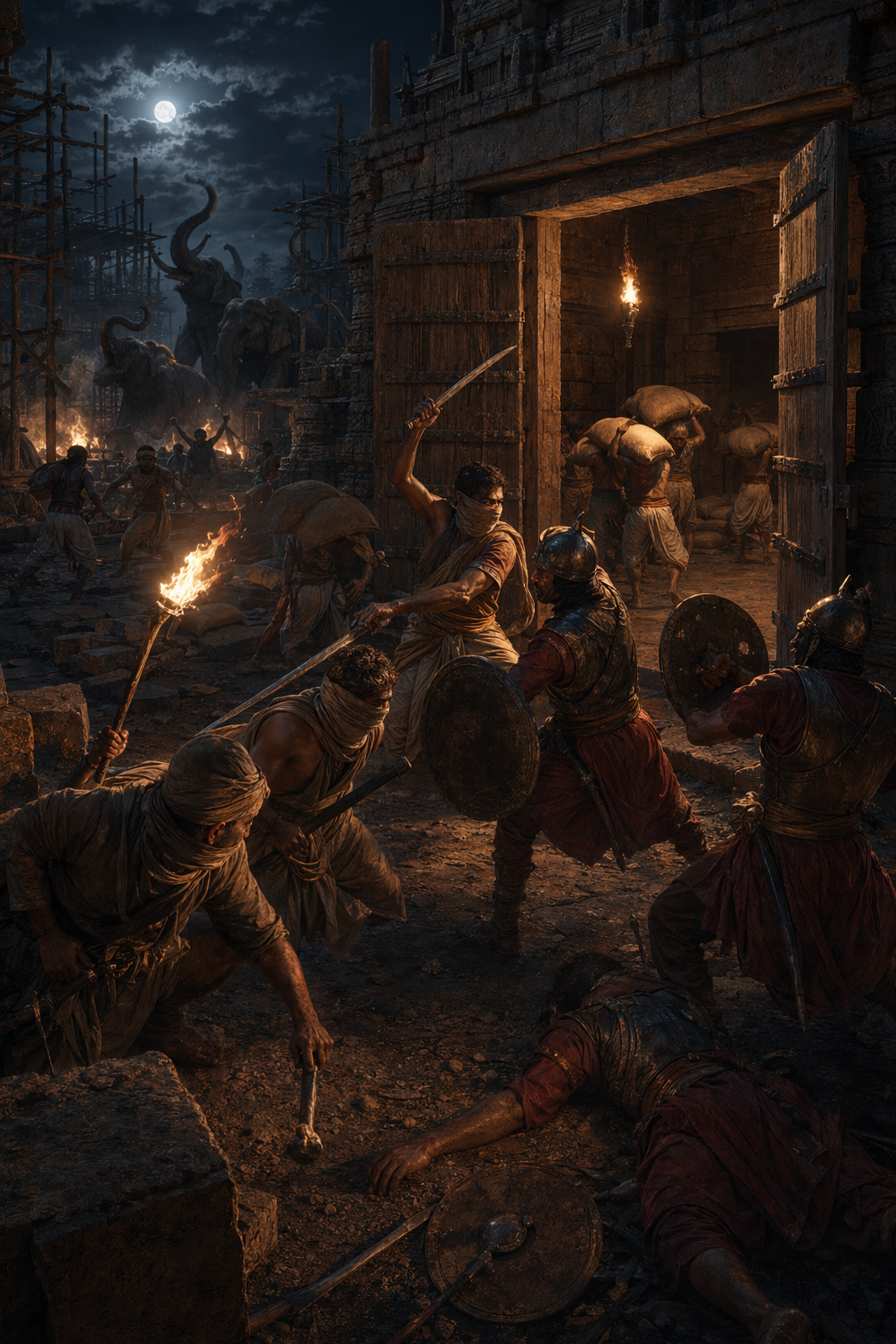 The ninth night — the sea was not the only problem.
The morning after the raid, the gate of the workers’ enclosure was opened.
A guard came, unlatched it, looked at Bishu and said: “You are needed for food transport.”
That was all.
Bishu picked up his pothi bag from where Madhu had hidden it near the water trough and walked out into the site. No apology. No acknowledgement. The gate simply open.
The work that followed was not the work he had come to do. Teams were organised to travel to villages along the coast — to buy and transport grain and oil back to the site. Bishu went twice, two days’ walk north and back, returning with loaded carts. On those roads, in those villages, away from the site and Hamija’s protected circle, there was no jail to contain the words people said.
Workers who had seen him dragged away. Villagers who had heard the story from site labourers resting at their chai stalls. Men who passed him on the road with a grain cart and felt no need to be quiet about what they thought of a sthapati who had been put in the workers’ jail by the greatest engineer in the eastern world.
The local boy who thought he knew better. Is this what Kalinganagar sends?
Bishu kept walking. He kept loading the carts. He kept coming back.
In Kalinganagar, the same days.
UshaRani walked home from the market.
The basket was heavy — aubergines, raw banana, green chilli. She walked the main lane in the afternoon light, her pregnancy no longer something that needed announcing. Two men stood at the corner before Pradhan’s house. She kept her eyes ahead.
They said what they said as she passed.
She did not stop. She did not look. She walked the full length of the lane with her back straight and her face forward and turned into her own gate and set the basket down and sat on the step with her hands in her lap.
The bara koli was in the courtyard. The afternoon light was in its upper branches.
She sat very still and let the words go into the place where she had been putting all such words — a place she kept closed and separate, that she would deal with when Bishu came back.
He would come back.
She got up and started the evening fire.
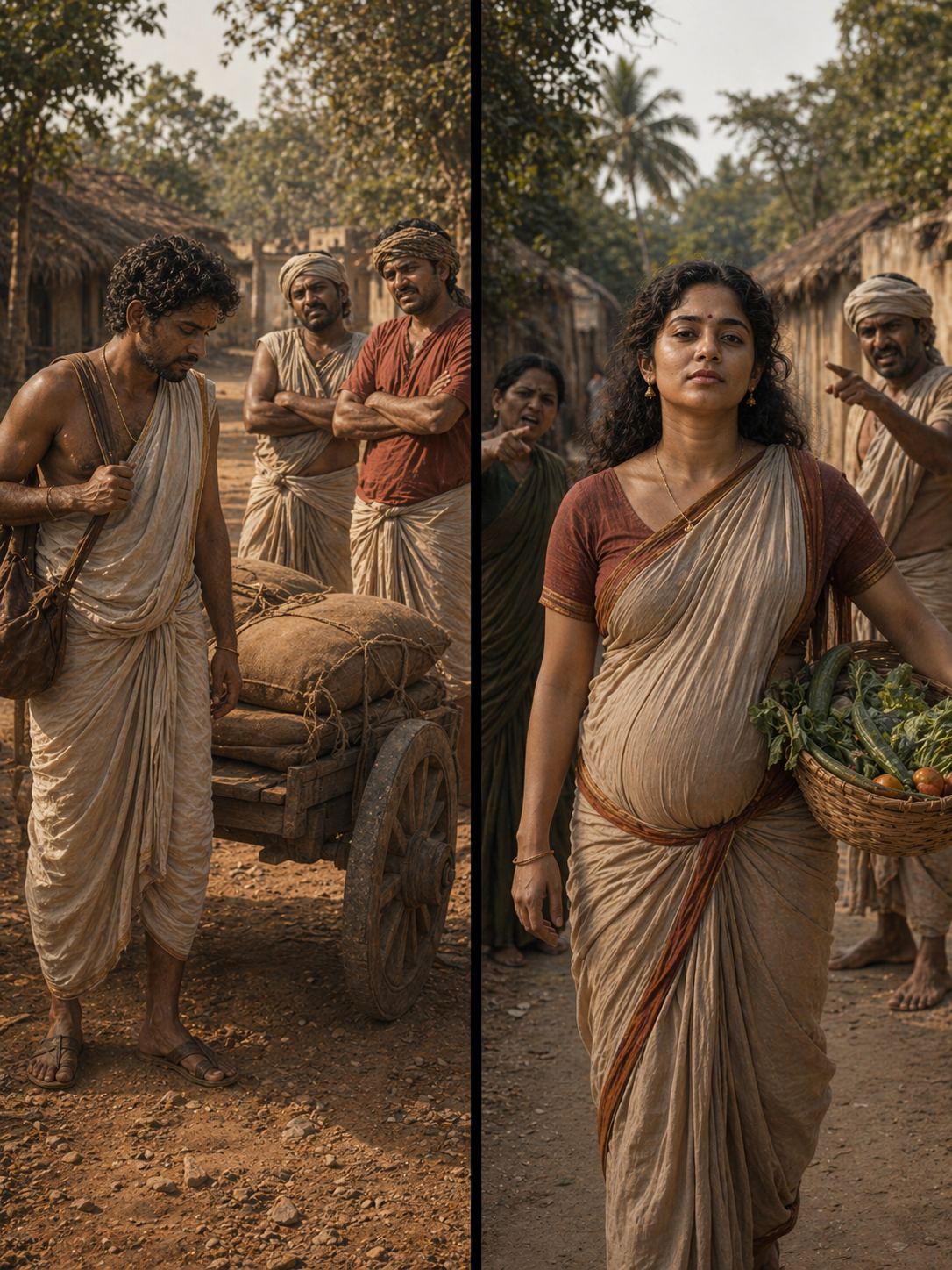 The same days — same words, same open road.
The temple work continued at the edges of this — stone cutters working, the elephant teams moving blocks — but the foundation problem was no closer to resolution and with the food problem layered on top the site had lost whatever momentum it had carried.
Dui paksha passed.
The edge of the rainy season was approaching — still weeks away but present in the quality of the evening air. The stone cutters knew it. The sthapatis knew it. When the rains came, the foundation work would halt entirely.
It was on the last day of the second paksha that a court official arrived from the direction of Cuttack, travelling with a small escort on a longer journey. He delivered his message to Hamija’s senior aide and was back on his horse within the hour.
The message reached Hamija in his planning room.
His Majesty Narasimhadeva, Sovereign of Kalinga, proceeds to Warangal on matters of the kingdom. His route passes through Konark. He will review the temple work on the way.
Hamija sat with the message for a long time.
The last visit, he had spoken of perfection and the minister had spoken of stone above the waterline. There was no stone above the waterline. There had been a raid. There had been dui paksha of reduced work. The rains were coming. And the king was coming first — this time not as a scheduled review, but as a stopover on the road to Warangal. Unannounced until today. No time to prepare speeches.
He set the message down on the unrolled plans. The plans that had not changed in all these weeks.
For the first time in all the days Bishu had been watching him, Hamija Maharana of Yawadvipa looked like a man who did not know what to do next.
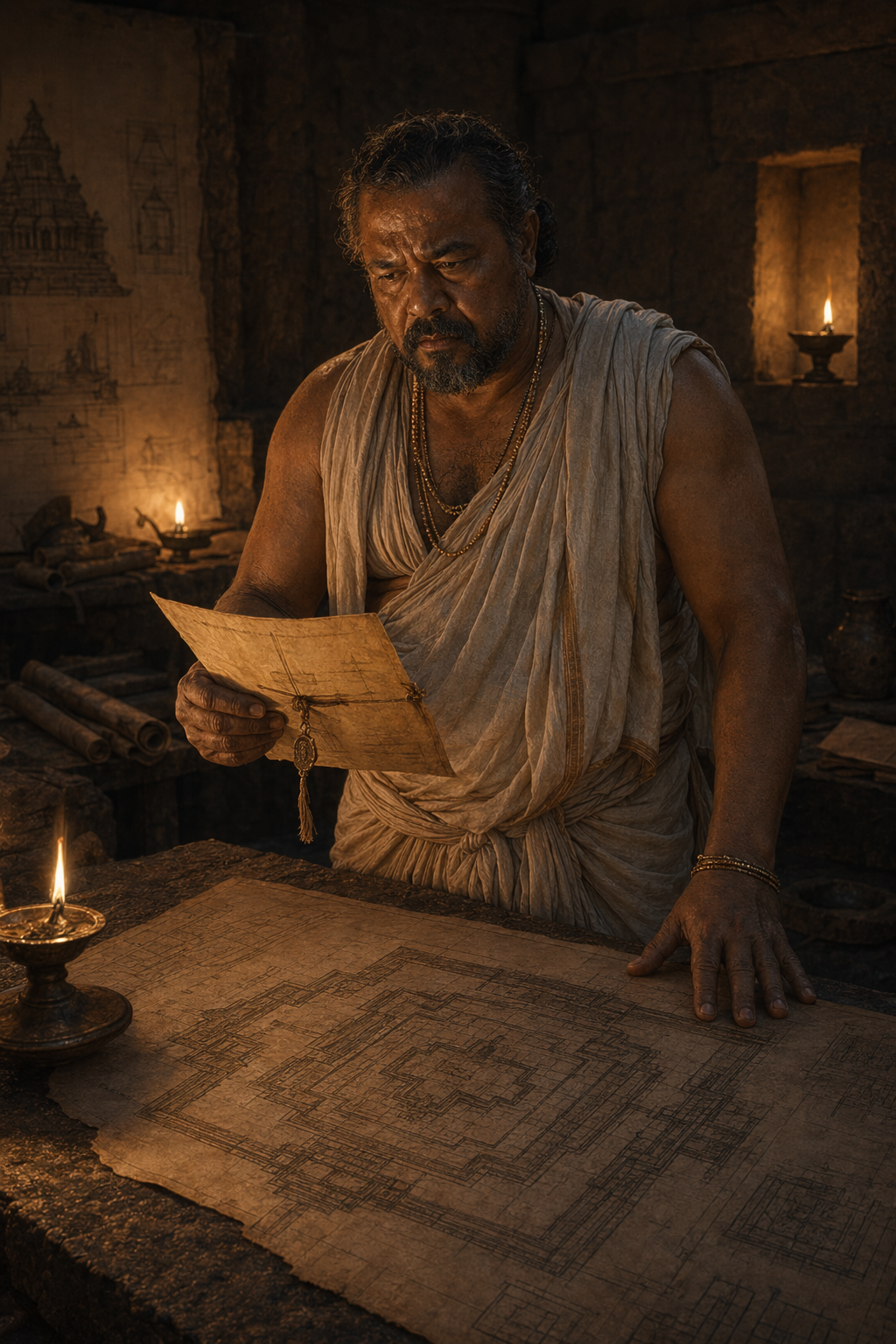 Dui paksha later — the king was coming again, this time on the road to Warangal. The sea had not moved.
To be continued — Part IV: The Water Finds Its Way
This is a work of historical fiction. The characters of Bishu Maharana, UshaRani, and Madhu are drawn from Odia oral tradition and legend. Dialogue, scenes, and personal details are the author’s invention. Hamija is a fictional character. Yawadvipa refers to the island kingdoms of present-day Java and Bali, known by this name in 13th-century Sanskrit literature. Warangal refers to the Kakatiya kingdom, a contemporary southern neighbour of Kalinga. Any resemblance to real persons beyond the historical record is unintentional.

Reader Comments
Loading comments…
Leave a Comment