The lamp had burned low by the time UshaRani stopped pretending she was asleep.
She lay on her side with her head on Bishu’s chest, her hand against the warm cotton of his dhoti, listening to his heartbeat. The room was dark except for the small flame at the threshold. Through the open window came the sound of the sea — distant, steady, without opinion.
“You are not sleeping,” Bishu said.
“Neither are you,” she said.
A pause. His hand found her hair.
“It will not be long,” he said. He had said this twice that evening. She hadn’t answered either time, because they both understood it was not true. A temple like the one the king had described — something the world had not seen before — was not a month’s work. Not a year’s.
“I know,” she said.
She had known since the morning the soldiers came. Known it even before that, in some quieter part of herself — the part that had watched him draw his elevations under the bara koli, morning after morning, and understood that what a man draws with that kind of absorption is not a profession. It is a calling. And callings, when they arrive in the form of four soldiers and a royal wax seal, do not negotiate.
She pressed her face into his chest.
“Bishu.”
“Hmm.”
She opened her mouth. The words were there — she had assembled them three times that evening: I am carrying your child. Our child. I have known for six days.
Three times. And three times she had set them down.
Because she knew him. If she said those words, he would look at the door waiting to be opened at dawn, and then he would look at her, and something in the calculation of his life would shift. This was his Konark. His pothis had been reaching toward this since before she existed in his life. A child was not a reason to let a king’s summons pass. But it would make the leaving heavier. And she loved him too exactly for that.
She closed her mouth.
“What?” he said.
“Nothing,” she said. “Tell me about the temple.”
He was quiet for a moment. Then he began to speak — softly, in the dark, as if telling a story — about a Rekha Deula of a scale not attempted since the great shrines of Lingaraja, about a structure that would face the rising sun so that first light entered the sanctum exactly at the solstice, about the chariot form he had been imagining for years: the temple as the sun god’s vehicle, twelve pairs of stone wheels, stone horses in full stride, the entire compound a single cosmological image in dressed stone.
His voice in the dark was the voice of a man who had been carrying something inside him for years without knowing that someday someone would hand him the stone.
She listened. She let his voice fill the room the way the lamplight filled the corners — insufficient for everything, enough for this.
When he finished, she lay still for a long time.
“Come back to me,” she said finally. Very quietly. “Whatever else you build — come back.”
His arms tightened around her. He didn’t answer. He didn’t need to.
She closed her eyes. The night passed without sleeping. The diya burned until it didn’t. Somewhere past midnight the bara koli shifted once in the sea wind outside.
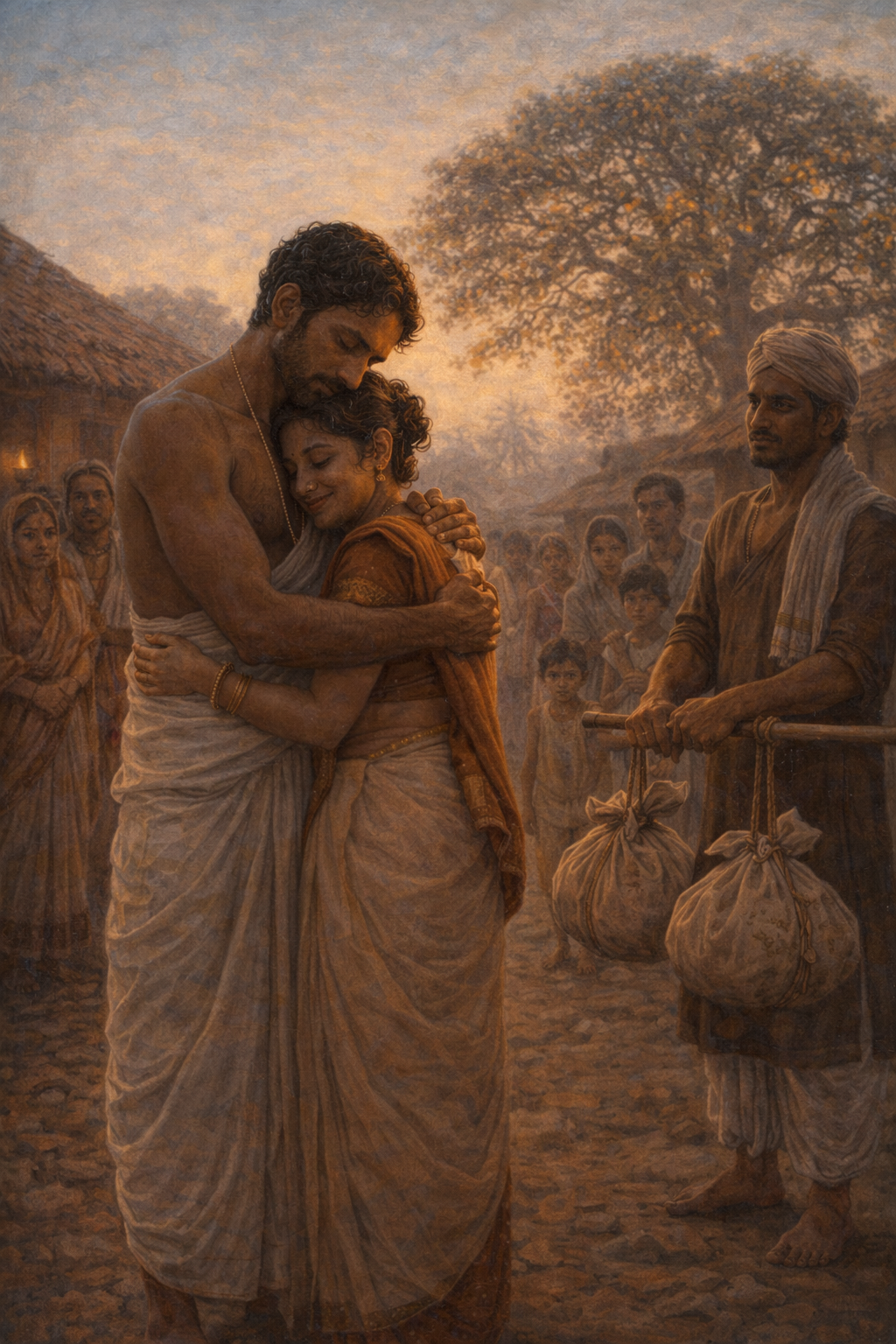
The whole of Kalinganagar was standing in the lane when Bishu opened the door at first light.
Not the entire village — not the infants, not the very oldest — but everyone else. They stood in the blue-grey half-light, the women with their pallus drawn against the chill, the men with gamchas folded over their shoulders, children clutching things they had brought.
Bishu stood in the doorway and looked at them and did not speak.
Madhu was at the front. He’d been awake before anyone else and had organized all of this without being asked. He met Bishu’s eyes and did not say anything sentimental. He nodded once — the way men nod when words would only reduce something.
They came forward one by one. Old Hara pressed dried bel leaves into Bishu’s hands — good for fever, good for long roads. The rice merchant’s wife had packed flattened rice and jaggery, three days’ worth. Govinda the weaver brought a thick cotton shawl, folded with care. The blacksmith had wrapped a small chisel in oilcloth — short-handled, the kind that fits in a pothi bag. The schoolmaster brought nothing and said: “We are watching, Bishu Maharana. All of us. Do not forget that we are watching.”
And one by one, each of them said the same thing to Madhu — some aloud, some with a look, some with a firm hand on his shoulder: Stay with him. At any cost, stay with him.
Madhu received each of these with the gravity they deserved.
The putlis were loaded — cloth-wrapped bundles tied at each end and slung over a carrying pole. Madhu’s was already packed and waiting at the gate. He had volunteered himself for this journey the previous evening in a single sentence: “You will need someone to talk to. You talk to yourself too much — it makes people uncomfortable.”
 Kalinganagar, dawn — “We are watching, Bishu Maharana”
UshaRani stood at the doorway.
She had dressed carefully — not silk, not ceremony, but not nothing either. Her hair properly pinned. The teel above the corner of her mouth catching the early light. She was smiling, which cost her more than anything in the world at that moment.
When the village had said everything it needed to say and the bundles were tied and old Hara had invoked Lord Jagannath three times with increasing volume, they stepped back. The lane fell quiet. Just the two of them in the doorway.
Bishu turned to her.
She stepped forward and held him — not the composed farewell of a Sthapati’s wife. She held him as hard as she could, her face against his shoulder, both arms around him, hands pressing against the cloth of his back. He held her back. His pothi bag between them, the blacksmith’s chisel already tucked inside.
“Ushi,” he said. Her name the way only he said it. Two syllables, private.
She loosened her hold. Straightened. Put one hand briefly against his cheek — one moment, exact — and stepped back.
“Go,” she said. “Go and build something that lasts.”
He picked up his pole and walked.
The village fell in behind him to the edge of the lane. Madhu walked at his shoulder. The morning opened around them — sea air over the coconut grove, first birds beginning, sky lightening over the Bay of Bengal.
UshaRani stood at the gate until the lane bent and the trees took them.
Then she went inside. Put her hand on the bark of the bara koli as she passed. Sat on the mat where Bishu worked every morning and looked at the empty space where his pothis had been. And she let herself feel, for three minutes, everything she had held since the soldiers knocked.
Then she got up and started the morning fire.
The road from Kalinganagar to Konark ran first through forest.
For two days the trees closed over them — old growth, dense, indifferent, the kind of forest that does not notice individual people passing through it, only the passage of feet. The path was narrow and well-used: traders, fish sellers, salt merchants, pilgrims bound for Puri had walked it for generations. Dappled green light. The sound of unseen water. Birds conducting their own arguments overhead.
Madhu talked. This was his function on long roads, as Bishu had always understood it — to keep the silence from becoming a place where you could too easily lose yourself.
“The king will have heard of the Sakshigopal shrine,” Madhu said, navigating a root across the path. “And the Charchika mandap at Banki. I am not saying it went directly to the king’s ear. I am saying news of good work travels.”
“You told the rice merchant’s cousin,” Bishu said.
“I may have mentioned it. Someone had to. You were never going to mention it yourself.”
“And you think this is how kings choose their Sthapati.”
“I think,” Madhu said, “that when the king of Kalinga calls a man from a village sixty houses wide to build something the world has not seen — that man is going as the head of the work. The Mukhya Maharana.”
Bishu said nothing. He was looking at how light distributed through branches from a central trunk.
“You are thinking about the temple,” Madhu said.
“I am always thinking about the temple.”
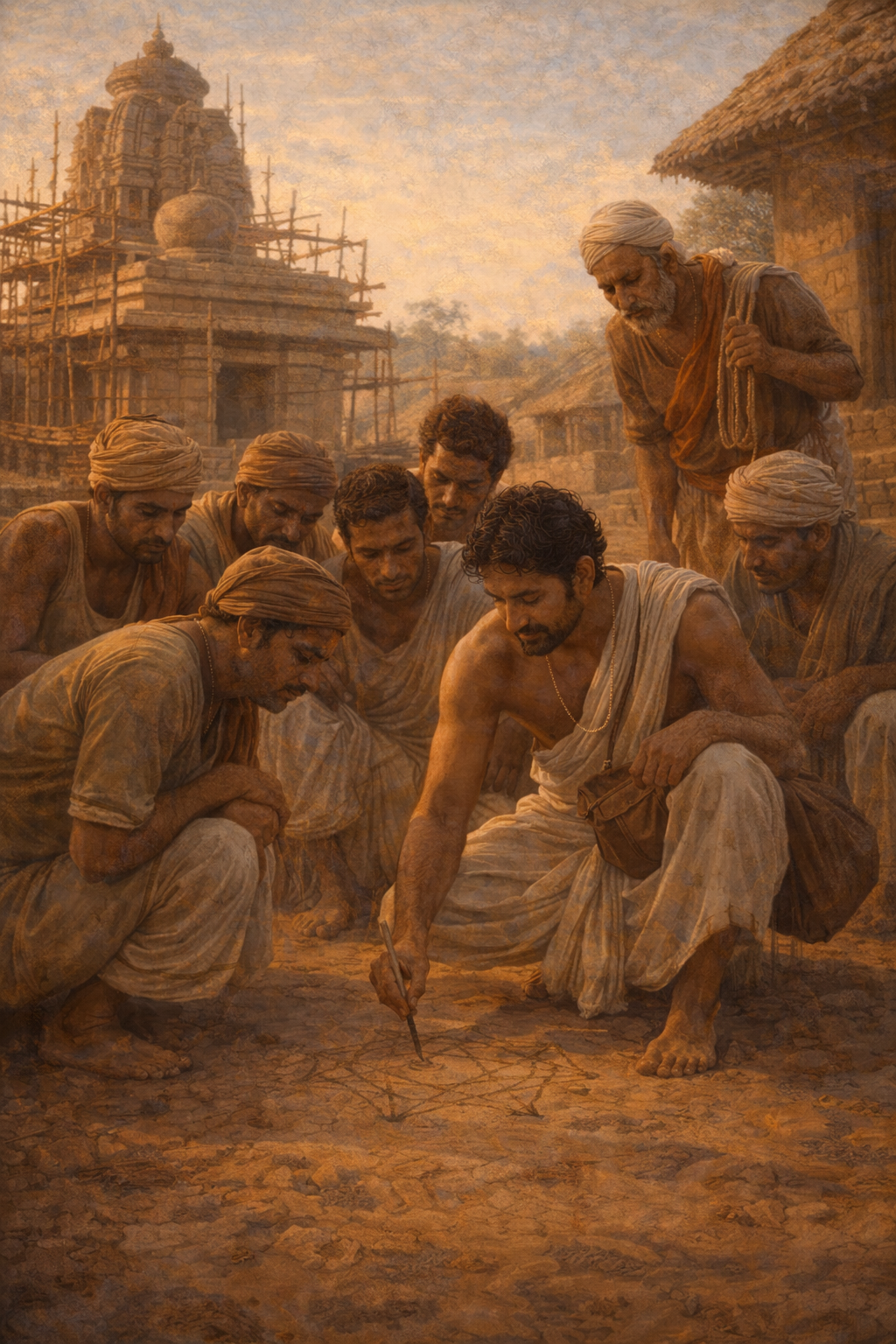
On the third day they came through a village — forty houses on a rise above a small river, a new Shiva temple under construction at its northern edge.
The problem was visible from thirty feet.
Six men stood around the shikhara — which had risen to two-thirds of its intended height — in the posture of men who have been arguing about something long enough that the argument has become the shape of the day. On a platform above them, waiting to be set, was the Kalasha stone — the crowning disc — and before anyone spoke, Bishu understood what was wrong.
He set down his putli pole.
“Who is the Sthapati here?”
A man came forward — local, calloused hands, measuring rope, and the wariness of a craftsman about to receive someone else’s opinion of his work. “Three times we have placed it and three times it shifts. The alignment is correct. The anchoring is correct. But it will not sit.”
Bishu walked around the base of the shikhara once, slowly. Looked up.
“What is the perimeter of the top course of your shikhara?” he asked.
The Sthapati told him.
“And the perimeter of your Kalasha?”
The same. Exactly.
Bishu nodded. “There is your problem.” He crouched and drew in the dust — a quick cross-section, the beki above the shikhara, the Kalasha at the crown. “The Kalasha must not match the perimeter below it. It must be smaller — by this proportion.” He marked the ratio. “When you match exactly, the mass between the temple stone and the crown stone creates an unresolved force at the contact point. The slightest asymmetry in placement and the crown shifts.”
“The texts say—”
“The texts give the principle. The principle is proportion, not equality.” Bishu stood. “What stone did you use for the Kalasha?”
“Same quarry. Same batch as the shikhara.”
“That is the second problem. The crown stone must be lighter than the body — not different in appearance, different in density. The body anchors. The crown arrives. That stone up there is fighting the structure beneath it instead of completing it.”
The local Sthapati looked at his Kalasha with the expression of a man seeing a familiar object for the first time.
“What is the correct mass?” he asked.
Bishu told him. Drew the ratios in the dust. Explained the way he always explained — as if the knowledge belonged to the work, not to himself.
 “The body anchors. The crown arrives.” — a village temple, third day of the road
They stayed two hours. When they left, the local Sthapati was already sending a man to the quarry with new measurements. Someone pressed a bundle of roasted groundnuts into Madhu’s hands.
“Head Maharana,” Madhu said on the road out, chewing a groundnut. “Guaranteed.”
“It was a simple error,” Bishu said.
“That no one else there could correct.”
Bishu didn’t answer. He was thinking about something else.
On the fifth day the forest gave way.
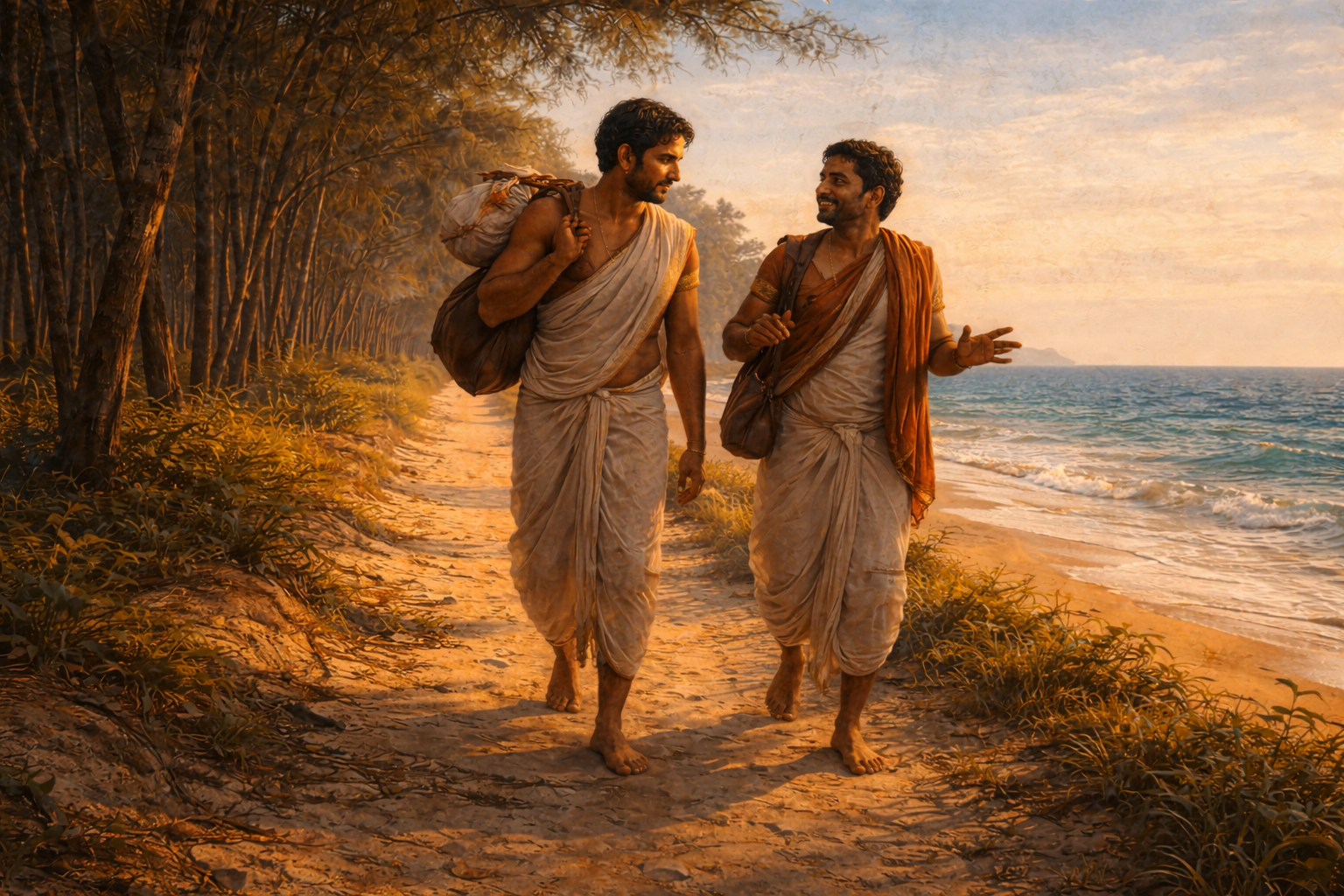
They came out onto the coastal plain — flat land, wide sky, the Bay of Bengal audible before it was visible. The path ran along the shore for several hours, close enough to the water that spray reached them when the wind shifted. The beach was wide and pale orange-gold. The sea a hard bright blue.
The jhaun grew thick along this stretch. Casuarina — the tree that looks like a pine that decided to grow by the sea instead: thin needle-branches shifting constantly in the salt wind, their sound a particular dry whisper unlike anything in the forest behind them. Long lines of them along the sand, branches moving in the continuous sea breeze.
Bishu stopped once, his hand on a trunk, listening.
“The wind through stone will sound like this,” he said. “If the perforations are placed correctly.”
Madhu looked at the trees. Looked at Bishu. “You are thinking about the temple.”
“I am always thinking about the temple.”
“Last night in your sleep you said her name. But your hands were doing calculations.”
Bishu started walking again.
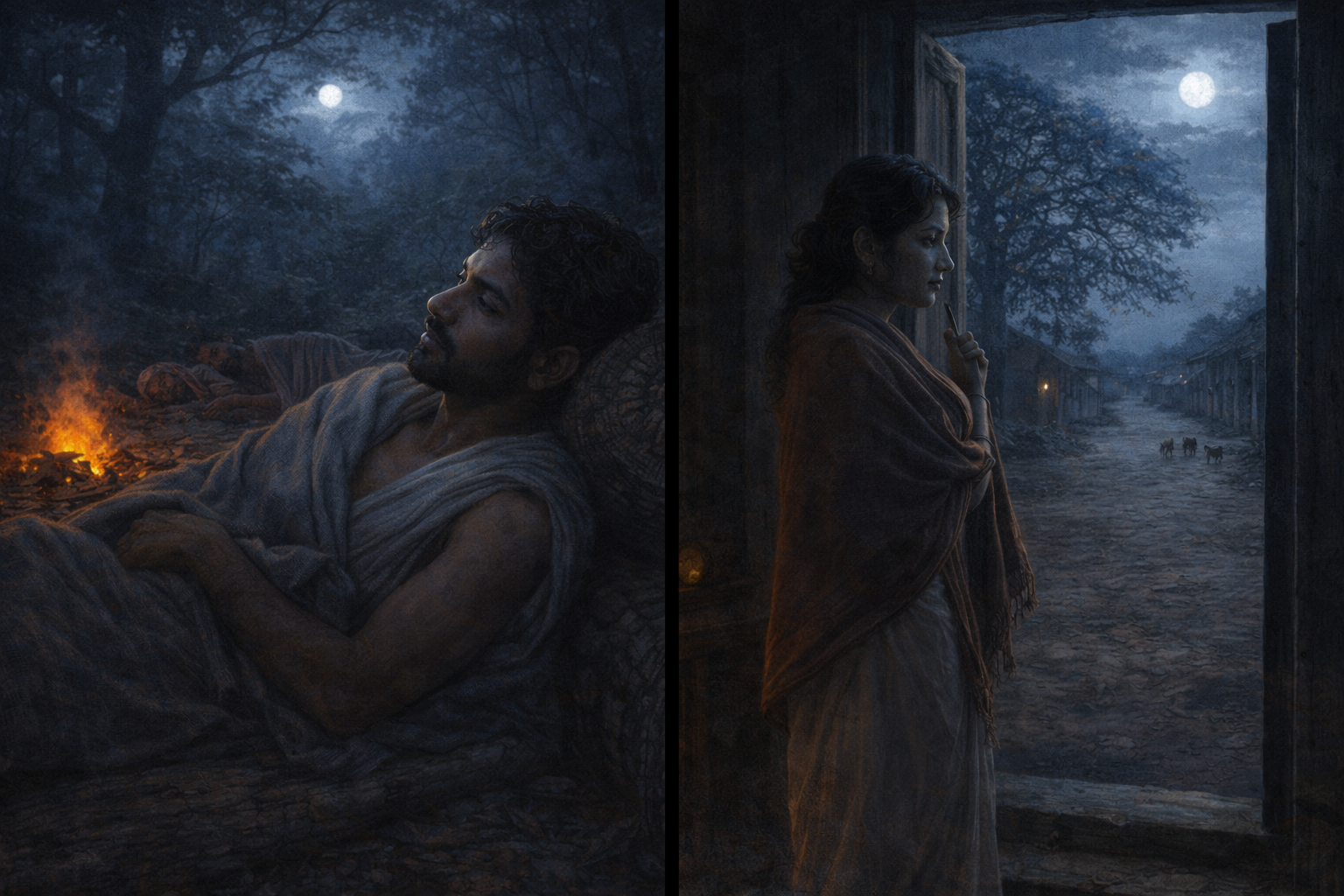
On the fourth night, deep in the forest before the coast opened, they made camp at the edge of a clearing under a sky doing its best to be vast. A fallen ashwatha — enormous, centuries old, dropped by some storm long before either of them was born — lay across one edge like a provided seat. Madhu built the fire against its root end. They ate the last of the flattened rice and what remained of the jaggery. Madhu was asleep within minutes, his gamcha over his face.
Somewhere to the north, at intervals, came the bark of a fox.
Bishu lay on his back on the fallen trunk, his pothi bag under his head, looking up through the canopy break. Fire low. The moon past full but still bright enough that the clearing had a silver quality, shadows long and still.
He closed his eyes.
And UshaRani came.
She came the way she came in the house — unhurried, knowing exactly where he was — carrying the thick cotton shawl from Govinda the weaver. She draped it over him, tucked the edge at his shoulder, and sat beside him on the bark. Within reach. Not touching. Her hand resting near his.
He said her name. Ushi.
She turned to look at him.
He opened his eyes.
The moon. The clearing. Madhu’s snoring. The fox barked once from the north and fell silent. The shawl from Govinda the weaver was around him — he must have pulled it on without remembering.
He lay still. He thought about the angle of her neck when she cooked by the stove, and something he could sense without being able to name — something she had held back from him in the dark the night before he left — sat just out of reach.
He turned on his side and waited for morning.
In Kalinganagar, the same night, UshaRani woke to the sound of her name.
Not her name. The other one. Ushi — spoken from just outside the door, quiet and certain.
She was up before she was fully awake. Her hand on the latch. The door open.
The lane was empty.
Deep night — the hour when the stars are brightest and the village is entirely without sound. The bara koli stood in the moonlight, branches silver-grey. Three dogs visible as shapes in the lane, occupied with the indifferent business of dogs at night, not looking at her.
She stood in the doorway.
She was not frightened. She felt something closer to the opposite — as if her name called from an empty lane was its own kind of presence, its own kind of answer.
“I am here,” she said quietly, to the dark, to him, four days’ walk away, asleep on a fallen tree under an open sky.
She closed the door and went back to the mat. Lay down with her hand placed gently over the small new fact of herself. And listened to the sea.
 The same night, four days apart — he opened his eyes to jungle, she opened the door to dark
They heard the site before they saw it.
A sound composed of many sounds — stone on stone, hammers in rhythm, men coordinating heavy work, the creak of wooden scaffolding under load. It reached them on the sea wind as they crested the last rise of the coastal path, and then the site was before them.
It was larger than Bishu had imagined. He had imagined it large.
The temple compound had been marked and cleared — an area of ground built to accommodate something vast, the earth already cut and levelled in sections, foundation trenches visible as long dark lines. Around the perimeter: scaffolding, organised labour — stone cutters, dressers, carriers, Sthapatis in small groups with plans unrolled on portable boards. Hundreds of men. Perhaps more.
At the centre, on a raised platform of dressed stone, stood a man with his back to them.
Heavyset, broad-shouldered, his dhoti and uttariya the dusty white of someone on this site from the first day. His voice — when he spoke, which was often — carried across the ambient noise without effort: adjustments, corrections, approvals, dismissals. The men around him moved with the speed of people who understand consequences.
“Hamija,” Madhu said quietly.
Bishu said nothing. He was watching.
A soldier appeared at their side — perimeter guard, royal Kalinga insignia. “Names and purpose.”
“Sthapati Bishu Maharana of Kalinganagar,” Madhu said. “Summoned by royal command of Maharaja Narasimhadeva.”
The soldier cross-referenced something. “Sthapati section. Report to the eastern assembly.”
He turned and walked.
Bishu stood still for a moment. He looked at the eastern assembly — a group of perhaps twenty men in similar dress, waiting near a stack of dressed stone, being addressed by a junior supervisor.
Twenty. He was one of twenty.
“Head Maharana,” Madhu said carefully. “Not yet assigned. Still possible.”
Bishu picked up his pothi bag and walked toward the eastern assembly without answering.
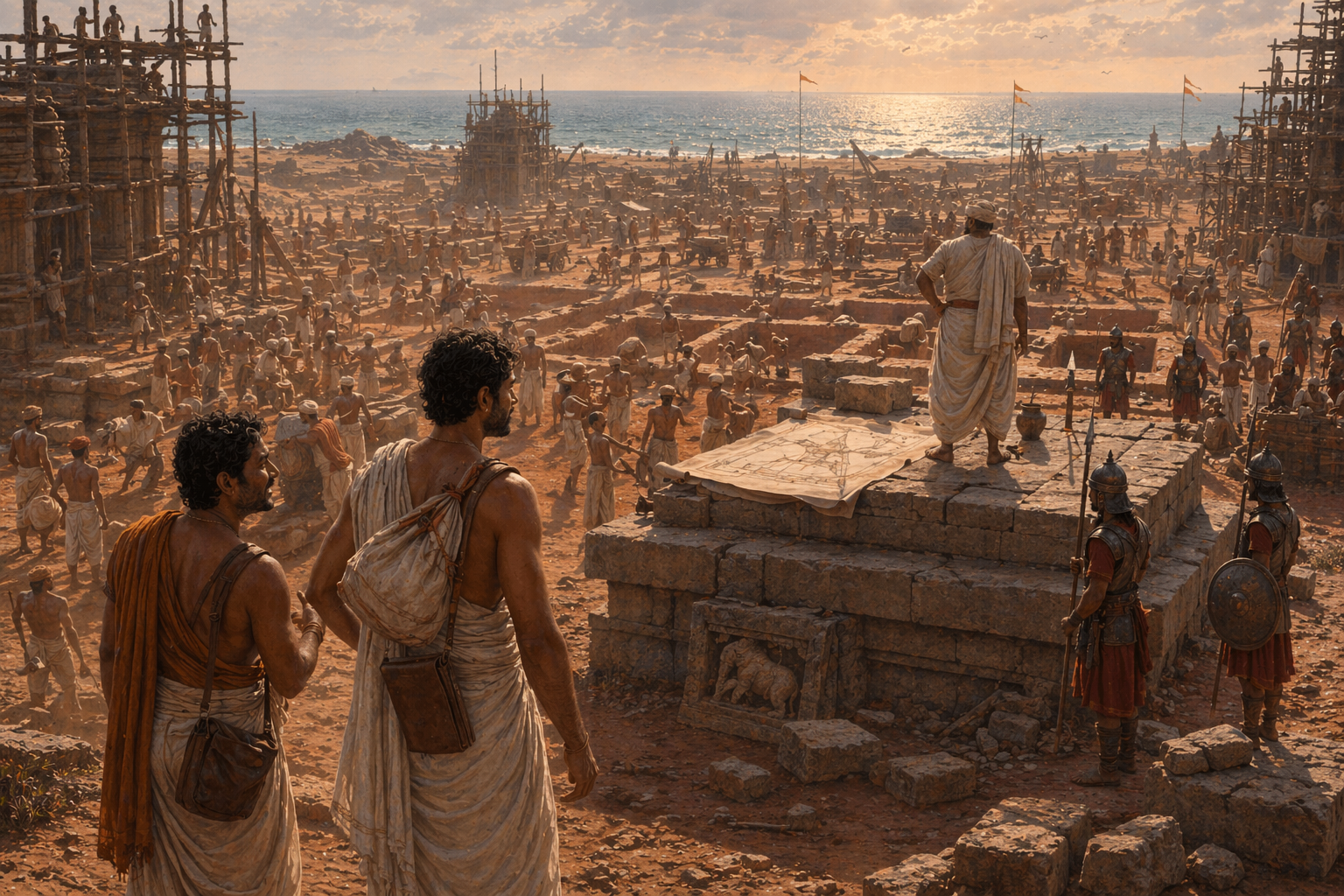 Konark, the site — larger than Bishu had imagined. He had imagined it large.
For two days Bishu worked in the assembly — reviewing plans, taking measurements, doing what was asked. He did it well and quietly. He was trying to understand the structure of the work before he said anything about the work.
On the third day he found the problem.
A foundation question. The primary base course on the western section had been laid three degrees off the cardinal alignment. Three degrees — nothing to the eye. Catastrophic at height. By the time the shikhara reached its intended elevation, the accumulated deviation would be — he calculated it twice, sitting against a stone with his reed — more than the width of a man’s hand at the crown. On a building designed to receive the sun’s first rays at precise angles on the morning of the solstice, a hand’s width at the crown was not a small matter.
He walked across the site toward Hamija’s platform.
Hamija was managing three simultaneous problems on different sections, his voice moving from section to section without interruption. He had been doing this for thirty years, it was clear, and did not require outside confirmation of what he already knew. He had also, Bishu understood from three days of watching, made the foundation decision himself and was not revisiting it.
Bishu reached the base of the platform.
“Hamija Maharana,” he said. “There is a matter of the western base course—”
He did not see the soldier to his left move.
The lash caught him across the upper back and shoulder — not a punishment stroke, but the flat-strap warning that cleared impertinent approaches from senior supervisors on royal construction sites. Quick, practiced, impersonal.
Bishu staggered one step.
The area around the platform went still.
Hamija had not turned around. He was marking a measurement. His voice continued, directed at someone on the eastern scaffold, entirely uninterrupted.
Madhu, thirty feet away, was on his feet.
Bishu straightened slowly. He stood for a moment looking at the broad back of the Head Maharana on his platform — at the plans being marked, at the site spreading in all its organised, purposeful, three-degrees-wrong scale.
Then he turned. He walked back to the assembly area.
Madhu reached him in six steps. “Bishu—”
“Not now,” Bishu said. He sat down against the stone. Opened his pothi. Turned to a clean page.
He was going to need a different approach.
Part 2 of 3 · Konark’s Dharmapada series · Continue: Part III: Stone and Tide
This is a work of historical fiction. The characters of Bishu Maharana, UshaRani, Madhu, and Dharmapada are drawn from Odia oral tradition and legend. Dialogue, scenes, and personal details are the author’s invention. Inspired by the legendary accounts surrounding the Konark Sun Temple. Hamija is a fictional character. Any resemblance to real persons beyond the historical record is unintentional.
Reader Comments
Loading comments…
Leave a Comment