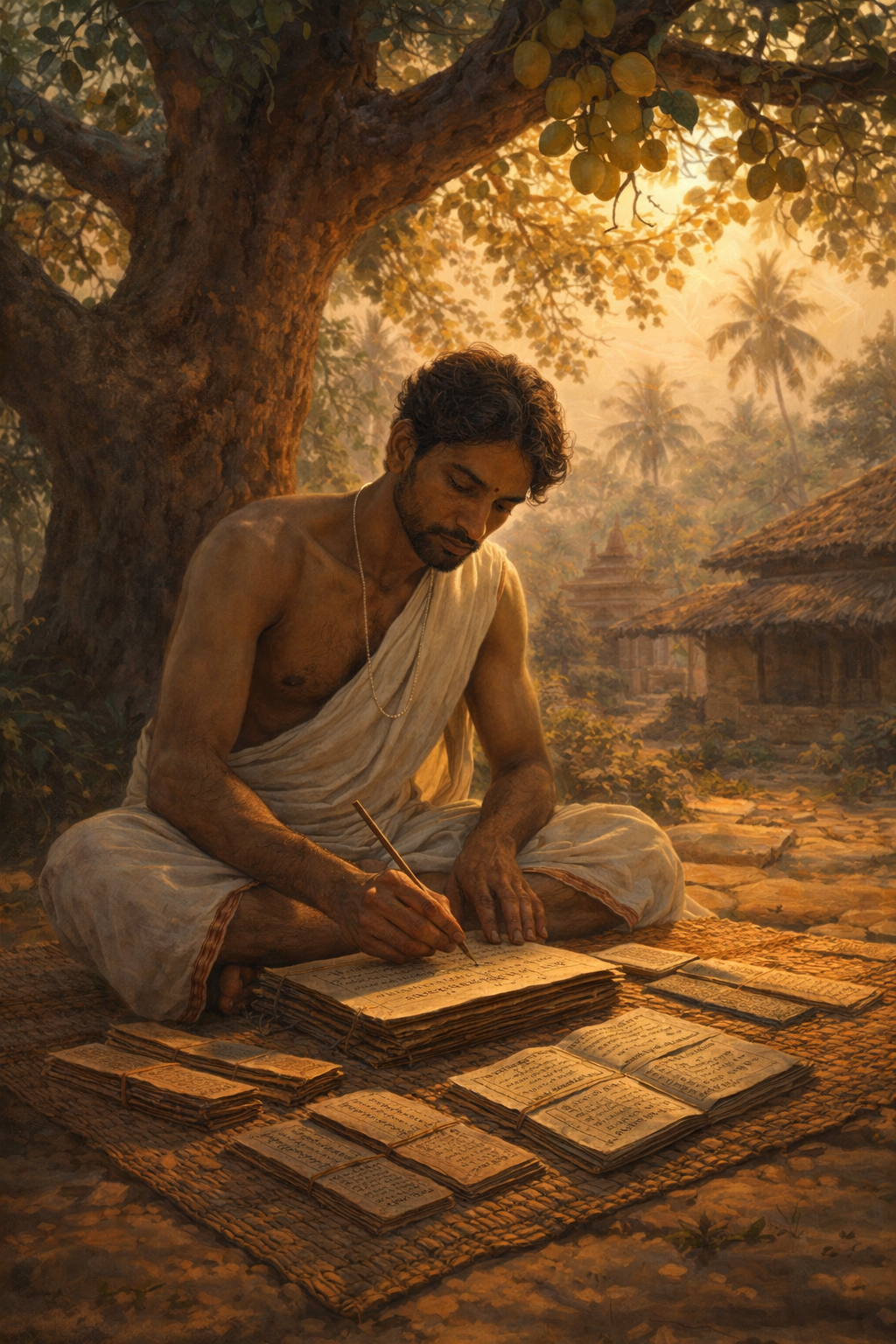
The sea did not care about Kalinganagar.
It moved past the village the way it moved past everything on this coast — restless, indifferent, carrying its salt wherever the wind directed it. The village stood on a strip of land between coconut groves and the Bay of Bengal — perhaps sixty houses, thatched roofs and mud walls the colour of old clay, a small pond at the centre, a Jagannath temple at the eastern edge. At the far end of the northern lane, behind a house somewhat larger than the others, stood a bara koli tree that had been there, by village estimate, since before anyone’s grandfather’s grandfather was born.
No divine significance. No legend. It produced fruit twice a year — small, pale yellow-green, sweet with a sourness underneath that sat in the back of your mouth for an hour. The villagers knew it the way they knew the pond and the temple. A fact of the place.
Except that since Bishu Maharana had moved in behind it, the tree had acquired a second significance.
It was where he worked.
Every morning before first prayers, before the village had properly decided to be awake, Bishu was already under the bara koli. Cross-legged on a woven mat, his pothis arranged around him in careful order — long rectangular palm leaves, each bound with a cord, covered in the close dense script of a man who thought faster than he wrote. His janai caught the early light as he bent over his work. He drew with a reed stylus: arcs, proportions, the elevation of an imagined Rekha Deula rising from its base, the mathematical relationships between the Garbhagriha and the Jagamohana that the Silpa Shastra called eternal as the stars.
He was thirty-two. His hands moved with the certainty of hands that have been doing this since they were old enough to hold a reed.
Kalinganagar called him Sthapati Bishu Maharana — the title of a master of Vastu Vidya, the ancient science of form, proportion, and divine space. He had earned it younger than anyone in the surrounding villages had heard of. The village was quietly proud of this, in the way small places are careful about exceptional things — afraid that too much talk would draw the world’s attention, and the world would take it.
People came to him constantly. A farmer whose new house sat at an inauspicious angle to the sun. A merchant wanting to know if his storehouse stood in harmony with the five elements. A temple committee arguing about the correct height of their shikhara. Bishu listened, asked his precise questions, unrolled a pothi, drew something quickly, explained. He charged very little. Money did not interest him.
His pothis interested him. His wife interested him. And the bara koli.
In that order, some said. Those who knew him better understood the order was entirely different.
Pradhan Judhistir had given his daughter UshaRani in marriage to Bishu on the fifth day of Kartik, one year ago.
The mandap stood in the Pradhan’s courtyard — bamboo poles hung with marigold chains and mango leaf toranas, the ground sprinkled with turmeric water, a square fire pit at the centre. Half the village came. The smell of the evening — wood smoke, sea air, white flowers — was one that Kalinganagar would carry for years.
The girls began singing before the groom arrived.
Aa re bou, aa re bou, aaji tora lagna ghara bhara—
Eight or ten of the young unmarried women in their reds and yellows, clapping in rhythm, their Mangala Gita rising into the evening with the joyful shamelessness of girls not yet required to be dignified. The chorus rolled through the courtyard and through the lanes beyond, reached the old women on their doorsteps who closed their eyes and smiled.
Bishu arrived in a new white dhoti and a garland of white flowers, his janai gleaming. He walked with the slight forward lean of a man whose mind was always partly elsewhere — in this case, almost certainly on the pothi he had nearly brought and been loudly talked out of by his friend Madhu at the gate. He sat at the mandap, folded his hands, and waited.
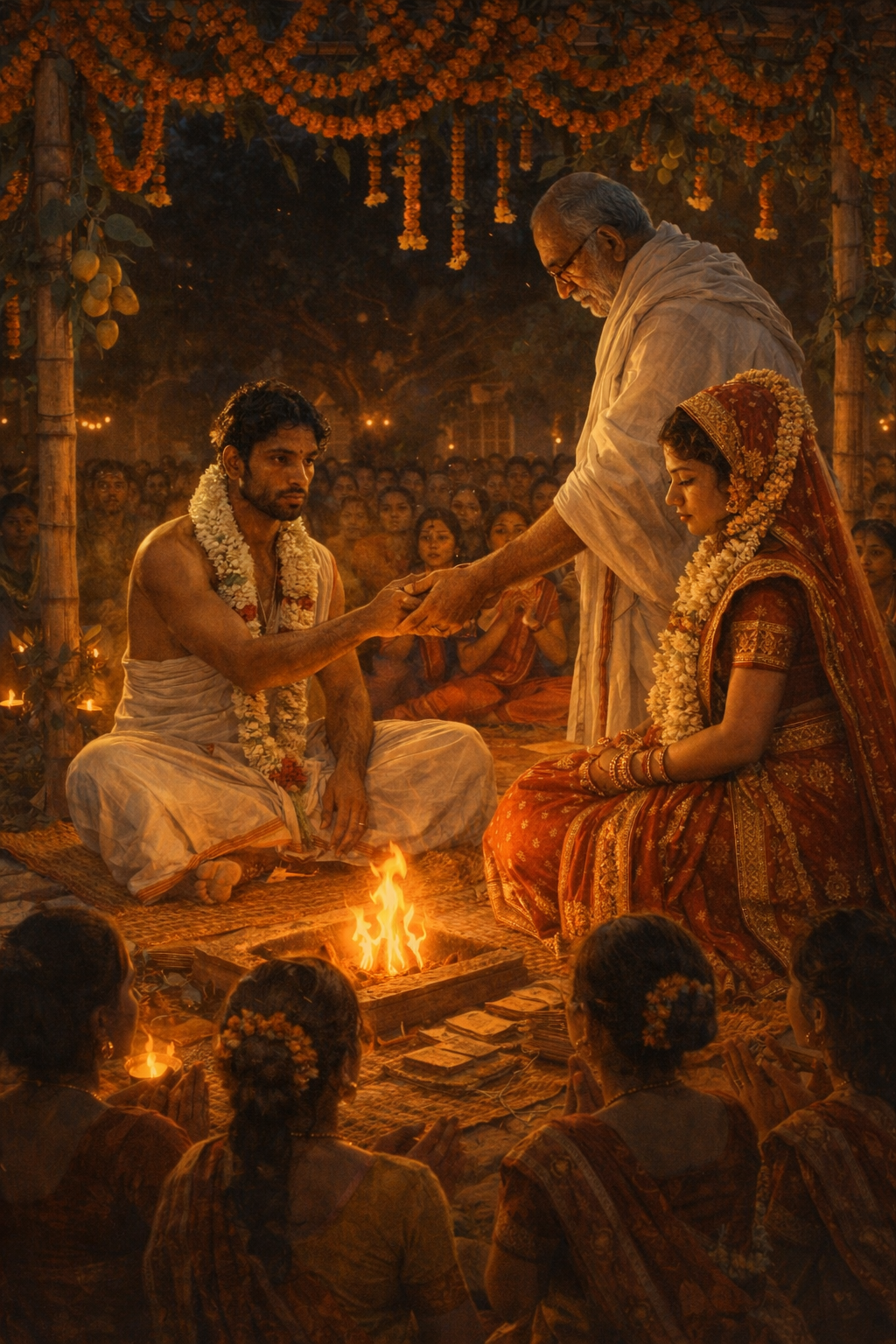 The fifth day of Kartik — Kalinganagar remembered this evening for years
When they brought UshaRani out, he forgot entirely about the pothi.
She was short — the top of her head barely reached his shoulder — and the wedding silk and gold ornaments seemed designed for someone of larger consequence. But she moved through it all with an ease that suggested she had no interest in consequence. Her face composed, her eyes finding her father’s face once, smiling at him quickly, then returning to the ground before her. Her lips were the shape the old poets had spent centuries trying to describe. And above the left corner of that mouth, slightly higher, was a small dark teel — a mole that caught the firelight and held it.
Bishu looked at it. Something settled in him the way a calculation settles when the numbers finally resolve — certain, clean, impossible to undo.
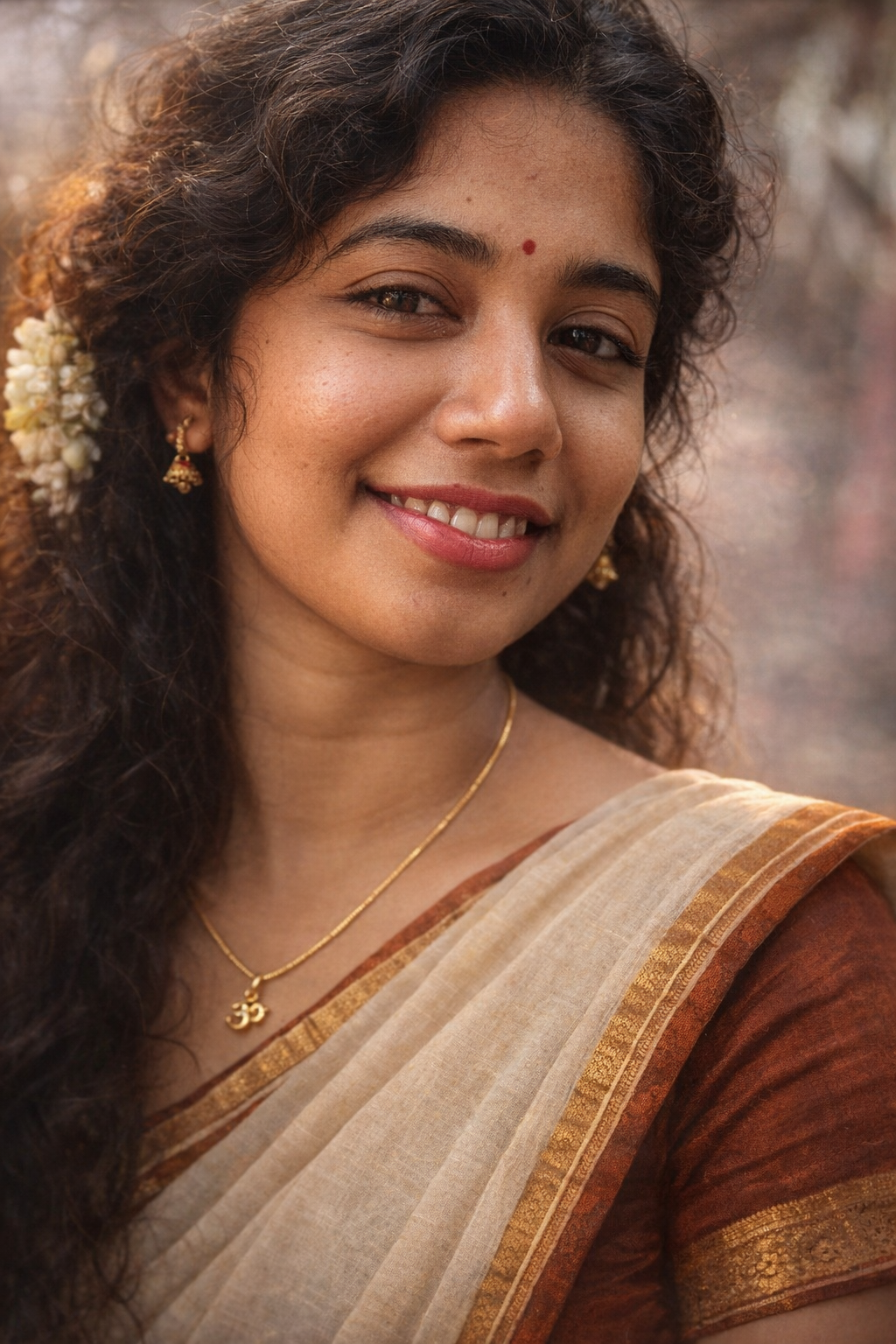 UshaRani — the whole architecture of his life
The priest chanted. The fire received its offerings. Pradhan Judhistir, eyes not entirely dry, placed his daughter’s hand in the Sthapati’s.
The girls in the corner began a new song. The courtyard smelled of marigold and smoke and the sea.
One year, and Bishu had not grown accustomed to the fact of UshaRani in the house.
He was aware of her the way you are aware of a lamp after a long time in the dark — not always looking at it, but always knowing exactly where it was.
She cooked, cleaned, managed the household, negotiated with the vegetable vendor with a firmness that surprised people who had underestimated her the first time, scolded the neighbour’s goat when it strayed into the courtyard, and maintained a running commentary on the world that Bishu found inexhaustibly entertaining. She did not understand the pothis. He had tried once to explain the mathematics of a Rekha Deula — the base, the wall elevation, the precise inward curve of the shikhara, the Amalaka at the crown. She listened with complete attention and said: “So it is like measuring a pot. Just bigger.”
He thought about this for three days. He was not certain she was wrong.
What she did not tolerate was that he was always underfoot.
“Bishu.”
“Hmm.”
“You are standing on my shadow again.”
“I am thinking.”
“Think somewhere else. I need the water pot.”
He moved. Six inches. She looked at him the way she looked at the neighbour’s goat.
The bara koli was in fruit.
When this happened, the house at the end of the northern lane entered a happiness with no other name. UshaRani had claimed the tree as the third member of the family from the week she arrived — she had walked around it slowly the morning after her wedding, touched the bark, tasted a fallen fruit, and announced: “This one stays.” As if there had been any question.
This particular afternoon she was cooking outside by the firewood stove near the base of the tree, where the shade was best. A clay pot sat on the stones. The smell of mustard oil heating, then turmeric, then the split onion dropped in — these moved through the courtyard and through the lower branches of the bara koli, mixing with the faint green sweetness of the hanging fruit.
Bishu had been watching her from the doorway for some time.
He crossed the courtyard and came and stood behind her. The fire was low. She was bent slightly forward, one hand adjusting the flame with a small stick, the other steadying the pot, her hair pulled back and pinned, a few strands loose at the nape of her neck where the afternoon light caught them.
He leaned down slowly and brought his lips to that curve of neck and shoulder.
UshaRani went still.
The ladle stayed in her hand. The fire continued its low crackle. Above them the bara koli shifted in the sea breeze and one ripe fruit detached and fell soft into the grass beside the stove. Her eyes closed — not surprise. The closing of someone receiving something they had been quietly waiting for.
For a moment there was only the fire and the distant water and his breath warm on her skin.
Then he straightened.
She opened her eyes. Adjusted the pot. Stirred the dal without looking at him.
“It will burn,” she said. Entirely steady.
He went back inside. He was still smiling ten minutes later when he had stopped reading and was simply sitting, looking at nothing, thinking about the teel above her lip.
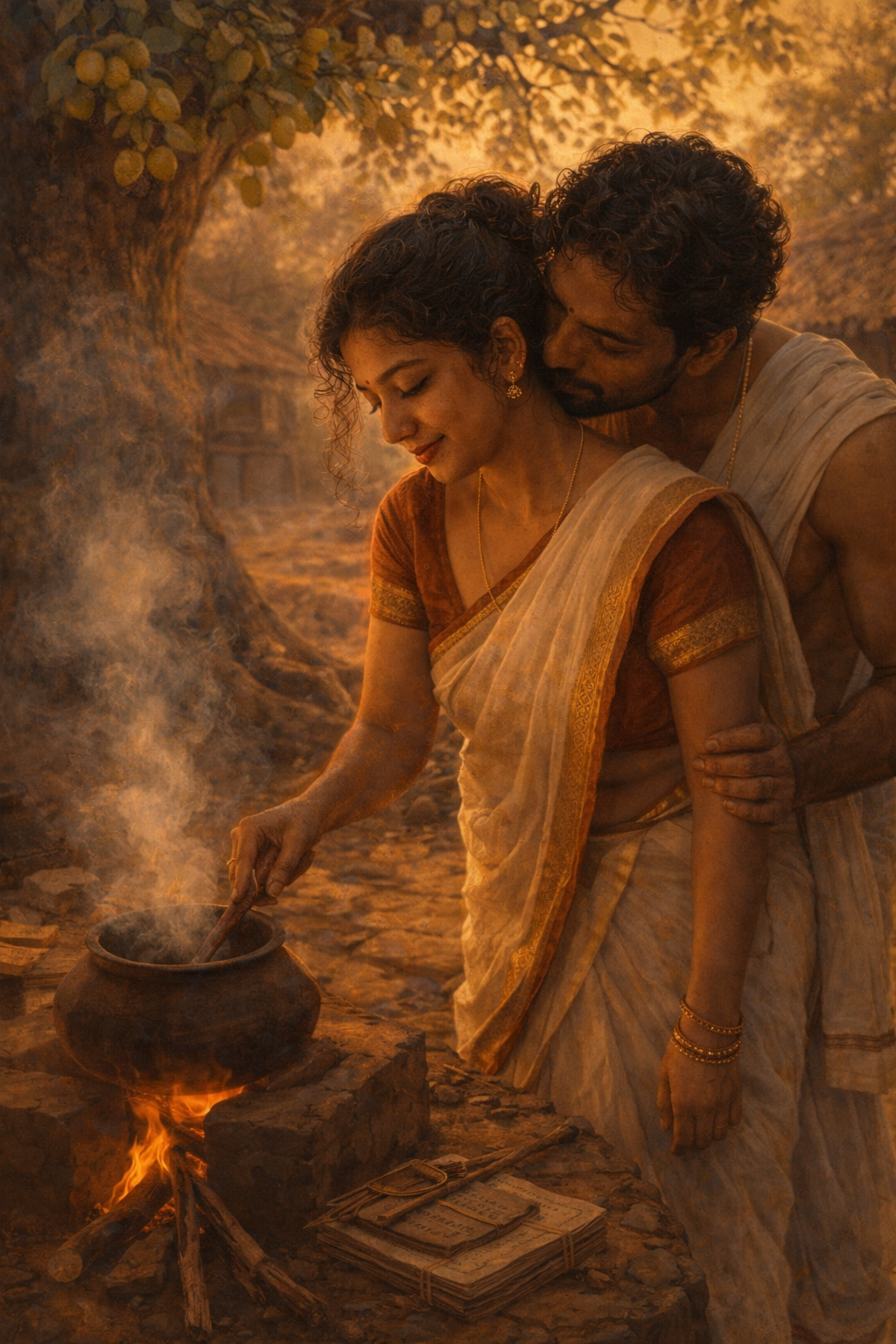 The bara koli, the fire, and the two of them — the whole world, for now
At the Bhakta Ghara, where the men of Kalinganagar gathered most evenings on the wide stone verandah under the neem tree, the subject of Bishu came up the way it always came up. Sideways. As if nobody had intended it.
It was Madhu who started it, splitting a koli with his thumbnail and not looking at anyone.
“I heard from the rice merchant at Puri,” he said, “that the soldiers of Kalinga have been asking questions. About who built the new Jagannath shrine at Sakshigopal.”
“And?” said old Hara, already tilted against the pillar with his eyes mostly shut.
“Someone told them it was the work of a Sthapati from Kalinganagar.”
Nobody spoke.
“King Narasimhadeva has visited the Puri temple three times this year,” said Gopala, the younger one, pulling his dhoti against the evening wind. “They say the king wants to build something — something that has not existed before. A temple so grand that the gods themselves would pause to look at it.”
Madhu was quiet. He looked down the northern lane toward the thatched roof at the far end, the dark shape of the bara koli rising behind it against the evening sky. The look of a man whose closest friend is the most gifted person he knows — proud, and slightly worried.
“If the king of Kalinga truly hears the name Sthapati Bishu Maharana,” he said, “he will not sleep until he has found him.”
“And our Bishu?” said Gopala.
Madhu split another koli.
“Our Bishu will stun the entire kingdom. He will raise something that will make all of Kalinga weep with wonder.”
Old Hara opened one eye. “First someone must untangle him from UshaRani long enough to hold a chisel.”
The verandah filled with laughter — warm, unhurried, the kind that floats through a village evening when no one is in a hurry. It drifted through the lanes. UshaRani, covering the fire for the night, heard it and shook her head, smiling without knowing the joke.
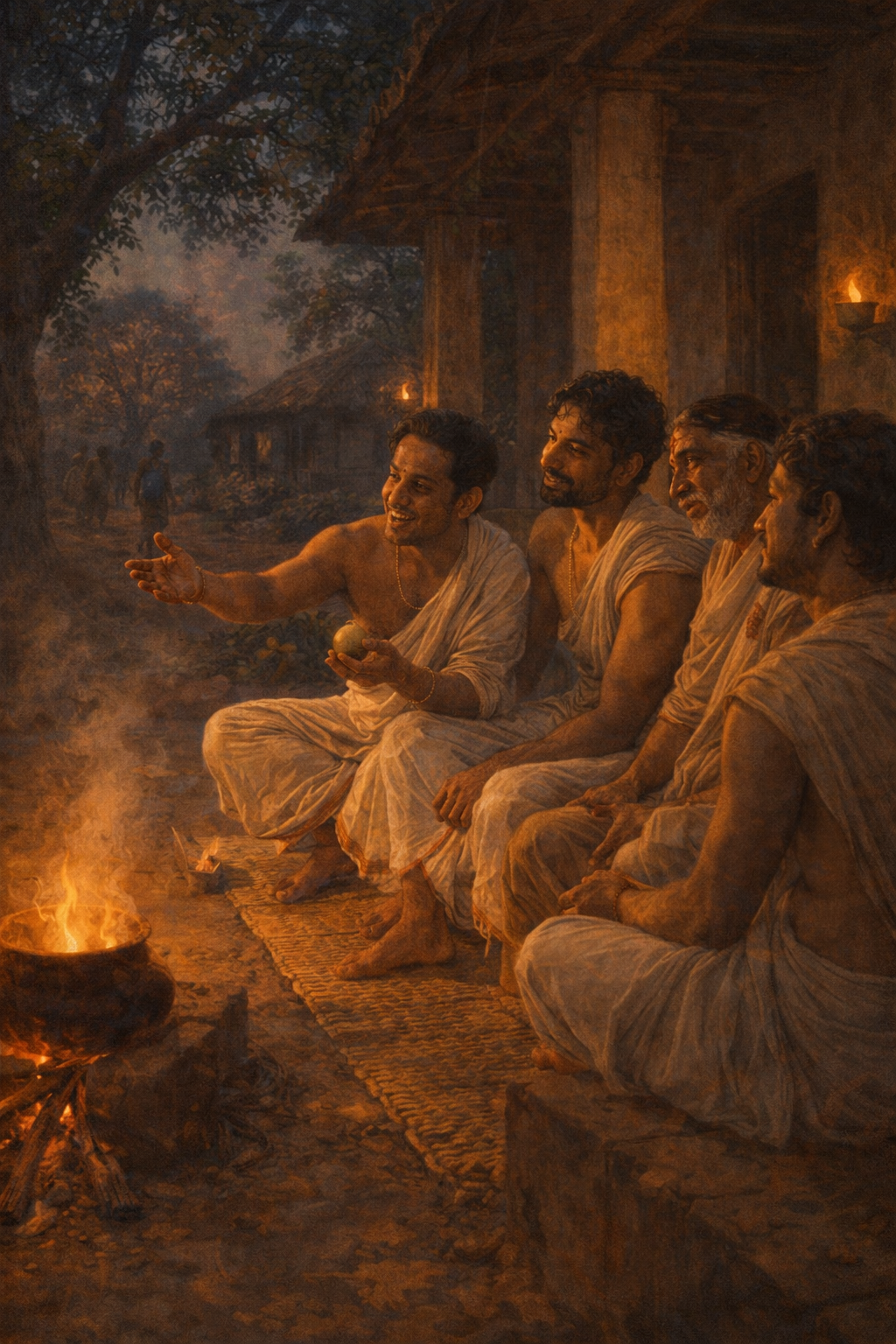 “He will stun the entire kingdom” — Bhakta Ghara, Kalinganagar
That night, Bishu lay on his side and watched her sleep.
The room was dark except for the lamp by the threshold. Through the open window came the sound of the sea and the faint sweetness of the bara koli. Her face in the lamplight was entirely at rest — the bow of her lips slightly parted, the teel above the corner of her mouth catching the small light.
Three things he could not have named living without.
His pothis, in which he had written everything he knew and was still learning. The bara koli, which asked nothing and gave everything in its season. And this. More precisely balanced than anything he had ever drawn on a palm leaf, and not one number in the Silpa Shastra that could account for it.
He closed his eyes.
The knock came at dawn.
Not a neighbour. Not a village boy with a message. Three heavy beats — the knock of men accustomed to doors opening when they knocked — then silence.
Bishu was already awake at his pothis. He looked up.
UshaRani came from the inner room, her hair loose, a shawl around her shoulders, and opened the door.
Four soldiers stood in the lane. Royal insignia of Kalinga. Behind them, a fifth man — older, formally robed, carrying a document sealed in wax. He looked past UshaRani to where Bishu had risen in the inner doorway.
“Sthapati Bishu Maharana?”
“Yes,” said Bishu.
“By the command of His Majesty Maharaja Narasimhadeva I, sovereign of Kalinga, Protector of Utkala, Devotee of the Sun God — you are summoned to the royal court at Cuttack.”
The morning light fell into the courtyard. The bara koli stood in its corner, heavy with fruit, unmoved by the weight of what had just arrived.
UshaRani’s hand found the edge of the door. She did not look at the soldiers. She looked at Bishu.
“For what purpose?” Bishu asked.
The envoy unrolled the document.
“The king wishes to build a temple,” he said. “Something the world has not seen before.”
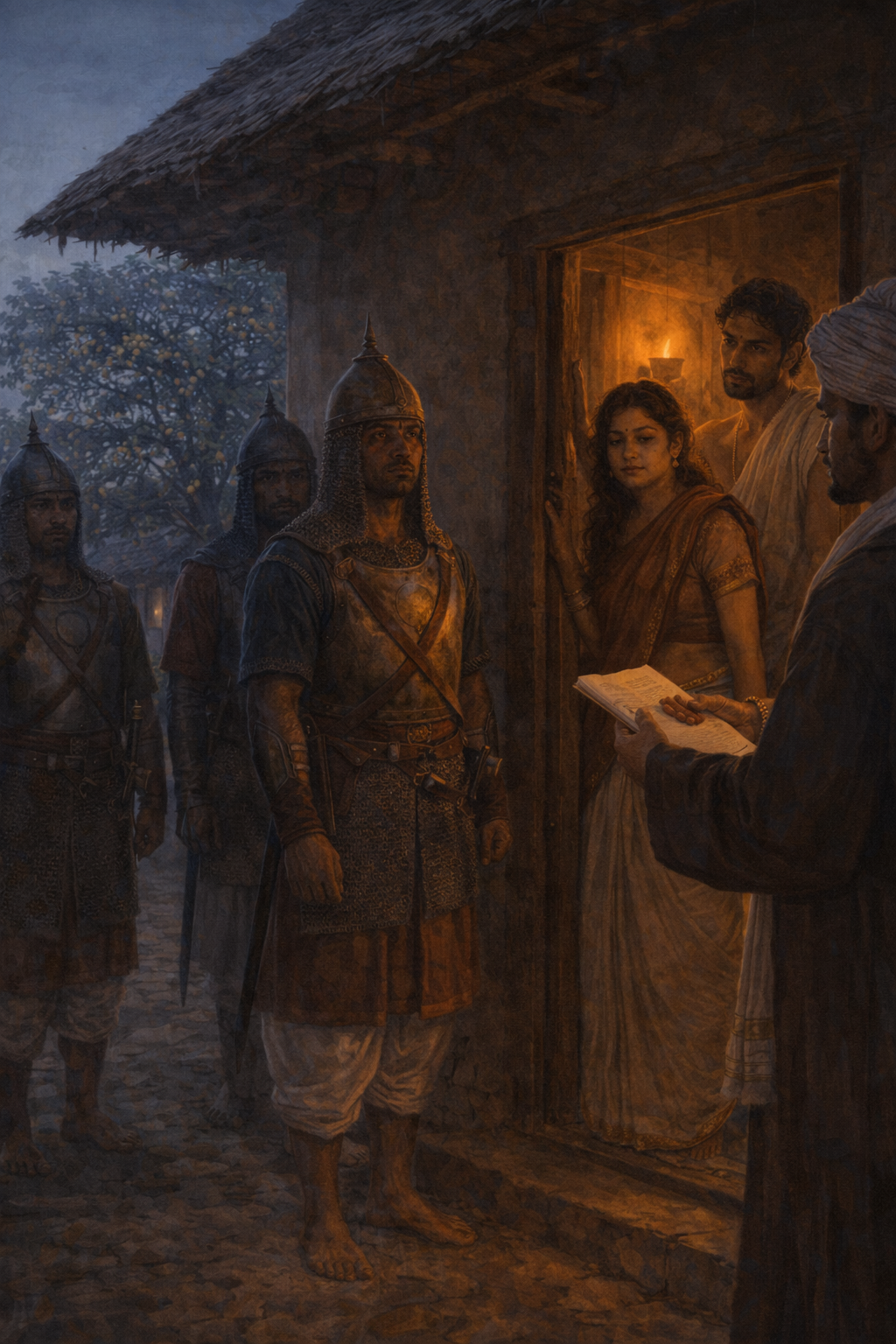 Dawn, Kalinganagar — the morning that changed everything
Part 1 of 3 · Konark’s Dharmapada series · Continue: Part II: The Road to Konark
This is a work of historical fiction. The characters of Bishu Maharana, UshaRani, and Dharmapada are drawn from Odia oral tradition and legend. Dialogue, scenes, and personal details are the author’s invention. Inspired by the legendary accounts surrounding the Konark Sun Temple. Any resemblance to real persons beyond the historical record is unintentional.
Reader Comments
Loading comments…
Leave a Comment